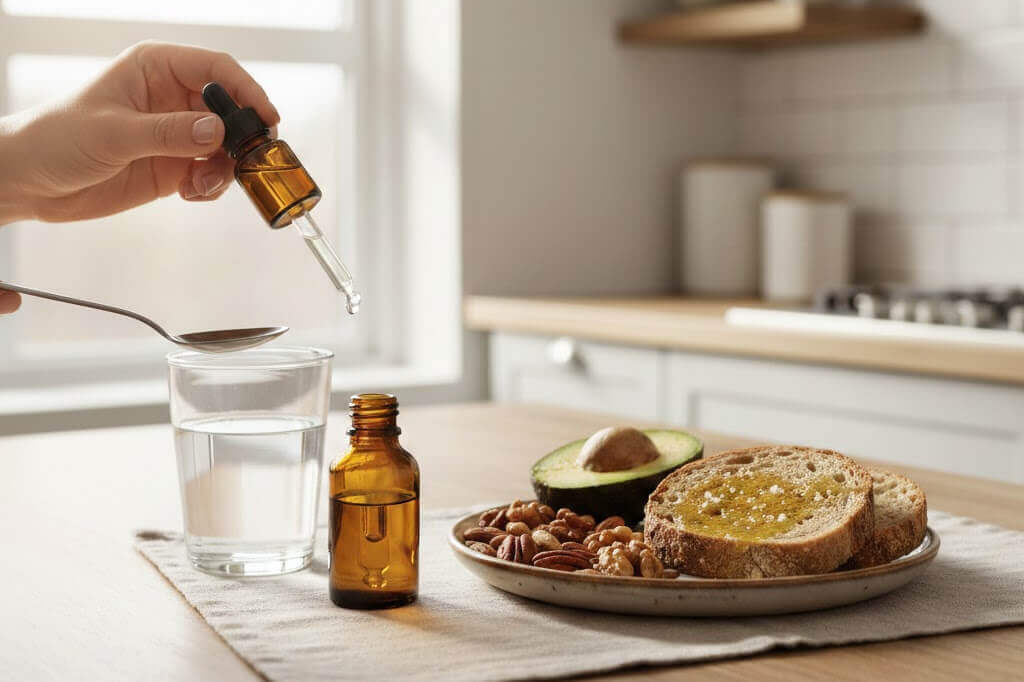
Why two people can take the same CBD dose and feel completely different – and what current research suggests you can do about it.
Why absorption matters
Many people try CBD and walk away thinking, “I don’t feel anything, I guess it doesn’t work for me.” In many cases, the issue is not only how much CBD you take, but how much your body actually absorbs. Scientists call this bioavailability – the percentage of a dose that reaches your bloodstream in an active form. Because CBD has naturally low and variable bioavailability, small changes in how you take it can make a meaningful difference in what you feel.
What is CBD Bioavailability?
Bioavailability is a pharmacology term for “how much of this substance actually gets into circulation and can be used by the body.” For CBD, researchers consistently find that:
- When CBD is swallowed (capsules, gummies, standard oils), much of it is lost in the digestive tract and liver before it reaches the bloodstream.
- This low oral bioavailability is one of the main challenges scientists are trying to solve when they design new CBD formulations.
A recent review of CBD delivery systems noted that incomplete absorption in the gut and extensive “first-pass” metabolism in the liver are key reasons for CBD’s poor oral bioavailability. This helps explain why people can respond so differently to the same labeled dose.
How different CBD formats compare
Human and preclinical research suggest that different routes of administration lead to very different bioavailability ranges.
- Oral CBD (capsules, gummies, standard oils swallowed)
- Typical oral bioavailability is low, often estimated in the range of about 6–20%.
- CBD must pass through the stomach and intestines and then the liver, where a significant portion is metabolized before entering circulation.
- Onset is slower (often 1–2 hours), but effects can last longer compared to inhalation.
- Sublingual CBD (drops held under the tongue)
- Placing CBD oil under the tongue allows some absorption through the thin membrane directly into the bloodstream, partially bypassing the digestive system.
- Estimates for sublingual bioavailability are higher than oral ingestion, often cited in the approximate range of 13–35%, although exact numbers vary between studies and products.
- Holding the drops under the tongue for about one minute appears to improve absorption compared with swallowing immediately.
- Inhaled CBD (vaping or smoking CBD-rich products)
- Inhalation delivers CBD through the lungs into the bloodstream very quickly, with onset in minutes.
- Studies suggest inhaled CBD can reach substantially higher bioavailability than oral forms, with ranges reported around roughly 31–56% for inhaled cannabinoids.
- This route may not be appropriate for everyone, especially people with lung or heart conditions, and long-term safety of vaping remains an active area of research.
- Topical CBD (creams, balms, lotions)
- Topicals are typically designed for local action on the skin, muscles, and joints rather than systemic absorption.
- Most standard topicals result in negligible CBD levels in the bloodstream; instead, they interact with receptors in the skin itself.
- Intranasal CBD (sprays, less common consumer products)
- Intranasal administration has shown relatively high bioavailability in preclinical models – often around the mid‑30% to mid‑40% range – by delivering CBD through the nasal mucosa directly into circulation.
- This route is still more common in experimental and medical contexts than in everyday consumer products.
Because these ranges are broad, two CBD products with the same milligrams on the label can behave very differently depending on how they are taken and how they are formulated.
How food – especially fat – changes CBD absorption
One of the most practical findings from recent human research is the impact of dietary fat on CBD absorption. In a randomized crossover study, healthy adults took a CBD-rich extract either while fasting or after a standardized high‑fat meal. When CBD was taken with a high‑fat meal:
- Peak blood concentration (Cmax) increased by about 17-fold compared with fasting.
- Overall exposure to CBD over time (AUC) increased by roughly 9–10 times.
The authors concluded that taking CBD with a meal – especially one that includes fat – can substantially increase bioavailability and that standardizing CBD intake in relation to meals is important for consistent effects. Since CBD is lipophilic (fat‑loving), co‑ingestion with dietary fats likely promotes absorption through the gut and into the lymphatic system, reducing the amount lost to first‑pass metabolism – in the liver.
Formulation strategies and enhancers
Researchers are also exploring ways to design CBD products that the body can absorb more efficiently.
- Lipid-based formulations
- Modern reviews identify lipid-based systems (such as certain self‑emulsifying or nanoemulsion formulations) as one of the most promising ways to improve oral CBD bioavailability.
- These formulations aim to keep CBD dissolved in tiny droplets that are more easily absorbed in the gut and may enhance transport through lymphatic pathways.
- Piperine (black pepper extract)
- Piperine, an alkaloid from black pepper, is known to inhibit some enzymes involved in first‑pass metabolism.
- In a preclinical rat study, adding piperine to an oral CBD formulation increased CBD bioavailability by about 2.5‑fold compared to CBD alone.
- These results are early and in animals, so they cannot be assumed to translate directly to humans, but they illustrate how formulation choices can substantially change exposure.
- Other advanced systems
- A 2024 review of strategies to improve CBD bioavailability highlights various technologies – solid dispersions, nanoemulsions, intranasal sprays, and alternative carriers – aimed at overcoming CBD’s poor water solubility and extensive metabolism.
- Many of these approaches are still being optimized, and not all consumer products clearly disclose whether such technologies are used or validated in clinical studies.
Practical, research-informed tips for everyday CBD use
Without making any health claims or promising specific outcomes, current evidence supports a few practical steps that may help you make more informed choices:
- Be intentional about your route of administration
- If you prioritize convenience and longer duration, oral products like capsules or gummies can still be a good fit – just remember their bioavailability is relatively low.
- If you want a faster onset or potentially higher systemic exposure, inhaled or sublingual formats may offer advantages, though each comes with its own safety and comfort considerations.
- Align CBD with meals – especially if you swallow it
- If you use swallowed CBD, taking it consistently with a meal that contains some healthy fat (for example, avocado, nuts, seeds, olive oil, or full‑fat yogurt) may substantially increase absorption compared with taking it when fasting.
- Try to be consistent – either always with a similar type of meal or always without – so your experience is more predictable.
- Use a thoughtful technique with sublingual products
- For sublingual drops, placing the oil under the tongue and holding it there for at least one minute before swallowing gives more time for absorption through the sublingual mucosa.
- Avoid washing it down immediately with water or food, which may shift more of the dose toward standard oral digestion.
- Recognize that product design matters
- Formulations that clearly describe using nanoemulsions or other absorption‑enhancing technologies are trying to address CBD’s bioavailability challenge, but quality and evidence can vary widely.
- Because regulation of non‑prescription CBD products is limited, it is wise to look for third‑party testing, clear labeling, and, when possible, products that are transparent about any clinical or pharmacokinetic data they have.
- Go slowly and involve your healthcare provider
- Even with better absorption, CBD can interact with certain medications, especially those that are processed by the same liver enzymes.
- Start with the serving size on the label, increase gradually if needed, and check in with your healthcare provider about timing, dose, and any other medications or supplements you use.

Contributing Expert
Alan first discovered CBD while recovering from a sports injury — and he’s been an advocate ever since. Over the years, he’s used CBD for sleep, skincare, easing anxiety, and even helping his family pet stay calm. With more than 20 years of experience running a marketing business, Alan now enjoys sharing scientific studies and personal experience with customers at Flourish + Live Well.