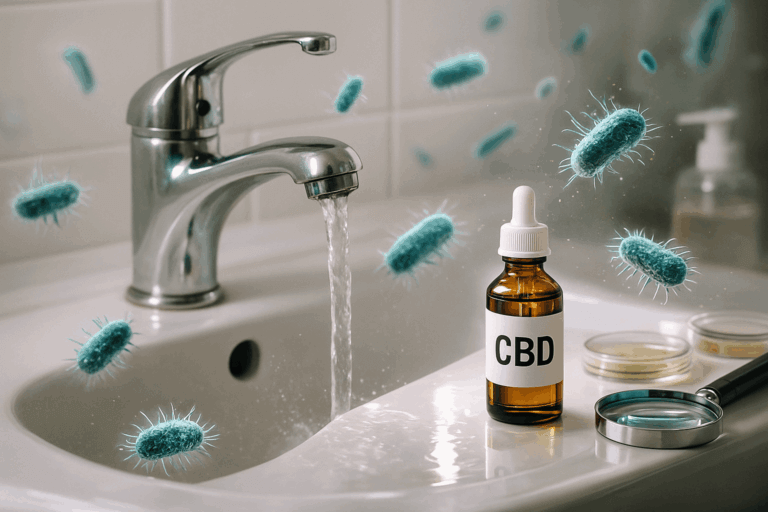
Superbugs are rising, but scientists have discovered something surprising: CBD may help challenge tough bacteria.
Imagine a world where a simple cut becomes dangerous. Where common infections no longer respond to treatment. Where antibiotics, the drugs that saved millions of lives, stop working.
That world isn’t science fiction. It’s happening now.
Antibiotic resistance is rising faster than new medications are being developed, and the medical world is sounding the alarm. Doctors are running out of options. Patients are running out of time. And researchers are racing to find something, anything that can help.
That’s why this new scientific discovery feels almost unbelievable:
CBD, the calm-supporting, non-intoxicating compound people use every day, might have surprising antibacterial powers.
Not hype. Not a rumor. But real, lab-tested, scientifically evaluated potential.
And for the first time, researchers have shown CBD can kill some of the most dangerous bacteria on the planet.
Science Snapshot
What was tested
CBD’s ability to kill dangerous bacteria, including resistant strains.
Key findings
• Strong activity against Gram-positive pathogens
• CBD can kill a subset of Gram-negative bacteria — a first
• Effective against biofilms
• Low tendency to create resistance
• Topical in vivo antibacterial effects
Why it matters
The world needs new antibiotic tools; CBD might help shape the next generation.
The Discovery No One Saw Coming
Scientists didn’t start this research expecting to find a miracle ingredient. They started because the situation was desperate.
Dangerous bacteria are evolving faster than our antibiotics. Some infections are already resistant to almost everything we have. This isn’t just inconvenient, it’s deadly.
While searching for new options, researchers noticed something unexpected in early lab tests:
CBD kept popping up as a possible antibacterial agent.
So a team of microbiologists, chemists, and infectious disease experts dug deeper and what they found shocked them.
CBD wasn’t just mildly helpful. It was powerful against several dangerous bacteria.
The Bacteria CBD Was Able to Fight, Including One of the World’s Highest-Threat Pathogens
The study tested CBD against a wide range of bacteria, including:
- Highly resistant Staphylococcus aureus
- Streptococcus pneumoniae
- Clostridioides difficile
- Neisseria gonorrhoeae — considered an urgent global threat
And here’s the dramatic part:
CBD showed strong antibacterial activity against all of the Gram-positive bacteria tested.
Even more surprising?
For the first time in scientific history, CBD was shown to kill a subset of Gram-negative bacteria, including Neisseria gonorrhoeae, one of the most difficult-to-treat pathogens on Earth.
This is a massive discovery because Gram-negative bacteria are notoriously hard to kill due to their armored outer membrane.
CBD breaking through that barrier is big news.
Why CBD’s Approach Is Different and Why That Matters
Antibiotics usually work by attacking specific parts of the bacteria. But bacteria fight back — they mutate, change shape, and become resistant.
CBD seems to have a completely different strategy:
It disrupts bacterial membranes.
Think of it like popping the bubble around the bacteria so it can’t survive. And here’s the exciting part for researchers:
Membrane-targeting approaches make it much harder for bacteria to develop resistance.
That means:
- CBD doesn’t just kill bacteria
- It kills them in a way that’s hard for them to fight back against
- It could help prevent future drug-resistant infections
This is exactly the kind of breakthrough scientists have been hoping for.
CBD Also Shows Activity Against Biofilms
Biofilms are sticky bacterial communities that cling to surfaces, medical devices, wounds, tissues, and resist nearly all antibiotics.
They’re responsible for countless chronic infections.
Researchers found that:
CBD had excellent activity against biofilms, breaking down these bacterial fortresses and helping eliminate the bacteria inside.
Most drugs struggle here. CBD didn’t. That’s a very big deal.
What About Real-Life Use? The Study Tested That Too
This wasn’t just a petri dish experiment.
Scientists tested CBD topically in vivo, meaning in a living organism, and saw antibacterial effects.
This doesn’t make CBD an antibiotic yet. But it does mean CBD might have a future as a topical support for bacterial issues, especially resistant ones.
It opens doors that researchers are excited to walk through.
The Promise: CBD Analogues Could Become a New Class of Antibiotics
Based on the results, chemists ran “structure-activity” studies, essentially designing CBD-like molecules to see if they could be even stronger.
The results?
CBD analogues could potentially become a brand-new antibiotic class.
That’s historic. It hasn’t happened in decades.
We’re not there yet, but CBD has given researchers something rare: hope.
What This Could Mean for Your Future Health
The problem this research is trying to solve is urgent and global:
Bacterial infections are becoming harder to treat, and we need new solutions fast.
Here’s what this study means for everyday people:
- CBD is showing antibacterial promise, especially for the toughest bacteria
- Its membrane-targeting action makes resistance harder to develop
- It may support new antibiotic development in the future
- Topical CBD might one day help with skin-related bacterial issues
- This research gives scientists a powerful new direction
- Your everyday CBD product isn’t an antibiotic—but it inspired a breakthrough
This doesn’t mean CBD replaces antibiotics. It doesn’t mean you should use CBD to treat infections. That’s not what the study says.
But it does mean CBD is part of a growing scientific conversation about the future of antimicrobial strategies.
And if CBD can play even a small role in protecting us from resistant bacteria, that’s something worth celebrating.
Original Study Section
Title: The antimicrobial potential of cannabidiol
Date: January 2021
Authors: Mark A. T. Blaskovich, Angela M. Kavanagh, Alysha G. Elliott, Bing Zhang, Soumya Ramu, Maite Amado, Gabrielle J. Lowe, Alexandra O. Hinton, Do Minh Thu Pham, Johannes Zuegg, Neil Beare, Diana Quach, Marc D. Sharp, Joe Pogliano, Ashleigh P. Rogers, Dena Lyras, Lendl Tan, Nicholas P. West, David W. Crawford, Marnie L. Peterson, Matthew Callahan, Michael Thurn
Link to Study: https://pmc.ncbi.nlm.nih.gov/articles/PMC7815910/
Contributing Expert
Alan first discovered CBD while recovering from a sports injury — and he’s been a believer ever since. Over the years, he’s used CBD for sleep, skincare, easing anxiety, and even helping his family pet stay calm. With more than 20 years of experience running a marketing business, Alan now enjoys sharing scientific studies and personal experience with customers at Flourish + Live Well.