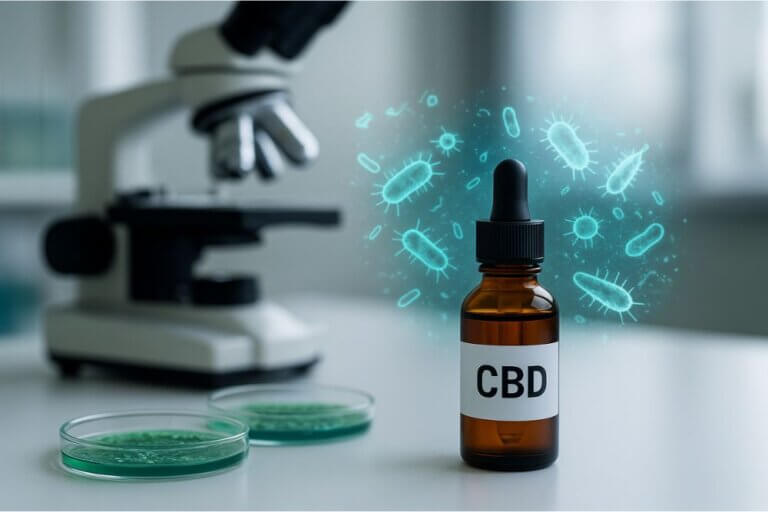
CBD may boost the power of antibiotics against stubborn infections.
You’ve heard the warnings: antibiotics aren’t working like they used to. Once life-saving drugs start to fail against infections that used to be simple to treat. Doctors call these new threats “superbugs”, bacteria that have evolved to survive almost anything we throw at them.
But in a twist that feels straight out of science fiction, scientists are now turning to natural compounds for answers, and one in particular, cannabidiol (CBD), is getting serious attention. You may already know CBD for its calming or skin-soothing effects, but new research suggests it could also have a hidden talent: helping doctors take on bacteria that are nearly impossible to treat.
Science Snapshot
- CBD weakened bacterial membranes and enhanced antibiotic power up to 1,000×.
- Destroyed biofilms, the sticky shields that protect bacteria.
- Worked against 26 strains of drug-resistant Acinetobacter baumannii, one of the world’s toughest hospital pathogens.
When Medicine Meets Its Match
Antibiotics once felt invincible. They wiped out infections that used to be deadly. But decades of overuse, in medicine, farming, and food production, have given bacteria time to evolve.
Now, some have become nearly unstoppable.
Among them is Acinetobacter baumannii, a hospital-acquired menace known for infecting wounds, lungs, and medical devices. It’s notorious in ICUs for resisting even last-resort antibiotics like carbapenems and colistin.
That’s the bacterial monster scientists set out to challenge in a 2025 study published in BMC Complementary Medicine and Therapies.
Their question:
Could CBD, a natural plant compound, make antibiotics powerful again?
How the Study Was Done
Researchers collected 26 strains of extensively drug-resistant (XDR) Acinetobacter baumannii, the kind that keep doctors awake at night.
They exposed the bacteria to CBD alone, to antibiotics alone, and then to CBD combined with antibiotics like gentamicin, meropenem, and colistin.
They ran bacterial growth assays, time-kill tests, and used fluorescent microscopy to see what was happening at the microscopic level.
What They Found Blew Them Away
CBD didn’t just slow the bacteria down. It made antibiotics a thousand times more effective.
When used together, CBD and antibiotics completely stopped bacterial growth and, in some cases, achieved full bacterial clearance within two hours.
The most fascinating part? Under the microscope, the researchers could see CBD damaging the bacterial membranes, creating tiny holes that caused the cells to leak proteins and DNA.
Without their protective walls, the bacteria were left defenseless, and antibiotics could finish them off.
In other words: CBD didn’t replace antibiotics; it supercharged them.
How CBD Weakens the Enemy
Antibiotics usually target specific bacterial processes like protein synthesis or DNA replication. Over time, bacteria learn to adapt, developing enzymes and defenses that block the drug.
CBD seems to work differently.
It disrupts the bacterial membrane itself, the same way a storm breaks apart a ship’s hull. When that barrier collapses, essential materials leak out, and the bacteria die.
That mechanism could be revolutionary because it doesn’t rely on the same pathways that bacteria typically learn to resist.
Even after repeated exposure, the study found no signs of bacteria developing resistance to CBD.
CBD Breaking Down Biofilms — Bacteria’s Hidden Fortress
One of the study’s most important findings was CBD’s ability to disrupt biofilms, sticky layers that bacteria form to protect themselves from antibiotics and cleaning agents.
In hospitals, biofilms are a nightmare. They cling to catheters, ventilators, and wounds, turning a small infection into a life-threatening one.
The CBD-antibiotic combo broke through those biofilms, exposing the bacteria and allowing the drugs to work again.
That’s not just a win in the lab, it’s a glimpse into how future infection treatments could evolve.
Why This Discovery Matters
Drug-resistant infections are one of the most serious health threats of our time. The World Health Organization estimates that antimicrobial resistance could cause 10 million deaths per year by 2050 if new solutions aren’t found.
CBD offers something unique: it’s a natural, plant-derived compound that seems to attack bacteria in a completely different way than traditional drugs. That means there’s less chance of bacteria developing the same resistance patterns.
Even more exciting, CBD could allow doctors to use smaller doses of antibiotics, reducing side effects and slowing down the spread of resistance.
CBD as a Teammate, Not a Replacement
It’s important to note that this study doesn’t suggest CBD will replace antibiotics anytime soon. Instead, scientists see it as a supportive teammate, something that could make existing treatments stronger and safer.
The researchers behind the study also highlighted that CBD’s potential goes beyond killing bacteria. It may also disrupt biofilms, prevent bacteria from sticking to medical devices, and even reduce inflammation caused by infections.
If future studies confirm these effects in humans, CBD might one day become part of combination therapies in hospitals, helping prevent infections from spreading in vulnerable patients.
From the Lab to the Real World
Of course, there’s still a lot we don’t know. These findings come from laboratory studies, which are an early step. Before CBD can be used in medical settings, researchers need to test it in animals and clinical trials to confirm safety, dosing, and real-world effectiveness.
There are also practical challenges. CBD’s stability and solubility can vary depending on how it’s formulated. Scientists are already experimenting with new delivery systems like nano-emulsions and liposomal carriers to make CBD more potent and easier for the body to absorb.
Still, the early data are encouraging. If CBD continues to show promise in future studies, it could pave the way for a new generation of antimicrobial treatments that combine nature and science in powerful ways.
What This Means for You
If you follow CBD research, this study is a reminder that the story is still unfolding and it’s getting more exciting.
It’s not about replacing the medicine cabinet; it’s about expanding it.
Science is showing that CBD may be capable of helping where modern antibiotics are struggling, giving doctors a new tool in one of the most important battles of our time.
For now, the research remains in the lab, but the hope it represents is very real.
Because if nature can help us outsmart the toughest bacteria on Earth, the future of medicine just got a little brighter.
Original Study Section
Title: Potential of Cannabidiol (CBD) to overcome extensively drug-resistant Acinetobacter baumannii
Date: August 2025
Authors: Atchariya Yosboonruang,Anong Kiddee,Achiraya Siriphap, Grissana Pook-In,Chittakun Suwancharoen,Acharaporn Duangjai,Ratsada Praphasawat,Nanthawan Reuk-ngam,Siriwan Nawong,Anchalee Rawangkan
Link to Study:BMC Complementary Medicine and Therapies

Contributing Expert
Alan first discovered CBD while recovering from a sports injury — and he’s been a believer ever since. Over the years, he’s used CBD for sleep, skincare, easing anxiety, and even helping his family pet stay calm. With more than 20 years of experience running a marketing business, Alan now enjoys sharing scientific studies and personal experience with customers at Flourish + Live Well.