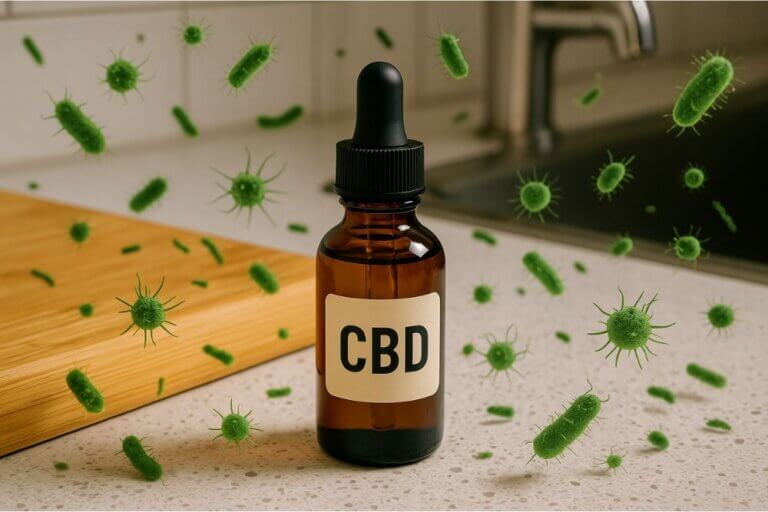
From kitchen counters to cutting boards, bacteria are everywhere, and CBD might help keep them under control.
You wash your hands, wipe down the counters, and trust your cleaning spray to do its job, yet bacteria always seem to find a way back. From the surfaces you touch daily to the food you prepare, harmful bacteria like Salmonella can still sneak into your home.
They hide in nooks, cling to surfaces, and multiply where you least expect them. Here’s where science is starting to look at something unexpected: cannabidiol, or CBD. Yes, the same natural compound loved for its calming properties might also help fight bacteria. And researchers are beginning to understand how.
Science Snapshot
- CBD disrupted Salmonella growth and survival in lab tests.
- Performed similarly to ampicillin, a common antibiotic.
- Reduced biofilm formation, making bacteria easier to eliminate.
CBD’s Hidden Potential Beyond Calm and Comfort
Most people know CBD for its soothing benefits or its use in skincare, but researchers are discovering it may have another powerful trait: antibacterial action. In a world where antibiotic resistance is growing, the idea that CBD could help defend against bacteria feels exciting and hopeful.
Unlike traditional antibiotics, CBD doesn’t target bacteria the same way. It interacts with bacterial membranes and disrupts certain processes that harmful microbes rely on to grow and multiply. This study focused on one particularly nasty group of Salmonella, which often causes foodborne illness and digestive distress.
What the Researchers Wanted to Know
The team behind this study asked a simple but important question: Can CBD protect against bacteria that make people sick, and could it do so as effectively as common antibiotics?
To find out, they compared CBD’s effects on two strains of Salmonella, S. typhimurium and S. newington, with a known antibiotic called ampicillin. These bacteria are common culprits in foodborne infections and are known for their ability to adapt quickly to medication.
The researchers used biological assays, bacterial growth tests, and fluorescent microscopy to track how the bacteria responded to CBD.
The Results Were Encouraging
CBD didn’t just slow down bacterial growth; it disrupted bacterial structure and reduced survival rates in both S. typhimurium and S. newington. Under the microscope, the researchers could actually see visible changes in the bacterial cells after being exposed to CBD.
What made this especially interesting is that the CBD extract performed comparably to ampicillin, a standard antibiotic. While CBD wasn’t tested as a replacement for antibiotics, its effects showed that it could serve as a potential natural helper in the fight against bacterial infections.
Even more promising: CBD seemed to reduce the formation of bacterial “biofilms”, those sticky layers that bacteria create to protect themselves from cleaning agents or immune responses. Preventing biofilm buildup could mean fewer chronic infections and safer food-handling environments.
Could Bacteria Develop Resistance to CBD?
One of the biggest concerns with any antibacterial compound is resistance. Over time, bacteria evolve ways to survive even the strongest antibiotics.
In this study, researchers tested that possibility too, and their findings were positive. The Salmonella strains didn’t show significant resistance buildup against CBD even after multiple exposures. That suggests CBD’s antibacterial mechanism may work differently from standard antibiotics, potentially slowing down resistance.
Of course, that doesn’t mean bacteria could never adapt, only that CBD may offer a fresh angle for researchers looking for new solutions.
Why It Matters More Than You Think
Food safety is a serious issue worldwide, with millions of people affected by bacterial contamination every year. Traditional antibiotics are becoming less effective due to overuse in both medicine and agriculture.
If CBD can naturally limit bacterial growth without encouraging resistance, it could one day play a role in safer food systems, topical treatments, and wound care. Imagine a CBD-based product that not only soothes skin but also defends against bacteria. Science is slowly moving in that direction.
It’s important to note that this study was conducted in controlled laboratory settings, not on humans. Still, it’s an early sign that CBD’s potential stretches far beyond what we currently know.
What This Means for You
For now, you don’t need to rush out and grab CBD oil for your kitchen counter; this research is still in early stages. But it highlights something bigger: CBD is more than a trend. It’s a compound full of potential, and science is just beginning to unlock what it can do.
If you already use CBD skincare or wellness products, studies like this remind us that quality matters. Choose reputable brands that test for purity and safety. High-quality CBD products are made under strict standards that keep contaminants out, ensuring you’re using something clean, gentle, and beneficial.
More importantly, this study adds one more reason to see CBD in a positive light. It’s not just about relaxation anymore; it’s about balance, protection, and discovery.
Original Study Section
Title: Cannabis sativa CBD Extract Shows Promising Antibacterial Activity against Salmonella typhimurium and S. newington
Date: April 2022
Authors: Logan Gildea, Joseph Atia Ayariga, Olufemi S. Ajayi, Junhuan Xu, Robert Villafane, Michelle Samuel-Foo
Link to Study: Read on MDPI – Molecules

Contributing Expert
Alan first discovered CBD while recovering from a sports injury — and he’s been a believer ever since. Over the years, he’s used CBD for sleep, skincare, easing anxiety, and even helping his family pet stay calm. With more than 20 years of experience running a marketing business, Alan now enjoys sharing scientific studies and personal experience with customers at Flourish + Live Well.