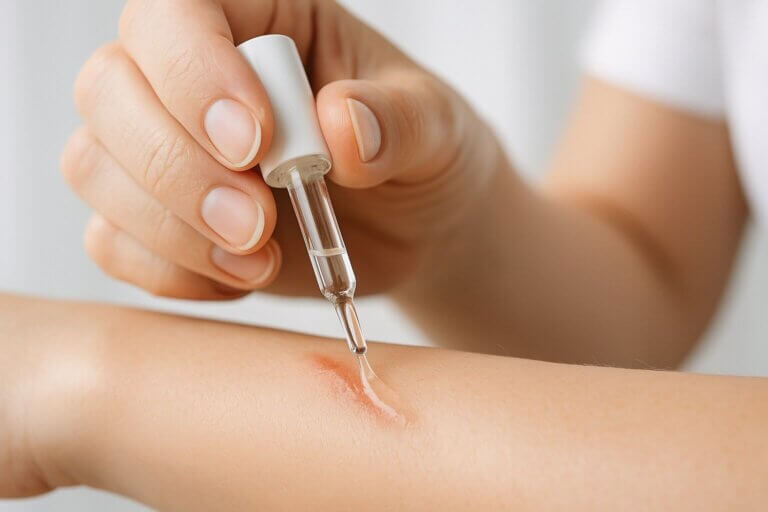
Scientists combine chitosan and CBD to create a new kind of antimicrobial skin film.
If you’ve ever tried to keep a bandage on your skin for more than a day, you know the struggle—peeling edges, sticky residue, or worse, a damp patch that makes your skin itch. Now imagine a treatment that forms a thin, invisible film on your skin, slowly releases medicine, and fights bacteria and fungi all at once.
That’s the promise of a new study from researchers in the Czech Republic, who’ve developed a chitosan-based film-forming system infused with cannabidiol (CBD). It sounds futuristic, but it’s actually built from two natural materials: chitosan, derived from crustacean shells, and CBD, the non-psychoactive compound found in cannabis. Together, they could form the basis for a new kind of topical antimicrobial therapy—one that sticks, breathes, and heals.
The Study in Plain Language
The research, published in the International Journal of Pharmaceutics in 2025, is titled “Chitosan-based film-forming systems with cannabidiol: a novel topical strategy for antimicrobial therapy.”
The team—Andrea Veris, Jan Loskot, Rudolf Andrys, Klara Konecna, Ondrej Jandourek, and Eva Snejdrova—set out to solve a simple but stubborn problem: how to deliver CBD effectively to the skin while keeping it stable, active, and long-lasting.
Why Chitosan and CBD?
Chitosan is a biopolymer made from chitin, the same material that gives shrimp shells their structure. It’s biodegradable, biocompatible, and naturally antimicrobial, which means it can help stop bacterial growth. It’s also great at forming thin, flexible films that adhere gently to skin.
CBD, on the other hand, has drawn attention for its anti-inflammatory, antioxidant, and antibacterial properties. It’s already used in some skin creams and medical trials, but it’s notoriously difficult to dissolve and deliver effectively because it’s oily and doesn’t mix well with water.
The researchers wondered: what if they combined the two? Could a chitosan-based film act as both a protective layer and a steady-release system for CBD, enhancing its antimicrobial power?
How They Did It
The scientists first had to solve a chemistry puzzle. Chitosan doesn’t dissolve easily in most solvents, and CBD doesn’t like water. So, they played with different ethanol-to-water ratios until they found a mix that could dissolve chitosan without breaking down its structure.
They also replaced the commonly used acetic acid (which can irritate skin) with lactic acid, a gentler alternative that’s already found in many skincare products. This not only helped dissolve chitosan but also made the resulting film more flexible and skin-friendly.
To keep CBD evenly distributed, the team used dual-purpose excipients—ingredients that acted both as CBD solubilizers and as plasticizers to make the film more elastic.
Once the films were made, they put them through a battery of tests:
- Differential Scanning Calorimetry (DSC) to study thermal stability.
- Rheological analysis to check flow and texture.
- Raman spectroscopy, optical microscopy, and scanning electron microscopy (SEM) to see how the CBD was distributed within the film.
Finally, they tested how the films performed in lab conditions—how well they released CBD over time, how strong and flexible they were, and how effectively they fought bacteria and fungi.
What They Found
The results were promising:
- Sustained CBD release: The films release CBD slowly and steadily over time, which could lead to longer-lasting effects when applied to the skin.
- Good mechanical properties: The films were strong yet flexible, adhering well to skin-like surfaces without cracking or peeling.
- Broad antimicrobial activity: The combination of chitosan and CBD showed significant antimicrobial effects against both Gram-positive and Gram-negative bacteria, as well as fungi—a rare feat for a natural formulation.
In other words, the researchers created a “smart” topical film that could stick to the skin, release medicine gradually, and fight a wide range of microbes—all without the need for traditional antibiotics.
Science Snapshot
- Material: Chitosan (from crustacean shells) + Cannabidiol (from cannabis).
- Form: A film-forming solution that dries into a thin, invisible layer on the skin.
- Key findings:
- Sustained CBD release over time.
- Strong antimicrobial activity against bacteria and fungi.
- Flexible, skin-friendly, and biocompatible.
- Potential use: Treating bacterial and fungal skin infections without antibiotics.
Why It Matters
Antibiotic resistance is one of the biggest challenges in modern medicine. Each year, tens of thousands of people in Europe alone die from infections that no longer respond to standard antibiotics. Meanwhile, overuse of antibiotic creams and pills continues to fuel the problem.
That’s why alternative antimicrobials—like chitosan and CBD—are so exciting. They work differently from antibiotics, attacking microbes through physical and chemical mechanisms that bacteria can’t easily evolve resistance to.
The film-forming system also solves a practical issue: compliance. Most people don’t like reapplying ointments or creams multiple times a day. A film that dries quickly, stays put, and keeps releasing medicine for hours—or even days—could make treatment easier and more effective.
What This Means for You
The problem this research tackles is clear: how to treat skin infections effectively without relying solely on antibiotics.
Here’s what this could mean in the future:
- Fewer antibiotic creams. If natural polymers and cannabinoids can do the job, they could reduce antibiotic overuse.
- Better comfort and convenience. A transparent, breathable film that doesn’t rub off or stain clothing could replace messy creams and bandages.
- Dual protection. Combining two antimicrobial agents—chitosan and CBD—could help prevent infections and soothe inflammation simultaneously.
- Not ready for home use (yet). This study was done in the lab, not on people. Clinical trials are needed to confirm safety, effectiveness, and real-world performance.
In short: this isn’t a product you’ll find at your local pharmacy tomorrow—but it’s a glimpse of where topical medicine is headed.
The Bigger Picture
This study sits at the intersection of biotechnology, materials science, and natural medicine. It’s part of a growing movement in pharmaceutical research that looks to nature-inspired materials—like chitosan, silk proteins, and plant-derived compounds—to create smarter, safer drug delivery systems.
It also reminds us that innovation often comes from unlikely pairings. Who would have guessed that shrimp shells and cannabis could team up to fight infections?
Original Study Details
- Title: Chitosan-based film-forming systems with cannabidiol: a novel topical strategy for antimicrobial therapy
- Authors: Andrea Veris, Jan Loskot, Rudolf Andrys, Klara Konecna, Ondrej Jandourek, Eva Snejdrova
- Journal: International Journal of Pharmaceutics
- DOI: https://doi.org/10.1016/j.ijpharm.2025.125940
- Date Published: 2025
Contributing Expert
Alan first discovered CBD while recovering from a sports injury — and he’s been a believer ever since. Over the years, he’s used CBD for sleep, skincare, easing anxiety, and even helping his family pet stay calm. With more than 20 years of experience running a marketing business, Alan now enjoys sharing scientific studies and personal experience with customers at Flourish + Live Well.