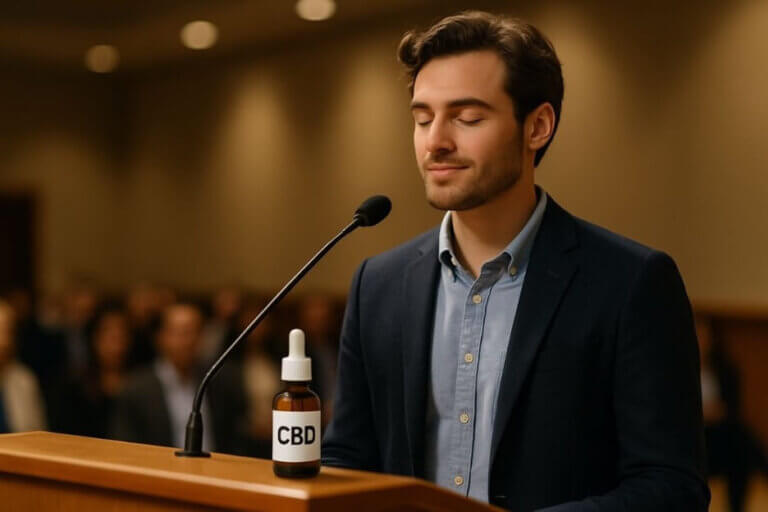
In a public-speaking test designed to make hearts race, scientists discovered that calm isn’t about dosage, it’s about balance.
The lights are bright, the room is silent, and your throat suddenly forgets how to swallow. The microphone glows red. Dozens of eyes watch in silence. Every heartbeat feels like thunder in your chest. For most people, standing at a podium is less “presentation” and more “panic in slow motion.”
That’s exactly why scientists at the University of São Paulo chose public speaking as their ultimate test of human anxiety and of something that might just ease it.
Their question was simple: Could CBD, the non-intoxicating compound, help steady the mind when stress hits its loudest note? The answer turned out to be a story about balance.
Researchers didn’t just confirm that CBD could help; they discovered that calm has a sweet spot. Too little, and nerves still take the wheel. Too much, and focus slips away. But right in the middle? That’s where confidence quietly returns and fear finally loses the mic.
Science Snapshot
- Stress Test Used: Simulated public speaking — one of the most reliable ways to measure real anxiety
- Doses Tested: 150 mg, 300 mg, 600 mg, and placebo
- Best Result: 300 mg led to a measurable drop in anxiety
- Pattern: Inverted U-shaped curve — moderate dose, maximum benefit
The Ultimate Test of Nerves
For years, CBD has been studied for its soothing properties, but mostly in theory or in animal models. This time, the researchers wanted something real, something nerve-shakingly human. So they created one of the most anxiety-inducing experiments in psychology: the Simulated Public Speaking Test (SPST).
Fifty-seven healthy men volunteered to face their fear. Before taking the stage, each participant swallowed a capsule containing either:
- 150 mg of CBD
- 300 mg of CBD
- 600 mg of CBD
- A placebo (nothing active)
Then came the moment of truth. Each person stood before an audience and gave a speech while researchers measured their heart rate, blood pressure, and anxiety levels using a detailed mood scale.
The Calm in the Curve
As the results rolled in, one group stood out. Those who took 300 mg of CBD, not the lowest, not the highest, were visibly calmer. Their heart rates stayed steady, their blood pressure didn’t spike, and their anxiety scores dropped significantly compared to the placebo group.
In contrast, both the 150 mg and 600 mg groups showed little to no difference. It wasn’t that CBD stopped working; it was that balance mattered more than volume. The researchers described it as an inverted U-shaped curve: at moderate levels, the benefits peak, but too little or too much flattens the effect.
The Beauty of Finding the “Just Right” Zone
This wasn’t a failure; it was a revelation. The study showed that CBD doesn’t need to overwhelm the brain to bring peace. Instead, it works like a dimmer switch, bright enough to calm anxiety, but gentle enough to let your mind stay sharp and present.
At moderate doses, CBD activates key serotonin receptors that promote relaxation and clarity. When the dose gets too high, it begins interacting with other systems, dulling the effect. The takeaway is beautifully human: your brain prefers balance, not blunt force.
What This Means for You
This study set out to answer one big question: Can CBD really help people stay calm in real-world stress? The answer is yes, and even more importantly, it showed us how.
Here’s what this discovery means for you:
- CBD works best in balance. The “perfect dose” matters more than the amount. Calm happens when your brain finds harmony, not overload.
- 300 mg made a real difference. It helped volunteers face the most stressful scenario imaginable speaking in front of strangers with steady nerves.
- More isn’t always more. Too much CBD can flatten its benefits. The key lies in understanding how your body responds.
- This is science catching up to intuition. For centuries, humans have turned to plant compounds for calm. Now, we’re learning the exact conditions that make them work.
- It’s a win for precision wellness. The more we learn about how CBD interacts with the brain, the closer we get to turning it into a reliable, evidence-backed therapy.
Sometimes, progress isn’t about dramatic change; it’s about finally understanding the why behind what works.
Original Study Details
Study Title: Cannabidiol Presents an Inverted U-Shaped Dose-Response Curve in a Simulated Public Speaking Test
Date Published: Jan–Feb 2019
Authors: Ila M. Linares, Antonio W. Zuardi, Luis C. Pereira, Regina H. Queiroz, Raphael Mechoulam, Francisco S. Guimarães, José A. Crippa
Source: Read on (SciELO)

Contributing Expert
Alan first discovered CBD while recovering from a sports injury — and he’s been a believer ever since. Over the years, he’s used CBD for sleep, skincare, easing anxiety, and even helping his family pet stay calm. With more than 20 years of experience running a marketing business, Alan now enjoys sharing scientific studies and personal experience with customers at Flourish + Live Well.