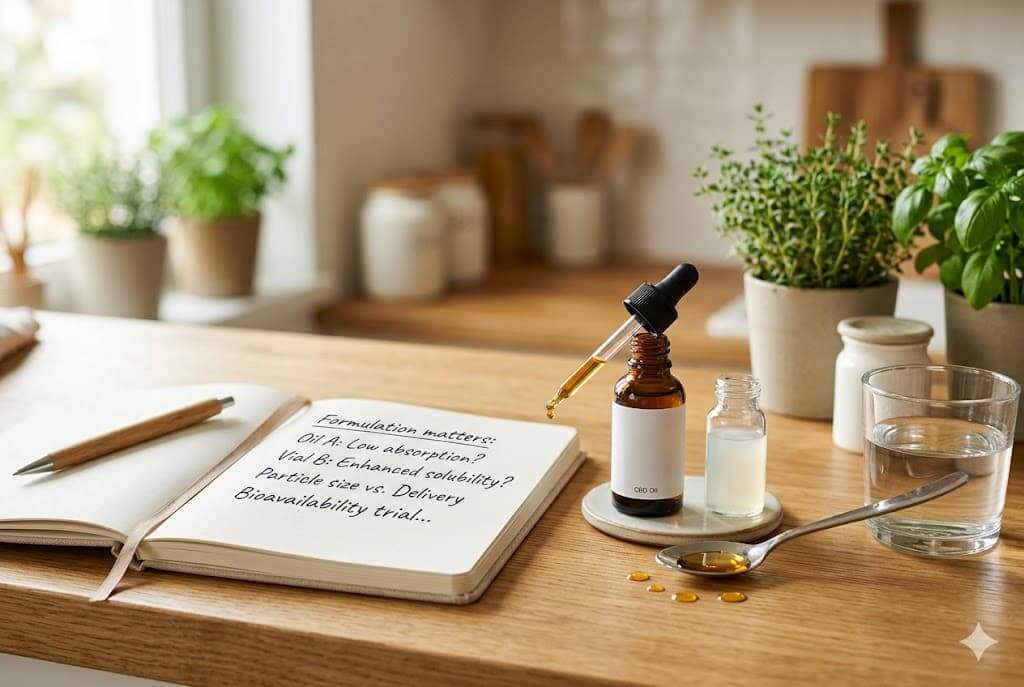
Why Your CBD Format May Matter More Than You Think
The science of CBD delivery is getting clearer, and one new study suggests that how CBD is formulated may shape how much actually gets into the body.
Ever buy a product that sounded promising, try it faithfully, and still wonder whether your body was really getting much of it?
That question is more relevant to CBD than many people realize. CBD gets a lot of attention for wellness support, but one of the biggest issues with oral CBD is not hype or headlines. It is absorption.
A 2025 study published in the Journal of Cannabis Research looked at a simple but important question. Can formulation changes help oral CBD become more bioavailable? In plain English, the researchers wanted to know whether certain delivery formats could help more CBD get absorbed instead of getting lost along the way.
Why this matters
CBD is a lipophilic compound, which means it does not mix well with water. That matters because the digestive system is a water-heavy environment, and oral CBD also goes through significant first-pass metabolism, meaning part of it is broken down before much reaches the bloodstream.
That does not mean oral CBD cannot be useful. It means the format may have a real effect on how efficiently the body handles it. This is exactly why formulation science is becoming one of the most useful CBD 101 topics for everyday readers.
What the study tested
The researchers compared several formulation strategies designed to improve CBD absorption. They looked at oil-based emulsions, oil-free particles, droplet or particle size, oil type, and surfactant concentration.
More specifically, the study evaluated:
- Sunflower-oil emulsions.
- Sesame-oil emulsions.
- Oil-free nanoparticles and microparticles.
- Different surfactant levels, including Tween 20 and lecithin.
This kind of comparison matters because many people assume “more advanced” automatically means “better.” The results were more nuanced than that.
What they found
The big takeaway is that formulation design made a meaningful difference.
Both sunflower-oil and sesame-oil emulsions improved bioavailability compared with a plain oil solution, though sunflower oil performed slightly better overall. The authors also reported that medium-sized emulsions, around 16 micrometers, delivered the most pronounced improvement.
Oil-free nanoparticles and microparticles also improved absorption, likely because of their amorphous character, and particle size had less impact there than some people might expect. That is useful because it suggests there may be more than one path to improving oral CBD delivery.
The study also showed something just as important: more additive is not always better. Higher Tween 20 concentrations sped up absorption but reduced overall exposure, and excess lecithin also lowered bioavailability.
In other words, the best formulation is not necessarily the most complicated one. It may be the most balanced one.
What this means for you
If you use CBD or are thinking about trying it, this study supports a simple idea. The delivery system may matter almost as much as the ingredient list.
That does not mean every emulsion or particle-based product is automatically superior. It means consumers should pay more attention to form, delivery language, and product quality instead of focusing only on the front-label milligram number.
Here are a few practical takeaways:
- A CBD oil is not just a CBD oil. The carrier system can influence how much is absorbed.
- Emulsion-based products may offer an absorption advantage over simpler oil solutions.
- More surfactant is not automatically better. The study found that excessive Tween 20 or lecithin could work against overall exposure.
- Product design matters. Readers should look for brands that explain delivery format clearly instead of relying on vague wellness claims.
A simple example
Think of CBD like a passenger trying to get through a busy airport. If the route is poorly designed, the passenger gets delayed, rerouted, or stopped before reaching the destination. If the route is streamlined, more of that passenger gets through efficiently.
That is essentially what formulation science is trying to solve. Not whether CBD exists, but whether the body can make better use of it.
What this means for you
A lot of people judge CBD by the label strength alone, but this study suggests that is only part of the story.
- Delivery format matters, not just milligrams.
- Balanced formulations may outperform more aggressive formulations.
- If CBD has felt inconsistent, formulation differences may be one reason why.
As CBD products continue to evolve, studies like this help move the conversation away from guesswork and toward smarter product design. That is good news for consumers who want clearer expectations and better education.
About the Original Study
Title: Oil-based and oil-free formulations for enhancing cannabidiol bioavailability.[1]
Date: December 2, 2025.
Authors: P. Jelínek, A. Klouček, A.H. George, H. Housar, P. Kozlík, and colleagues.
Original study link: PubMed record here: https://pubmed.ncbi.nlm.nih.gov/41331788/.

Contributing Expert
Alan first discovered CBD while recovering from a sports injury — and he’s been an advocate ever since. Over the years, he’s used CBD for sleep, skincare, easing anxiety, and even helping his family pet stay calm. With more than 20 years of experience running a marketing business, Alan now enjoys sharing scientific studies and personal experience with customers at Flourish + Live Well.