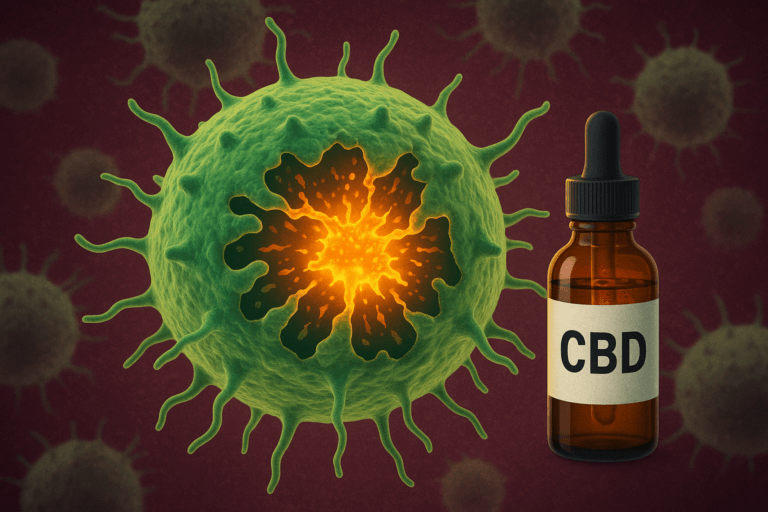
A closer look at how CBD sparks protective signals that push damaged cells to stop surviving.
A cancer diagnosis feels like the ground drops out from under you.
Your priorities shift.
Your emotions swing.
You start searching desperately for anything that might offer comfort, support, or even the smallest sliver of control.
People have turned to CBD for many reasons: for calm, for sleep, for general wellness, and for support during difficult times. But one question quietly lingers for many:
Could CBD do something meaningful at the cellular level?
This new study doesn’t claim CBD cures cancer.
It doesn’t replace treatment.
It doesn’t promise miracles.
But the research does reveal something encouraging:
CBD appears to push aggressive breast cancer cells into self-destruction using multiple biological pathways at once.
For scientists, that’s a big deal.
For people looking for hope, it’s something to take notice of.
Science Snapshot
What researchers studied
How CBD affects aggressive breast cancer cells at the molecular level.
Key findings
- CBD triggered both apoptosis and autophagy
- It activated Beclin1-driven shutdown pathways
- It disrupted AKT/mTOR growth signaling
- It impacted mitochondria
- ROS played a central role
- CBD’s actions were independent of cannabinoid receptors
Why it matters
CBD may influence cellular stress responses, a promising direction for future research.
The Discovery That Turned Heads in the Research Community
This study examined aggressive breast cancer cells, the kind known for resisting treatments and behaving unpredictably.
Researchers wanted to answer one powerful question:
What exactly does CBD do when it interacts with harmful cells?
What they found was something unexpected, complex, and surprisingly coordinated. CBD didn’t act through the usual cannabinoid receptors. It didn’t behave like a typical compound. Instead, it sparked a cascade of events inside the cells, the kind of events that cause those cells to shut themselves down.
And the way it happened was unlike anything researchers expected.
CBD Triggered Not One, But Two Cellular Self-Destruction Pathways
Cells have several built-in safety mechanisms. When something goes wrong, they can choose one of two options:
- Apoptosis: A clean, organized form of programmed cell death
- Autophagy: A recycling mode that breaks down damaged components
But here’s what shocked the scientists:
CBD activated both pathways at the same time.
This dual activation is extremely rare. It means the harmful cells were hit with two internal shutdown signals, not just one.
Under an electron microscope, researchers saw:
- Signs of autophagy — the cells breaking down from the inside
- Signs of apoptosis — the cells are dismantling themselves in an orderly way
This wasn’t chaos. This was coordination.
CBD wasn’t confusing the cells. It was directing them.
The Central Protein CBD Switched On And Why It Matters
To understand why this dual shutdown happened, researchers looked at a protein called Beclin1.
Beclin1 acts like a traffic controller inside cells, deciding whether to repair or remove damaged components.
CBD dramatically changed its behavior:
- Beclin1 partnered more with Vps34 (which promotes autophagy)
- Beclin1 stopped interacting with Bcl-2 (which normally protects cells from dying)
This shift pushed the cells toward self-destruction.
For aggressive cancer cells, which often refuse to die, this is scientifically important. It shows CBD can influence the internal “decision-making” of cells in profound ways.
CBD Also Shut Down the Cell’s Growth System
CBD didn’t stop at the Beclin1 pathway.
It also triggered endoplasmic reticulum stress, which then led to:
- Reduced AKT activity
- Reduced mTOR signaling
- Lower levels of cyclin D1
If these sound complicated, here’s the simple version:
AKT and mTOR are the pathways cancer cells use to grow, multiply, and survive. CBD slowed them down.
That would be like shutting off the fuel lines while the building is already being dismantled from the inside.
Again, this does not mean CBD treats cancer. But it does show scientists why CBD deserves continued study.
CBD Caused Mitochondria to Break Rank
Another fascinating discovery:
CBD affected the mitochondria so significantly that harmful cells lost their internal energy balance.
Researchers observed:
- Reduced mitochondrial membrane potential
- BID moving into the mitochondria
- Cytochrome c escaping into the cytosol
- The intrinsic apoptotic (self-destruct) pathway is switched on
In simpler terms?
The cells received both an internal and external signal to stop surviving.
This is extremely valuable for research into compounds that may support cellular wellness under extreme stress.
Reactive Oxygen Species (ROS): The Spark That Started It All
CBD increased levels of reactive oxygen species (ROS) inside the harmful cells.
But here’s the twist:
When scientists blocked ROS, both apoptosis and autophagy stopped. This means ROS acted like the “on” switch for all the cellular changes CBD caused.
Again, this does not translate to medical claims. But it helps scientists understand how CBD communicates with cells under pressure.
What This Could Mean for Your Wellness Journey
The problem this study explores is one of the most painful and frightening problems people ever face:
What happens when cells grow out of control?
Here’s what this research means for you in a grounded, honest, hopeful way:
- CBD may influence how stressed cells respond internally
- It may help activate natural cleanup systems inside damaged cells
- It may promote pathways that encourage unhealthy cells to shut down
- Scientists now have a clearer idea of CBD’s complex mechanisms
- CBD’s potential role in wellness support is broader than anyone expected
- Research is growing, not slowing
CBD is not a cancer treatment. But what this study reveals is powerful:
CBD communicates with the body at a deeper level than previously understood. And that opens doors for future discoveries that could one day support people facing the hardest moments of their lives.
For now, this research offers something everyone needs in times of uncertainty:
Hope rooted in science, not speculation.
Original Study Section
Title: Cannabidiol induces programmed cell death in breast cancer cells by coordinating the cross-talk between apoptosis and autophagy
Date: July 2011
Authors: Ashutosh Shrivastava, Paula M. Kuzontkoski, Jerome E. Groopman, Anil Prasad
Link to Study: https://pubmed.ncbi.nlm.nih.gov/21566064/
Contributing Expert
Alan first discovered CBD while recovering from a sports injury — and he’s been a believer ever since. Over the years, he’s used CBD for sleep, skincare, easing anxiety, and even helping his family pet stay calm. With more than 20 years of experience running a marketing business, Alan now enjoys sharing scientific studies and personal experience with customers at Flourish + Live Well.