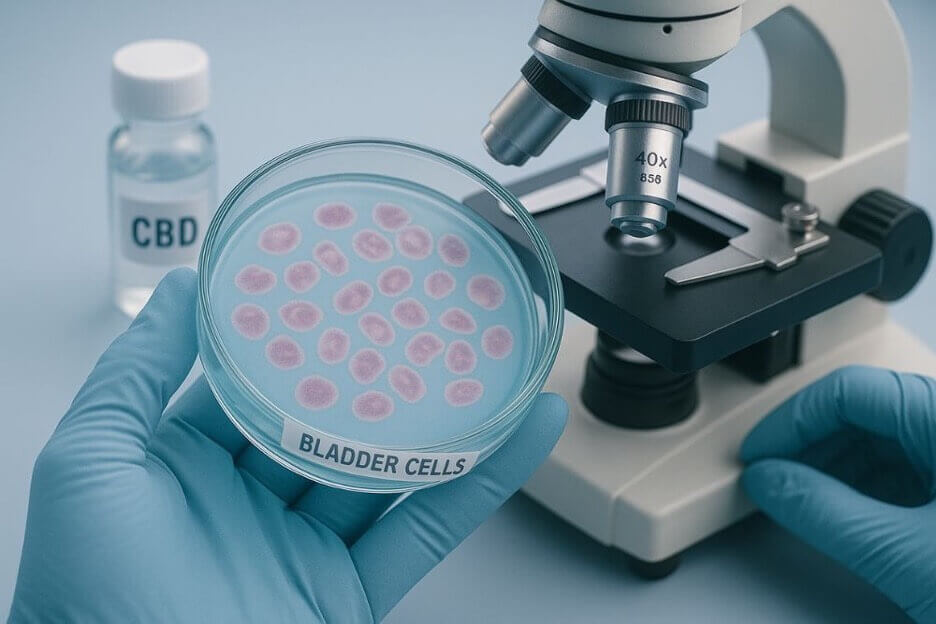
Scientists found that cannabidiol (CBD) can turn bladder cancer cells against themselves and designed a new way to keep the treatment right where it works best.
Most cancer treatments fight like a war; they attack fast, hit hard, and often leave the body struggling to recover. But what if the battle didn’t need to be so brutal? What if cancer cells could be convinced to self-destruct instead?
That’s the quiet power scientists uncovered with cannabidiol (CBD), a natural compound that didn’t just weaken bladder cancer cells but triggered them to shut down from the inside.
And to make sure the treatment could stay long enough to work, researchers engineered a “sticky” delivery system that helps CBD remain in contact with bladder tissue, a small but important detail that could change how cancer drugs are delivered in the future.
Science Snapshot
- Focus: Effects of cannabidiol (CBD) on bladder cancer cell death and delivery improvement
- Key Mechanism: Inactivation of the PI3K/Akt pathway
- Model Used: Human bladder cancer cell lines (T24, 5637, UM-UC-3)
- Main Result: ~50% of cancer cells underwent apoptosis within 48 hours of CBD exposure
- Innovation: Chitosan-coated CBD nanoparticles achieved 97% adhesion to bladder tissue
- Safety: High biocompatibility, strong adhesion, and localized effect
Looking at Bladder Cancer from a New Angle
Bladder cancer can be challenging to treat. The bladder’s constant flushing makes it hard for medication to stay in place long enough to work, and standard chemotherapy often affects healthy tissue. Researchers wanted to find out if CBD could slow cancer cell growth and if so, whether they could deliver it in a way that allowed it to stay and act effectively.
Testing CBD in the Lab
The research team led by Shanshan Chen, Changping Deng, and colleagues tested CBD on three human bladder cancer cell lines: T24, 5637, and UM-UC-3. After 48 hours, nearly half of the cancer cells began undergoing apoptosis, a natural form of cell death that prevents damaged or abnormal cells from spreading.
This wasn’t a case of CBD poisoning the cells; it seemed to disrupt their survival mechanisms, leading them to shut down from within.
Finding the Pathway Behind It
When the team looked closer, they found that CBD affected a key signaling route called the PI3K/Akt pathway, a pathway that cancer cells rely on to keep dividing and avoid death. By inactivating this system, CBD made the cells more vulnerable, reducing their ability to grow and migrate.
In simple terms, CBD didn’t just attack the cells. It took away their ability to resist.
Designing a Smarter Delivery System
Delivering any treatment to the bladder is difficult; most solutions are quickly washed out. To address this, the researchers created a nanoparticle-based system that could hold CBD in place. They wrapped CBD-loaded nanoparticles in chitosan, a natural compound that acts like an adhesive.
When tested in animal models, the chitosan coating allowed the particles to stick to the bladder wall with a 97% adhesion rate, giving CBD time to interact with the tissue. This localized approach could make future bladder treatments more precise and reduce side effects by limiting exposure to other organs.
It’s not about replacing chemotherapy or surgery. It’s about adding another tool, one that works differently, quietly, and with precision.
What This Means for You
If you’ve ever known someone going through cancer treatment, you know how hard it can be, powerful drugs, long recoveries, and side effects that take their own toll. This study doesn’t promise an easier cure, but it points to something worth paying attention to: a gentler, more precise way to treat cancer.
Here’s what that could mean in the long run:
- CBD might one day help doctors target cancer cells more precisely, guiding them to shut down from the inside rather than attacking them broadly.
- A new “sticky” delivery method keeps treatment where it’s needed, so medicine doesn’t just wash away or harm healthy parts of the body.
- It opens the door to treatments that feel less punishing, using natural compounds alongside carefully designed materials.
For patients, this kind of research suggests a shift in thinking from fighting the body to working with it. We’re still a long way from seeing CBD-based cancer therapies in hospitals, but studies like this help move science toward something deeply human: treatment that heals without taking so much away.
Original Study Details
Study Title: Cannabidiol Effectively Promoted Cell Death in Bladder Cancer and the Improved Intravesical Adhesion Drug Delivery Strategy Could Be Better Used for Treatment
Authors: Shanshan Chen, Changping Deng, Wenyun Zheng, Shihui Li, Yuping Liu, Tong Zhang, Chen Zhang, Yunhui Fu, Hui Miao, Fuzheng Ren, Xingyuan Ma
Published: September 2021
Link to Study: Read here

Contributing Expert
Alan first discovered CBD while recovering from a sports injury — and he’s been an advocate ever since. Over the years, he’s used CBD for sleep, skincare, easing anxiety, and even helping his family pet stay calm. With more than 20 years of experience running a marketing business, Alan now enjoys sharing scientific studies and personal experience with customers at Flourish + Live Well.