With tens of millions of Americans now using CBD regularly, the question of safety has never been more important. A new gold-standard scientific review finally gives us the clearest picture yet.
The Question That Deserves a Real Answer
Walk into any pharmacy, grocery store, or wellness shop in America, and you’ll find CBD products on the shelf. Oils, gummies, capsules, topicals, beverages – the market has exploded. An estimated 26% of American adults have tried CBD, and regular use continues to grow year over year.
Yet for all its popularity, a surprisingly large number of CBD users – and even many of their healthcare providers – remain uncertain about one fundamental question: how safe is it, really?
Not “is it legal?” Not “does it get you high?” But the basic, essential medical question: what does rigorous science say about the safety profile of CBD in healthy adults who use it regularly?
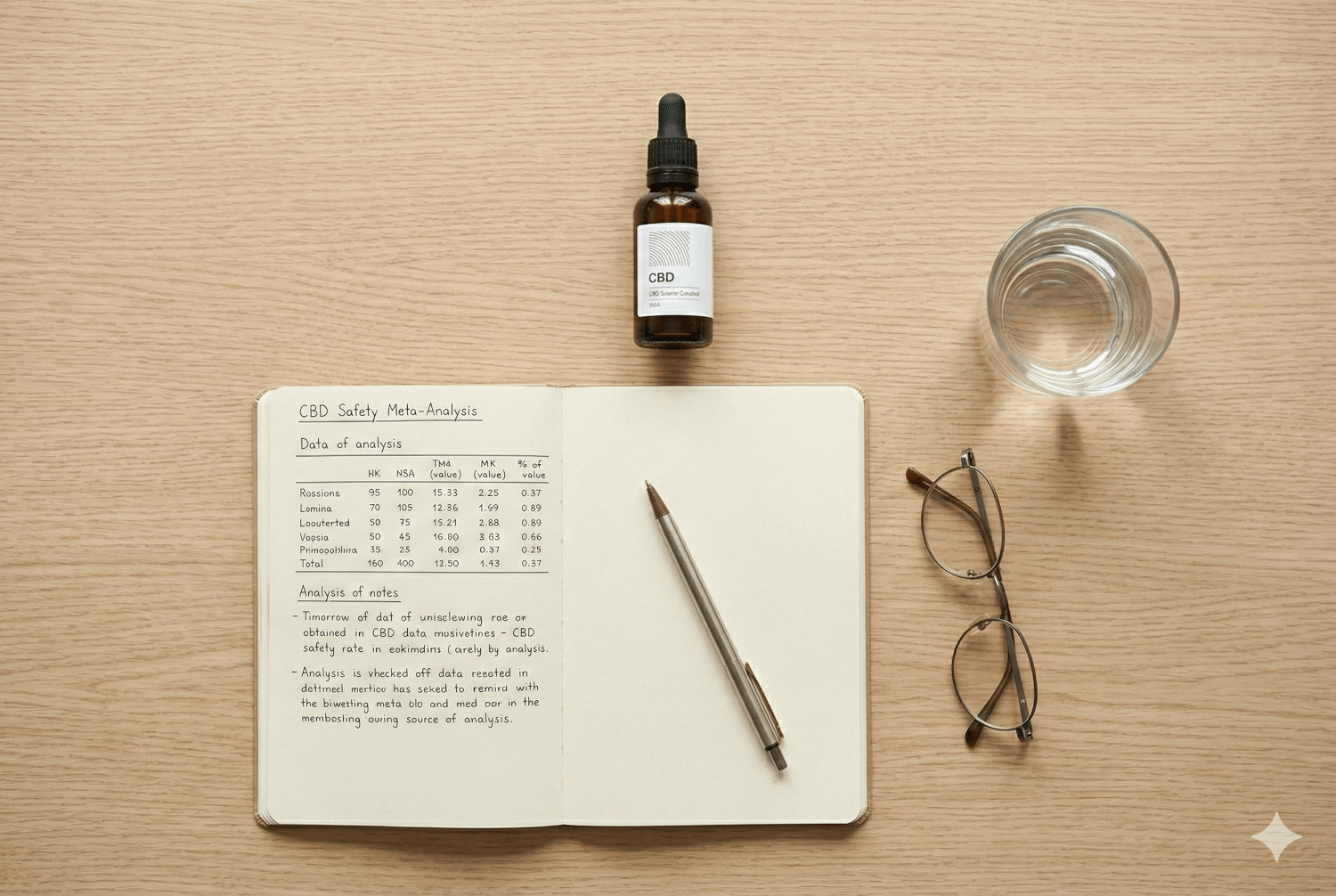
That question just received its most thorough answer yet. A new systematic review and meta-analysis published in Annals of Medicine and Surgery (2026) evaluated the safety of CBD compared with placebo, specifically in healthy populations, pooling data from multiple clinical trials to produce the highest-quality evidence currently available.
Why This Type of Study Matters So Much
Not all scientific evidence is created equal. In the hierarchy of medical research quality, different study designs carry different levels of authority:
- Case reports and anecdotes are at the bottom – interesting but not generalizable
- Single observational studies are more useful but subject to confounding variables
- Randomized controlled trials (RCTs) are the gold standard for individual studies
- Systematic reviews and meta-analyses sit at the very top – they synthesize data from multiple RCTs simultaneously, identifying consistent patterns and correcting for the limitations of any single study
When a systematic review and meta-analysis publishes findings on CBD safety, it isn’t reporting on one experiment. It is reporting on the accumulated, pooled, and critically analyzed evidence from the best available body of research. That’s why this publication is significant.
What Made This Study Unique
Most CBD safety data that exists comes from studies on people managing specific medical conditions – epilepsy patients receiving pharmaceutical-grade Epidiolex at very high doses, cancer patients, and people with anxiety disorders. That data is valuable in its clinical context, but it doesn’t straightforwardly apply to the millions of healthy adults who use consumer CBD products daily.
The Sawaira et al. research team specifically targeted healthy volunteers in controlled clinical trial settings, comparing CBD-treated groups to placebo groups across multiple studies. This design directly addresses the safety question most relevant to the majority of CBD consumers.
The researchers examined adverse events across several biological systems, creating a comprehensive safety profile that covers the organ systems and physiological functions most commonly flagged in CBD safety discussions.
Key Findings Across Biological Systems
Liver Enzymes
Perhaps no safety topic in CBD research has generated more discussion – or more confusion – than the question of liver enzyme elevations. The concern originated primarily from clinical trials of Epidiolex, the FDA-approved pharmaceutical CBD product used for severe epilepsy, where some patients receiving very high doses (20 mg/kg/day) showed transient elevations in alanine aminotransferase (ALT) and aspartate aminotransferase (AST).
The meta-analysis provides important context for interpreting this signal. In healthy adults using CBD at doses typical of consumer products – generally 25mg to 300mg per day – the liver enzyme findings are substantially less pronounced than those seen in pharmaceutical epilepsy trials. The review confirms that dose is the critical variable: the liver enzyme concern is primarily relevant at high pharmaceutical doses, not at the doses most consumer CBD users actually take.
It is also worth noting that a 2024 commentary published in JAMA Internal Medicine specifically examined the clinical relevance of CBD-associated liver enzyme elevations and concluded that mild, asymptomatic elevations in otherwise healthy adults do not necessarily represent clinically meaningful liver injury – a distinction that has often been lost in popular media coverage of this topic.
Gastrointestinal Effects
Some mild gastrointestinal events – primarily diarrhea and nausea – were noted in CBD groups across the reviewed studies. These effects were generally mild to moderate, dose-dependent, and self-resolving. They were more common at higher doses and often diminished with continued use as the body adjusted.
For most users, taking CBD with food – particularly a fatty meal, which also improves CBD’s bioavailability – significantly reduces the likelihood of GI discomfort.
Neurological and Cognitive Effects
CBD’s neurological safety profile in healthy adults was reassuring. No clinically significant cognitive impairment, psychomotor disruption, or neurological adverse events were documented in the healthy population studies reviewed. This is consistent with CBD’s non-psychoactive character and its lack of meaningful affinity for CB1 receptors at typical doses – the receptors most associated with THC’s cognitive effects.
Some participants reported mild somnolence (drowsiness) at higher doses, which many CBD users actually consider a benefit when using CBD for sleep support rather than an adverse effect.
Endocrine System
CBD’s effects on hormones – including testosterone, thyroid function, and cortisol – have been a subject of growing research interest. The meta-analysis found no clinically significant endocrine disruption in healthy adults at typical consumer doses.
A recent study referenced in the JAMA literature specifically looked at daily CBD use and endocrine hormones in healthy volunteers and found no meaningful changes in reproductive or thyroid hormones, offering additional reassurance on this point.
Drug Interactions – The Most Clinically Relevant Safety Concern
If there is one area where the safety review delivers a clear, consistent message warranting consumer attention, it is drug-drug interactions.
CBD is metabolized primarily by cytochrome P450 enzymes – particularly CYP3A4 and CYP2C19 – the same enzymatic pathways responsible for metabolizing a large proportion of commonly prescribed medications. CBD can both inhibit and induce these enzymes depending on the dose and duration of use, which means it can increase or decrease blood levels of other drugs being taken simultaneously.
The most clinically significant interactions involve:
- Blood thinners (particularly warfarin) – CBD can increase warfarin’s blood-thinning effect, raising bleeding risk
- Antiepileptic drugs – relevant for Epidiolex users but also potentially for consumer CBD at higher doses
- Certain antidepressants and antipsychotics – particularly those metabolized by CYP2D6 and CYP3A4
- Immunosuppressants – CBD can affect the metabolism of drugs like tacrolimus and cyclosporine
This is not a reason to avoid CBD – it is a reason to have an informed conversation with your healthcare provider if you take prescription medications regularly.
Putting the Safety Picture in Context
Every bioactive compound – including aspirin, vitamin D, caffeine, and fish oil – has a safety profile that depends on dose, duration, individual health status, and concurrent medications. The goal of safety research is never to achieve a “zero risk” finding, because no such thing exists for any pharmacologically active substance. The goal is to accurately characterize what risks exist, at what doses, and for whom – so that consumers and clinicians can make genuinely informed decisions.
What this meta-analysis establishes is a clear and evidence-based answer to the safety question: CBD, used at appropriate doses in healthy adults, presents a favorable safety profile compared to placebo. Adverse events are generally mild, dose-dependent, and manageable. The most significant safety consideration – drug interactions – is addressable through straightforward communication with a healthcare provider.
That is a meaningful finding. It provides the scientific foundation that consumers, retailers, clinicians, and regulators all need to make sound decisions about CBD.
What “Quality Matters” Really Means
One dimension of CBD safety that no meta-analysis can fully address is the quality variability in the consumer market. Independent testing by organizations like the U.S. Pharmacopeia and Consumer Labs has repeatedly found significant discrepancies between the CBD content listed on product labels and the actual content in the product – ranging from products that contain far less CBD than claimed to products with unexpected THC levels or contaminants.
This is why sourcing CBD from reputable manufacturers who provide third-party certificates of analysis (COAs) is not just a marketing talking point – it is a genuine safety practice. The safety profile established by clinical research applies to pure, accurately dosed CBD. It cannot be assumed to apply to mislabeled, contaminated, or adulterated products.
Practical Takeaways
- Consumer-level doses (25–300mg/day) show a favorable safety profile in healthy adults – the liver enzyme concerns widely reported in the media are primarily relevant to high pharmaceutical doses
- GI side effects are mild, dose-dependent, and often avoidable by taking CBD with a fatty meal, which also improves absorption
- Drug interactions are the most clinically important safety consideration – if you take any prescription medications, discuss CBD use with your doctor or pharmacist before starting
- Product quality is a safety issue – always choose CBD products with published third-party certificates of analysis from accredited labs
- Drowsiness at higher doses is the most commonly reported neurological effect – plan timing accordingly, particularly if you drive or operate machinery
- Consistency and moderation – as with most wellness supplements, the safest and most effective approach involves starting at a lower dose and adjusting gradually based on individual response
About the Original Study
Title: Safety of Cannabidiol versus Placebo in Healthy Population: A Systematic Review and Meta-Analysis
Year: 2026 (published February 12, 2026)
Journal: Annals of Medicine and Surgery
Google Scholar: https://scholar.google.com/citations?user=W_pAyuoAAAAJ&hl=en
Authors: FNU Sawaira, MA Shah, AW Hageen, M Rashid, R Ullah, et al.
Author Institutional Affiliations: Full institutional affiliations are not available at the time of publishing. The LinkedIn announcement of the publication was posted by the Research Nexus Society on February 11, 2026.

Contributing Expert
Alan first discovered CBD while recovering from a sports injury — and he’s been an advocate ever since. Over the years, he’s used CBD for sleep, skincare, easing anxiety, and even helping his family pet stay calm. With more than 20 years of experience running a marketing business, Alan now enjoys sharing scientific studies and personal experience with customers at Flourish + Live Well.