America Turns 250 This Weekend, and the True Story of Hemp Runs Right Through It
This weekend, the United States turns 250 years old. July 4, 2026, marks two and a half centuries since the Declaration of Independence was adopted in Philadelphia, and between the fireworks and the barbecue, we thought this was the right week to tell a story most people only half know: the story of hemp in early America. Some of what circulates about the founders and this plant is true, some of it is myth, and a store that lives on research should be able to tell you which is which.
So that is what we will do. We checked every claim below against the people who would actually know: the historians at Mount Vernon and Monticello, the National Archives, and the federal agencies that regulate hemp today. Where the record supports the story, we will say so; where it doesn’t, we will say that too.
What hemp meant in 1776
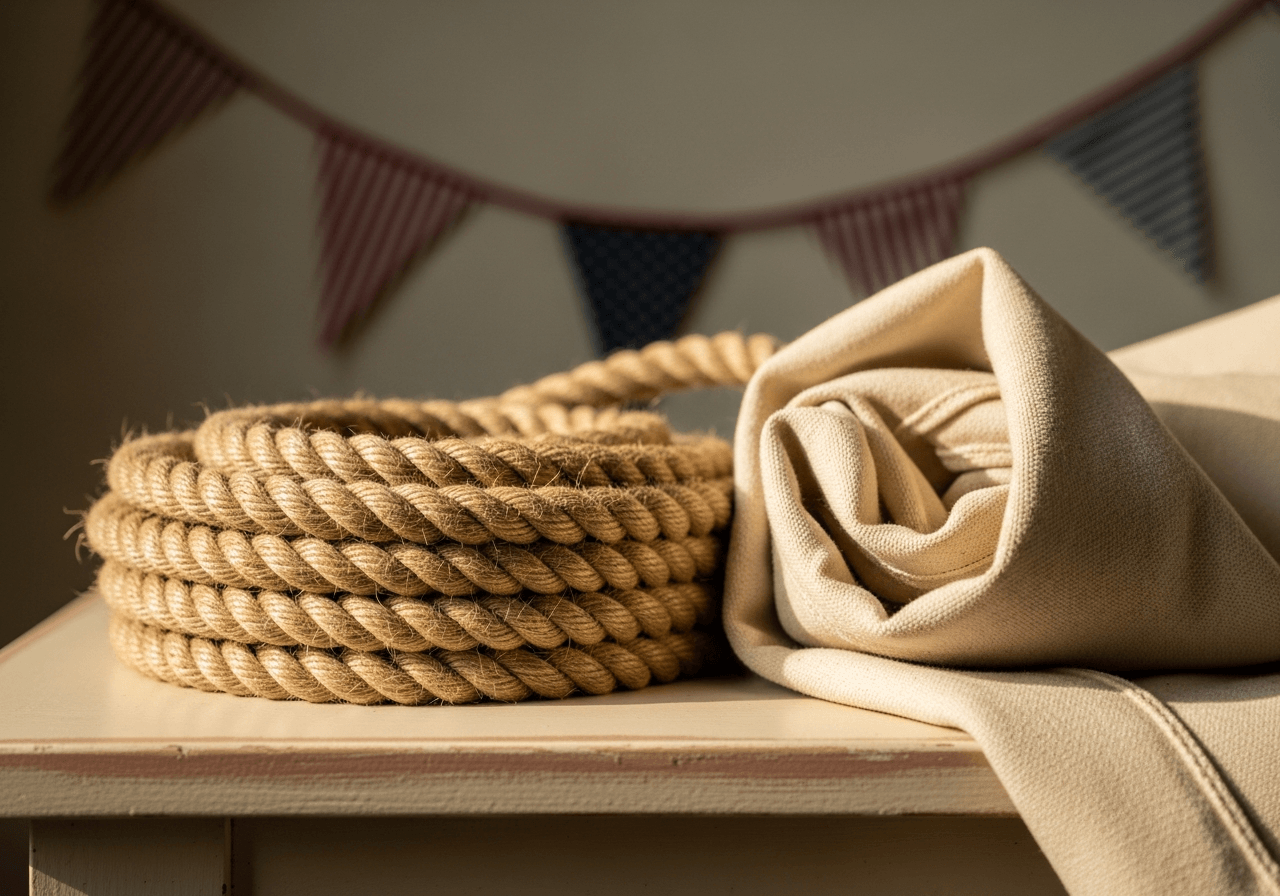
Start with what the word meant back then, because it is not what most people picture today. Hemp in the colonial era was Cannabis sativa grown for its stalk fiber, and that fiber was everywhere: rope, sail canvas, thread, coarse cloth, and fishing nets. A sailing economy ran on the stuff; every ship leaving an American port carried rigging and sails that started as hemp in somebody’s field.
One more thing worth knowing before we go further. The industrial hemp grown on colonial farms is not the same cultivar of cannabis used for recreational or medicinal purposes. As Mount Vernon’s own horticulturists put it, industrial hemp contains less than 0.3% THC and has no physical or psychological effects. Nobody in a tricorn hat was feeling anything from this crop. It was a working plant with a job to do.
Myth check: was the Declaration written on hemp paper?
You have probably seen this one online, usually around this time of year: the claim that the Declaration of Independence was written on hemp paper. It is an interesting story, but it is not what the record shows.
The signed original, the one on display at the National Archives in Washington, is written on parchment, which is animal skin prepared for writing, not paper of any kind. A scribe named Timothy Matlack engrossed the text by hand onto that parchment in 1776. The Archives is plain about the material, and parchment was the standard choice for documents meant to last; public laws, land records, and religious texts got the same treatment.
So when someone tells you the founding document of the United States is hemp, you can offer them something better: the real hemp story is in the fields, not the filing cabinet, and it is well documented.
Myth check: Jefferson’s back veranda
There is a quote that makes the rounds every July: “Some of my finest hours have been spent on my back veranda, smoking hemp.” It is attributed to Thomas Jefferson, and it is fake. Monticello’s research staff maintains a list of spurious Jefferson quotations, and this one is on it; there is no evidence he ever said or wrote it.
It would have been a strange claim anyway. The hemp Jefferson knew was a fiber crop, the kind Mount Vernon notes has no physical or psychological effects, so the quote fails on botany as well as on documentation. We like this example because it shows how a story can survive for years on charm alone. Charm is not evidence, in history or in wellness.
Fact check: Washington grew hemp
This one is true, and the source is as close to first-hand as history gets: Mount Vernon, the organization that preserves Washington’s estate and his farm records.
Washington’s diaries and farm reports show hemp growing at all five farms that made up Mount Vernon: Mansion House, River Farm, Dogue Run, Muddy Hole, and Union Farm. In the 1760s, he weighed whether hemp might beat tobacco as his cash crop; he decided wheat was the better bet, but he kept growing hemp for the plantation’s own needs. The fibers went into rope and thread, and Mount Vernon’s records show them used to repair the large seine nets in Washington’s fishing operation on the Potomac.
There is a nice coda to this one. Since the spring of 2018, Mount Vernon has planted an industrial hemp cultivar on its four-acre farm site, so visitors today can see the same crop the first president grew.
Fact check: Jefferson grew hemp, with an honest footnote
Also true. Jefferson grew hemp at Monticello and at Poplar Forest, his plantation in Bedford County, Virginia. For him it was a textile crop; hemp, flax, and cotton supplied the cloth woven on the estate, and his stated goal was about 1,200 yards of cloth a year. He even designed machinery to speed up hemp processing when hand-breaking the stalks proved slow.
Here is the footnote, and we are not going to skip it: the people cultivating and processing that hemp were enslaved. Monticello’s historians are direct about this, and we should be too. The 250th is a birthday worth celebrating, and celebrating honestly means telling the comfortable parts and the uncomfortable parts together. That is the same standard we try to hold when we read research: the whole record, not just the flattering half.
The long detour, and the 2018 return
After the founding era, hemp slowly faded from American fields, tangled up over the twentieth century in the broader legal treatment of cannabis. The turning point back came in December 2018, and it is worth being precise about what happened, because it is the reason a store like ours exists.
The 2018 Farm Bill defined hemp as Cannabis sativa L., including its derivatives, extracts, and cannabinoids, with a delta-9 THC concentration of not more than 0.3 percent on a dry weight basis. Anything meeting that definition was removed from the Controlled Substances Act. In other words, the federal government drew a clear line: at or under 0.3% THC, the plant Washington and Jefferson grew is legal agriculture again.
The same law preserved the FDA’s authority over hemp products. That matters to you as a reader, because it is why we write the way we do. CBD is not an approved treatment for any condition, with the single exception of Epidiolex for certain forms of epilepsy, so we say “research suggests” and “studies found,” and we link you to the actual studies. The founders’ era ran on hemp fiber; ours should run on evidence.
From sail canvas to CBD
It is worth pausing on how different the two eras’ relationship with this plant really is. The founders grew hemp for the stalk; the flower was beside the point. Modern hemp is largely grown for what is in the flower: cannabinoids like CBD, which researchers are now studying across sleep, stress, skin, and dozens of other areas. Same species, completely different job.
That research era is young. Most weeks in this newsletter, we walk through a new study, what it measured, and what it did not prove, and the honest answer is usually “promising, with more work to do.” We think that is the right spirit for a 250th birthday: proud of what is documented, clear-eyed about what is not settled yet.
What this means for you
You are buying a founding-era crop, updated
The hemp behind every CBD product on our shelves meets the same federal definition: no more than 0.3% delta-9 THC on a dry weight basis. It will not get you high, which puts it closer to Washington’s rope crop than to anything else people associate with cannabis. Two hundred fifty years later, hemp is simply American agriculture again.
Myth-sorting is a skill, and it transfers
The same discipline that separates the parchment fact from the hemp-paper myth is the discipline we use on CBD claims. A story that sounds perfect usually deserves a second look; a claim with a named source usually survives one. If this article made you a little more skeptical of tidy internet stories, it did its job, and that skepticism will serve you well reading any wellness label.
Freedom to choose, informed by evidence
If there is a theme that fits the weekend, it is this one. The 2018 Farm Bill returned a choice to Americans that had been off the table for generations, and the best way to use a choice is with good information. Read labels, look for third-party lab results, and ask questions; we are always glad to answer them.
The takeaway
Here is what the record supports: hemp was a real, documented crop of the founding era, grown by Washington at all five of his farms and by Jefferson at two plantations, and it powered the rope, sails, and cloth of early America. What it was not is a wellness product; the fiber cultivar has no physical or psychological effects, and the famous stories linking the founders to anything stronger do not hold up. What we still don’t know is where modern cannabinoid research will land; the studies are accumulating, and we will keep reading them with you, one honest week at a time.
Happy 250th. We think the founders, who checked their facts against their farm ledgers, would approve of the method.
About Our Sources
This week’s article is historical rather than study-based, so in place of a single study, we are listing the primary sources we verified each claim against.
Sources:
- George Washington Grew Hemp — Mount Vernon Ladies’ Association, the organization that preserves Washington’s estate and farm records
- Hemp — Thomas Jefferson Encyclopedia — Thomas Jefferson Foundation, Monticello
- Spurious Quotation: “smoking hemp” — Thomas Jefferson Foundation, Monticello
- The Declaration of Independence — U.S. National Archives
- Hemp Production and the 2018 Farm Bill — U.S. Food and Drug Administration, congressional testimony, July 2019