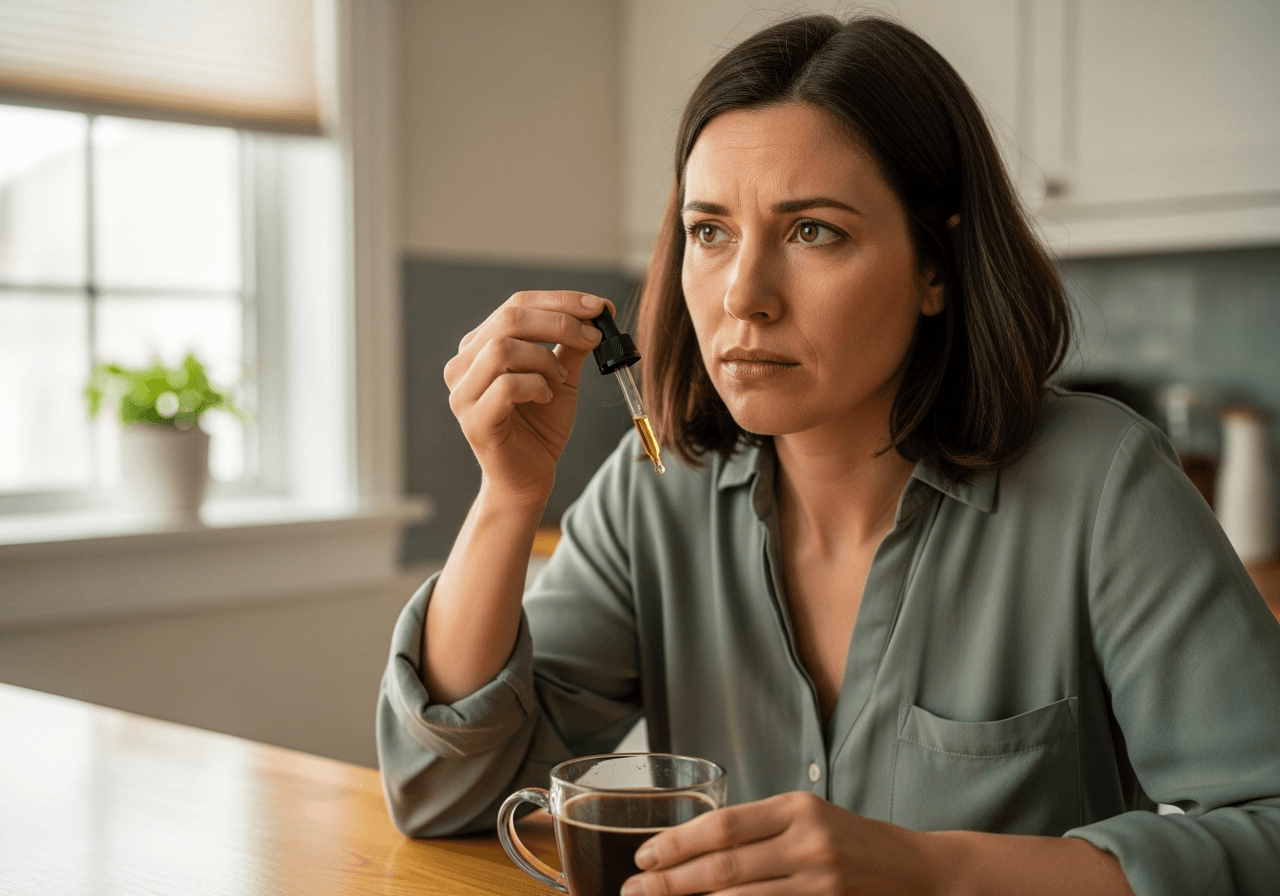
What a 2025 Wageningen trial found about fat, timing, and the gap between the CBD you take and the CBD you actually absorb
Two people take the same 70 mg of CBD on the same morning. One takes it with breakfast. The other takes it on an empty stomach before heading out the door.
By any label either of them can read, they took an identical dose.
Inside their bodies, the difference was not small, and it was not subtle. In a controlled trial published in Scientific Reports in January 2025, the one who ate first ended up with roughly ten times as much CBD in their bloodstream.
Same bottle. Same milligrams. Same morning. Almost none of the same result.
The Question Nobody Asks at the Point of Purchase
Most conversations about CBD stop at strength. How many milligrams, how much per serving, how big is the bottle.
That is a reasonable place to start and a poor place to finish, because milligrams on a label describe what goes into your mouth, not what reaches your bloodstream. Between those two points sits your digestive system, and CBD has a difficult time there.
CBD is fat-loving. In water it barely dissolves at all. Swallowed on its own, most of a dose never makes it into circulation; it is processed by the liver before it gets the chance. Researchers have understood this for years, which is why the question of how you take CBD has quietly become as interesting as how much.
The Wageningen trial put a number on it.
What the Study Did
A team led by Bo Saals at Wageningen University in the Netherlands ran a randomized crossover trial in eleven healthy adults, five men and six women.
Crossover means each participant served as their own comparison. Everyone did both conditions on separate occasions:
- A single dose equivalent to 70 mg of CBD from a CBD-rich hemp extract, taken after a high-fat meal
- The same dose taken fasted
Blood was sampled repeatedly afterward to track CBD and 7-hydroxy-cannabidiol, the main compound the body converts CBD into.
Two details make this trial unusually relevant. The dose is one an ordinary person might genuinely take, not a prescription-scale amount used in epilepsy research. And the product was a CBD-rich botanical extract rather than purified isolate, which is closer to what most full-spectrum tinctures actually contain.
What the Study Found
The fat effect was enormous
With a high-fat meal, compared with fasting:
- Peak blood concentration rose 17.4-fold (90% confidence interval 12.4 to 24.2)
- Total exposure over time rose 9.7-fold (90% confidence interval 7.7 to 12.3)
Those are not percentage improvements. A 17-fold peak means the fasted condition delivered a small fraction of what the fed condition did, from a dose that was identical on paper.
Absorption arrived in two waves
The fed condition produced something the researchers call a double peak: CBD levels rose, dipped, then rose again, and stayed elevated for longer rather than spiking and falling away.
The paper offers several possible explanations, including transport through the lymphatic system, recirculation between the liver and gut, and the effect of a second meal later in the day. The mechanism is not settled.
What is clear is the practical shape of it. Food did not merely raise the peak. It changed the whole curve, extending how long CBD stayed in circulation.
Why Fat Changes Anything
The reason comes down to what kind of molecule CBD is.
CBD is lipophilic, which is a technical way of saying it dissolves in fat and not in water. Your digestive tract is mostly a watery environment, so a fat-loving compound arriving on its own has very little to attach to and very little chance of being carried anywhere useful.
Arrive alongside a fatty meal and the situation changes completely. Fat in the gut triggers bile release and the formation of tiny droplets that ferry fat-soluble compounds across the intestinal wall. CBD gets to travel with them rather than fending for itself.
There is a second piece, and it is the likeliest explanation for that double peak. Compounds packaged with dietary fat can enter the lymphatic system rather than heading straight to the liver through the bloodstream. That route bypasses a first pass through the liver, where a large share of swallowed CBD is normally broken down before it ever reaches general circulation.
The Wageningen authors raise lymphatic transport as one candidate explanation and are careful not to overstate it. The mechanism is a live research question. The measurable outcome, in this trial, was not ambiguous at all.
What Supporting Studies Add
This is not a lone result. The food effect has shown up repeatedly in controlled human work.
A 2020 trial in Epilepsia tested different meal compositions against a 750 mg CBD dose and found that what you eat, not simply whether you eat, shifts exposure. A low-fat meal raised total exposure 2.7-fold and peak concentration 3.8-fold against fasting; whole milk on its own raised them 2.4-fold and 3.1-fold; alcohol produced a smaller rise. A 2018 Phase I trial in CNS Drugs had already established a clear food effect for an oral CBD solution, at a 1,500 mg single dose.
Those studies used doses far above what anyone buys off a shelf, which limits how directly they transfer. The Wageningen work matters because it tested the same phenomenon at a dose an ordinary customer might actually take, using an extract rather than a purified drug.
Different populations, different doses, different formulations. The direction of the finding holds across all of them.
What the Study Didn’t Prove
Being clear about the limits is part of reading research properly.
Eleven people is a small trial. The confidence intervals are wide, and the exact multiplier should be treated as a strong signal rather than a precise constant. Your kitchen is not a crossover trial.
Nothing here is a health outcome. This study measured what reaches the bloodstream. It did not measure sleep, pain, anxiety, or any other endpoint, and it makes no claim that more CBD in circulation produces more of any benefit.
“High-fat meal” was a standardized research meal. The paper gives its nutrition rather than its menu: roughly 800 to 1,000 calories, of which 500 to 600 came from fat, working out to 55 to 65 grams of fat and at least half the meal’s calories. That is the food-effect standard the FDA and EFSA set for trials like this one, and it was built with a dietician. In everyday terms it is closer to a cooked breakfast than to a yogurt, and participants ate it half an hour before the capsules. The middle ground was never tested, so how little fat still works remains an open question.
Two of the seven authors are employed by Becanex GmbH, a cannabinoid company, and another by a pharmaceutical services firm. Industry involvement in cannabinoid research is common and does not by itself invalidate a result, but it belongs on the table rather than in a footnote.
The trial used swallowed CBD. That matters more than it first appears, and it leads directly to the next question.
Swallowed or Under the Tongue?
A tincture can be used two ways, and they are not the same event.
Swallow it, and it follows the path this study measured: through the digestive tract, through the liver, heavily influenced by what else is in your stomach. That is where the 17-fold figure applies.
Hold it under the tongue, and part of the dose is absorbed through the tissue in your mouth instead. Pharmacologically that route works differently. How much of a typical tincture dose is genuinely absorbed that way, rather than eventually swallowed, is still debated in the literature, so the sensible position is that holding it under the tongue is worth doing and is not a reason to skip the food question.
The useful takeaway is not that one route wins. It is that a tincture is the only common format that gives you the choice at all. A capsule or a gummy is swallowed, full stop, which means it inherits the full food effect whether you planned for it or not.
What This Means for You
If you swallow your CBD, take it with a meal that contains fat. Not a cracker. Something with real fat content: eggs, yogurt, avocado, nuts, cheese, oily fish. On the evidence here, this is the single highest-impact change most people can make, and it costs nothing.
Be consistent about it. If you took it with dinner last week and on an empty stomach this week, you have changed your effective dose without changing your bottle. That inconsistency is a common reason people conclude a product “stopped working.”
Reconsider before you increase the dose. Someone taking CBD fasted and finding it underwhelming may not need more milligrams. They may need the same milligrams alongside food. Buying a stronger bottle to solve an absorption problem is an expensive way to miss the point.
Give a routine time to settle. Because the fed condition kept levels elevated for longer, judging a product across a few inconsistent doses will not tell you much. Take it the same way, at the same time, alongside the same kind of meal, and then assess.
About the Original Study
Title: A high-fat meal significantly impacts the bioavailability and biphasic absorption of cannabidiol (CBD) from a CBD-rich extract in men and women
Published: Scientific Reports, 29 January 2025; 15(1):3678
Authors:
- Bo Anne Daniëlla Frederique Saals, Division of Human Nutrition and Health, Wageningen University, The Netherlands
- Tessa Helena De Bie, Division of Human Nutrition and Health, Wageningen University, The Netherlands
- Eral Osmanoglou, Becanex GmbH, Berlin, Germany
- Ties van de Laar, Becanex GmbH, Berlin, Germany
- Adriaan Willem Tuin, Ardena, Assen, The Netherlands
- Anne Claire Benedikte van Orten-Luiten, Division of Human Nutrition and Health, Wageningen University, The Netherlands
- Renger Frederik Witkamp, Professor of Nutritional Biology, Division of Human Nutrition and Health, Wageningen University, The Netherlands
Link: https://pubmed.ncbi.nlm.nih.gov/39880884/ (DOI: 10.1038/s41598-025-87621-4)

Contributing Expert
Alan first discovered CBD while recovering from a sports injury — and he’s been an advocate ever since. Over the years, he’s used CBD for sleep, skincare, easing anxiety, and even helping his family pet stay calm. With more than 20 years of experience running a marketing business, Alan now enjoys sharing scientific studies and personal experience with customers at Flourish + Live Well.