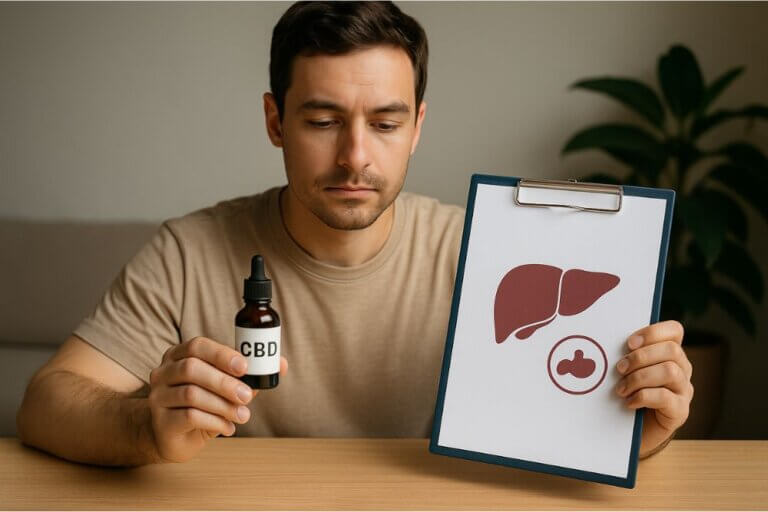
CBD has its perks, but how does your liver handle it? Science offers some answers.
You’ve seen it everywhere: CBD gummies for stress, oils for sleep, tinctures for focus. What started as a niche wellness trend has become an entire aisle in your local pharmacy. Millions of people now take CBD daily, hoping for calm without chemicals or a high.
But as “everyday CBD” becomes as normal as morning coffee, one big question keeps resurfacing:
Is it actually safe for your liver?
That’s the question researchers at JAMA Internal Medicine decided to answer in one of the most rigorous studies yet. And what they found offers a grounded, science-based perspective, one that neither glamorizes nor demonizes CBD, but gives us something even more valuable: clarity.
Science Snapshot
- 201 healthy adults took CBD or a placebo daily for four weeks.
- 5.6% showed temporary elevations in liver enzymes, but no symptoms or lasting harm.
- CBD did not affect hormone levels like thyroid or testosterone.
- Overall liver function remained normal, suggesting CBD is well-tolerated in healthy adults.
Why the Liver Matters in the CBD Conversation
Your liver is the body’s chemical control center. It filters blood, breaks down food, processes medications, and detoxifies everything from alcohol to Tylenol.
CBD, like many compounds, is metabolized through the liver, using the same enzyme systems that handle countless drugs and supplements. That overlap raised a reasonable concern: Could daily CBD add extra strain, especially for people who already take other medications?
Until recently, the only research available came from high-dose medical trials, where patients were taking hundreds or even thousands of milligrams of prescription-strength CBD. Those doses are far beyond what typical consumers use. So scientists wanted to know what happens at real-world levels, the kind found in common oils and gummies.
Inside the Four-Week CBD Safety Trial
The new study, conducted by a clinical research team in Wisconsin, enrolled 201 healthy adults, ranging in age from their late 20s to mid-40s.
Each volunteer was randomly assigned to one of two groups:
- The CBD group, who received around 5 mg per kilogram of body weight per day (split into two doses) — roughly equivalent to what a wellness-minded consumer might use.
- The placebo group, which took identical-looking capsules without CBD.
Over four weeks, both groups came in weekly for bloodwork and medical check-ins. Researchers tracked key liver enzymes ALT and AST, which can rise when the liver is under stress. They also measured hormone levels to check for any disruptions in thyroid or reproductive health.
It was the kind of methodical, no-nonsense study CBD research has needed for years: double-blind, controlled, and designed around everyday use.
What the Results Showed
At the end of the study, the majority of participants taking CBD had no major issues. However, about 5.6% showed temporary elevations in liver enzymes, three times higher than normal. Importantly, none of those participants experienced symptoms of liver disease or long-term damage, and the enzyme changes returned to normal after stopping CBD.
The placebo group showed no enzyme spikes, which helped researchers confirm that the temporary rise was related to CBD metabolism, not random variation.
When it came to hormones like thyroid or testosterone, no significant differences were found between the CBD and placebo groups. That means CBD didn’t appear to disrupt normal hormonal balance.
Understanding the Science Behind the Numbers
Think of your liver as a busy airport terminal. Every compound you consume, coffee, ibuprofen, a glass of wine, or CBD, needs to “land,” get processed, and take off again.
Sometimes, when traffic increases, the system temporarily lights up with extra activity. That’s what those enzyme elevations reflect. It doesn’t mean the airport is broken; it means it’s managing a new flight path.
The researchers emphasized that context matters. For healthy people, the liver adjusts easily. But if someone already has liver disease or is taking multiple medications that rely on the same metabolic pathways, CBD could theoretically create an extra load, which is why medical supervision is key for those individuals.
Why This Study Matters
Transparency builds trust, and that’s what makes this trial so valuable. Instead of promoting CBD as a miracle cure, it looked squarely at potential risks in a scientific, controlled way.
For consumers, that’s a win. It shows that most people can safely enjoy CBD’s relaxing benefits while understanding where moderation and responsible use come in.
It also sends a message to the industry: as CBD continues to grow in popularity, quality control, accurate labeling, and third-party lab testing are essential for protecting public health.
Using CBD the Smart Way
If you’re currently using CBD or thinking about starting, here are a few easy tips drawn from both research and real-world experience:
- Start low and go slow. Begin with a small amount and give your body time to adjust before increasing.
- Buy from trusted sources. Look for lab-tested products that clearly list cannabinoid content and confirm they’re free of heavy metals or pesticides.
- Avoid mixing with alcohol or unnecessary medications. Both can strain the liver and make it harder for your body to process CBD efficiently.
- Listen to your body. If you ever feel off, fatigued, or notice changes in appetite or digestion, pause use and check in with your doctor.
Responsible use makes all the difference, and studies like this one help everyone use CBD with more confidence and awareness.
The Bigger Picture: Confidence Through Clarity
This study is more than a safety check. It’s a reflection of how far the CBD conversation has come.
We’re no longer asking, “Does it work?” in vague terms. We’re now asking, “How does it work safely?”
That’s the kind of progress that helps transform a trend into a legitimate wellness tool.
As researchers continue to study CBD’s effects on sleep, mood, inflammation, and pain, the takeaway from this trial is simple: balance matters. CBD seems to offer calm for the mind and, in the right doses, calm for the body, too.
What This Means for You
The big takeaway: CBD appears generally safe for everyday use when taken in moderate amounts. A few people may see short-term changes in liver enzyme levels, but these changes weren’t harmful and resolved quickly.
If you’re healthy, stick to recommended serving sizes, and use a reputable product, CBD can be part of your wellness toolkit. And if you have liver concerns or take prescription medication, a quick conversation with your healthcare provider will help you decide what’s best for you.
In the end, this study reminds us that CBD is not just popular, it’s being taken seriously by scientists who want to make sure it stays safe for the millions who use it every day.
Original Study Section
Title: Cannabidiol and Liver Enzyme Level Elevations in Healthy Adults: A Randomized Clinical Trial
Date: July 2025
Authors: Jeffry Florian, Pablo Salcedo, Keith Burkhart, Aanchal Shah, Lakshmi Manasa Chekka, Dro Keshishi, Vikram Patel, ShanChao Yang, Melanie Fein, Ryan DePalma, Murali Matta, David G. Strauss, Rodney Rouse
Link: Read the Study on JAMA Network

Contributing Expert
Alan first discovered CBD while recovering from a sports injury — and he’s been a believer ever since. Over the years, he’s used CBD for sleep, skincare, easing anxiety, and even helping his family pet stay calm. With more than 20 years of experience running a marketing business, Alan now enjoys sharing scientific studies and personal experience with customers at Flourish + Live Well.