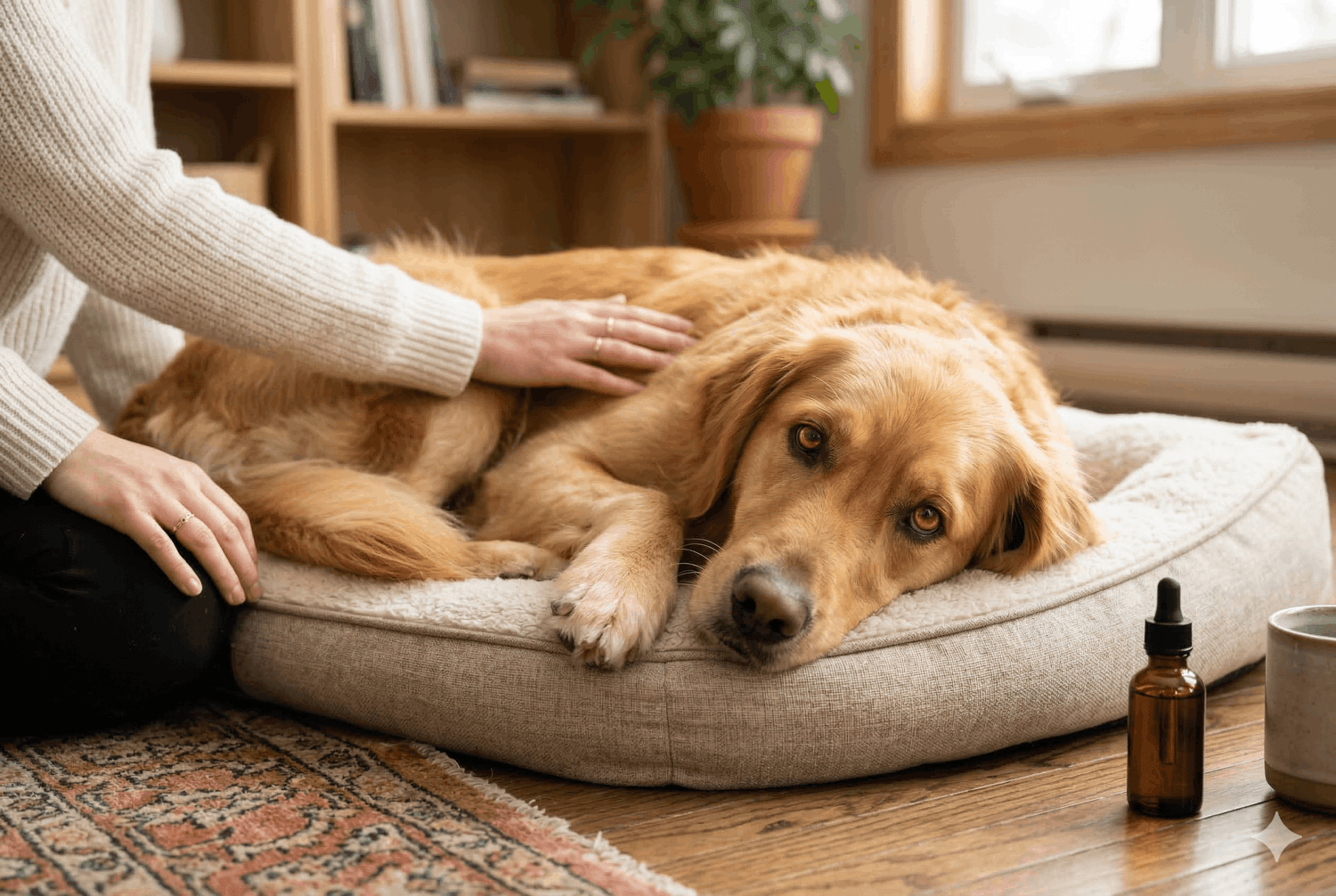
How a new injectable CBD formula is changing the pain relief conversation for dogs with arthritis.
Picture this. Your dog, who used to sprint to the door the second you picked up the leash, now just looks up at you from the floor. Getting up is slow. The stairs are a project. And the joy in those eyes is still there, but something else is there too.
Osteoarthritis affects an estimated 20% of adult dogs, and managing that pain is one of the most common and frustrating challenges in veterinary medicine. Standard pain medications work for many dogs, but they come with side effects, especially on the liver and kidneys with long-term use.
A new study published in Frontiers in Veterinary Science tested a completely different approach: liposomal synthetic CBD injected under the skin.
What did this study actually do?
Researchers at the Hebrew University of Jerusalem and partner institutions ran a randomized, blinded, placebo-controlled, crossover trial — one of the most rigorous study designs possible.
Here’s what that means in plain terms:
- Dogs with confirmed osteoarthritis were randomized to receive either liposomal synthetic CBD (injected subcutaneously, meaning just under the skin) or a placebo injection.
- Because it was a crossover design, every dog eventually received both treatments, separated by a washout period. That means each dog served as their own control, which makes the results especially reliable.
- The study was blinded — neither the veterinarians assessing the dogs nor the owners knew which treatment the dog had received at any given time.
- Researchers measured pain and mobility using validated veterinary scoring tools, owner-reported observations, and objective movement assessments.
The key innovation here was the delivery method. Oral CBD has notoriously poor bioavailability in dogs due to first-pass liver metabolism — meaning much of what a dog swallows gets broken down before it can do anything useful. A subcutaneous liposomal formula bypasses that problem entirely, delivering CBD more directly into circulation.
What did they find?
The results were encouraging:
- Dogs receiving the liposomal CBD injection showed significant improvements in pain scores compared to placebo.
- Mobility and activity levels improved — owners reported dogs moving more freely, getting up with less effort, and showing more interest in activity.
- The liposomal formula was well-tolerated with no serious adverse effects reported during the trial period.
- Pharmacokinetic data confirmed that the subcutaneous liposomal delivery achieved better CBD blood levels than oral administration typically does in dogs.
The authors concluded that this delivery method overcomes one of the biggest obstacles to CBD use in veterinary pain management: getting enough CBD into the bloodstream to actually work.
Why does delivery method matter so much?
Think of it this way. You could have the best medication in the world, but if your dog’s body destroys most of it before it reaches the target, it won’t matter.
Oral CBD in dogs faces exactly that problem. Studies have consistently shown that dogs metabolize CBD rapidly through first-pass liver processing, which means:
- Much of an oral dose never reaches effective blood levels
- Dosing is inconsistent and hard to predict
- Higher oral doses are needed, which increases cost and potential side effects
Liposomal delivery wraps CBD in tiny fat-based particles that protect it from rapid breakdown and help it absorb more efficiently. The subcutaneous route adds another layer of reliability by bypassing the digestive system entirely.[1]
What this means for you and your dog
The problem: if your dog has osteoarthritis, you’ve probably already tried something — joint supplements, NSAIDs, prescription pain meds, or oral CBD. And you’ve probably noticed that results are inconsistent or come with trade-offs.
Here’s what to take from this study:
- Oral CBD for dogs may be underperforming simply because of how dogs metabolize it — not because CBD doesn’t work.
- Injectable formulations are not yet widely available in clinical veterinary practice. This study represents early but promising evidence that should push the field forward.
- If you’re using oral CBD for your dog now, the research suggests looking for high-quality, oil-based formulas with good bioavailability data, and always discuss dosing with your vet.
- Talk to your veterinarian. CBD for dogs is not regulated the same way as pharmaceutical medications, and dosing guidance varies widely. Your vet is the best person to help you weigh options for your specific dog.
How to have the right conversation with your vet
If this study has you thinking about CBD for your arthritic dog, here’s how to approach it:
- Bring the research. You can reference this Frontiers in Veterinary Science study when you talk to your vet. It shows CBD for canine pain is being taken seriously at the clinical level.
- Ask specifically about bioavailability. Not all CBD products for dogs are created equal. Ask your vet about formulations that have absorption data to back them up.
- Track your dog’s response. Keep a simple log — activity level, ease of rising, interest in walks, any side effects — over a 4-week period.
- Don’t replace proven pain management without guidance. If your dog is on NSAIDs or other vet-prescribed pain meds, don’t substitute CBD without your vet’s involvement.
About the Original Study
Title: Efficacy, pharmacokinetics and safety of liposomal synthetic cannabidiol injected subcutaneously in dogs: A randomized, blinded, placebo-controlled, crossover trial[1]
Year: 2025
Journal: Frontiers in Veterinary Science[1]
Publisher full text: https://www.frontiersin.org/journals/veterinary-science
Authors:
- Yael Shilo-Benjamini, DVM, PhD — Veterinary anesthesiologist and pain specialist, Koret School of Veterinary Medicine, Hebrew University of Jerusalem. Research focus: veterinary pain management and cannabinoid pharmacology.[1]
- Joseph Milgram, DVM — Veterinary orthopedic surgeon, Koret School of Veterinary Medicine, Hebrew University of Jerusalem.[1]
- Eran Lavy, DVM — Veterinary internal medicine specialist, Hebrew University of Jerusalem.[1]
- Maya Quint — Co-author, cannabinoid pharmacology research.[1]
(Full author list and affiliations: Frontiers in Veterinary Science article page)

Contributing Expert
Alan first discovered CBD while recovering from a sports injury — and he’s been an advocate ever since. Over the years, he’s used CBD for sleep, skincare, easing anxiety, and even helping his family pet stay calm. With more than 20 years of experience running a marketing business, Alan now enjoys sharing scientific studies and personal experience with customers at Flourish + Live Well.