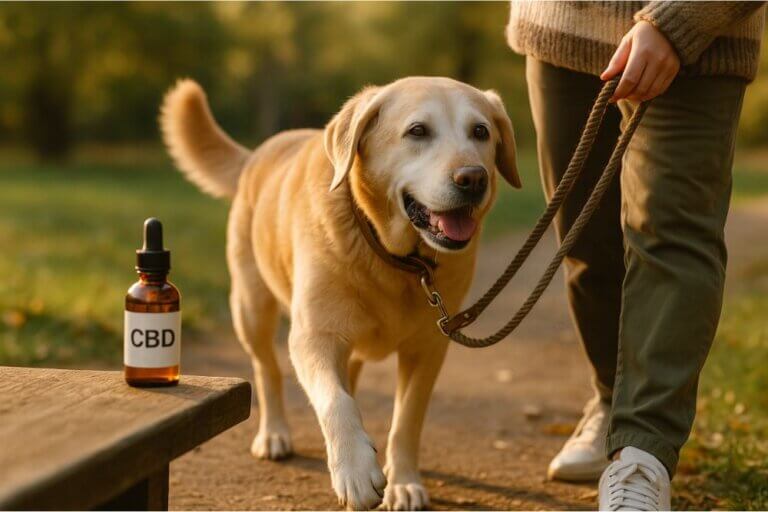
Aging doesn’t have to mean slowing down; CBD can help keep tails wagging.
If you’ve noticed your dog hesitating before climbing the stairs or taking longer to get up from a nap, you’re not alone. As dogs age, their joints naturally begin to ache, just like ours do.
Osteoarthritis is one of the most common health challenges older dogs face, and it can quietly steal away their joy of movement.
While pain medications and supplements exist, many pet owners are searching for gentler options, something that can help without causing new problems. That’s where CBD has started to attract attention.
Science Snapshot
- CBD improved mobility and comfort in dogs with arthritis.
- No harmful side effects were observed after four weeks.
- Liposomal CBD worked effectively at lower doses due to better absorption.
Why CBD Is Getting Attention for Pet Health
CBD, short for cannabidiol, is a natural compound found in hemp. It doesn’t make pets “high,” and it’s known for supporting balance and calm in the body. Over the past few years, researchers have been studying CBD’s potential to help with inflammation and discomfort not just in humans, but in animals too.
Veterinarians and pet owners alike have wondered: could CBD safely help aging dogs feel more comfortable? A team of researchers set out to find the answer in one of the most rigorous types of scientific studies: a randomized, double-blind, placebo-controlled trial.
Inside the Study on Dogs and CBD
The 2020 study, published in Frontiers in Veterinary Science, looked at dogs diagnosed with osteoarthritis, a degenerative joint condition that causes pain, stiffness, and limited mobility. The researchers wanted to see if daily CBD could improve comfort and movement over four weeks.
The trial was designed carefully, and neither the researchers nor the pet owners knew which dogs were receiving CBD or a placebo. Some dogs were given standard CBD, while others received liposomal CBD, a special form that helps the compound absorb more efficiently in the body.
Over the course of four weeks, veterinarians and owners observed each dog’s pain levels, activity, and overall mobility. The dogs’ bloodwork and health markers were also monitored to ensure safety.
The Results Were Hard to Ignore
By the end of the study, both forms of CBD, standard and liposomal, showed clear benefits. Dogs receiving CBD moved more easily, were more active, and showed fewer signs of pain compared to those given the placebo.
Interestingly, liposomal CBD (20 mg/day) was as effective as a much higher dose of regular CBD (50 mg/day). This finding suggests that improved absorption could allow pets to benefit from smaller amounts.
Blood tests and health checks also brought encouraging news: there were no significant side effects or negative changes in any of the dogs’ lab results. CBD appeared to be well-tolerated over the four weeks, adding confidence to its safety profile.
What Makes This Study Special
Many claims about CBD come from anecdotal stories of pet owners noticing that their dog seems calmer or more mobile after using it. While those experiences are valuable, scientific studies like this one provide something more: measurable evidence.
This research used controlled conditions to separate real effects from coincidence. And the results weren’t just about movement. In lab tests, CBD also reduced the production of pro-inflammatory molecules (like IL-6 and TNF-α) and boosted anti-inflammatory signals such as IL-10.
In simple terms, CBD seemed to help dogs’ bodies calm unnecessary inflammation, one of the main drivers of joint pain and stiffness.
CBD’s Gentle Approach to Comfort
What pet owners often love about CBD is that it feels like a gentle, natural option. Instead of masking pain, CBD appears to help the body respond to inflammation more effectively. That may be why the dogs in the study didn’t just appear sedated; they seemed genuinely more comfortable and eager to move.
It’s also worth noting that the dogs didn’t experience worrisome side effects. Unlike some medications that can upset the stomach or stress the liver, CBD in this study showed no harmful impact on the dogs’ blood chemistry or overall health.
Of course, this doesn’t mean CBD is a cure or that all pets will respond the same way. But it’s an encouraging step forward in understanding how this natural compound could support joint comfort safely.
Why This Matters for Pet Owners
For many people, dogs are family. Seeing them struggle with pain can be heartbreaking, and the options for relief can feel limited. Studies like this bring hope that CBD could become a trusted part of pet wellness, not as a replacement for veterinary care, but as an additional tool for improving quality of life.
If you’re curious about trying CBD for your dog, always start by talking to your veterinarian. They can help you determine the right approach, the correct dosage, and whether your pet’s existing medications are compatible.
What This Means for Your Pet’s Comfort
Your dog may not be able to tell you when their joints ache, but their movement says a lot. This research suggests that CBD could help older dogs feel more like themselves again, playful, mobile, and eager to explore.
The takeaway? CBD may not just be for humans looking to unwind. It might also be a gentle way to support your dog’s comfort as they age. The science is still evolving, but it’s clear that CBD’s story in pet wellness is only beginning.
Original Study Section
Title: A randomized, double-blind, placebo-controlled study of daily cannabidiol for the treatment of canine osteoarthritis pain
Date: September 2020
Authors:Chris D. Verrico,Shonda Wesson, Vanaja Konduri, Colby J. Hofferek,Jonathan Vazquez-Perez,Emek Blair,Kenneth Dunner Jr.,Pedram Salimpour, William K. Decker,Matthew M. Halpert
Link to Study:Read the Study on PubMed Central

Contributing Expert
Alan first discovered CBD while recovering from a sports injury — and he’s been a believer ever since. Over the years, he’s used CBD for sleep, skincare, easing anxiety, and even helping his family pet stay calm. With more than 20 years of experience running a marketing business, Alan now enjoys sharing scientific studies and personal experience with customers at Flourish + Live Well.