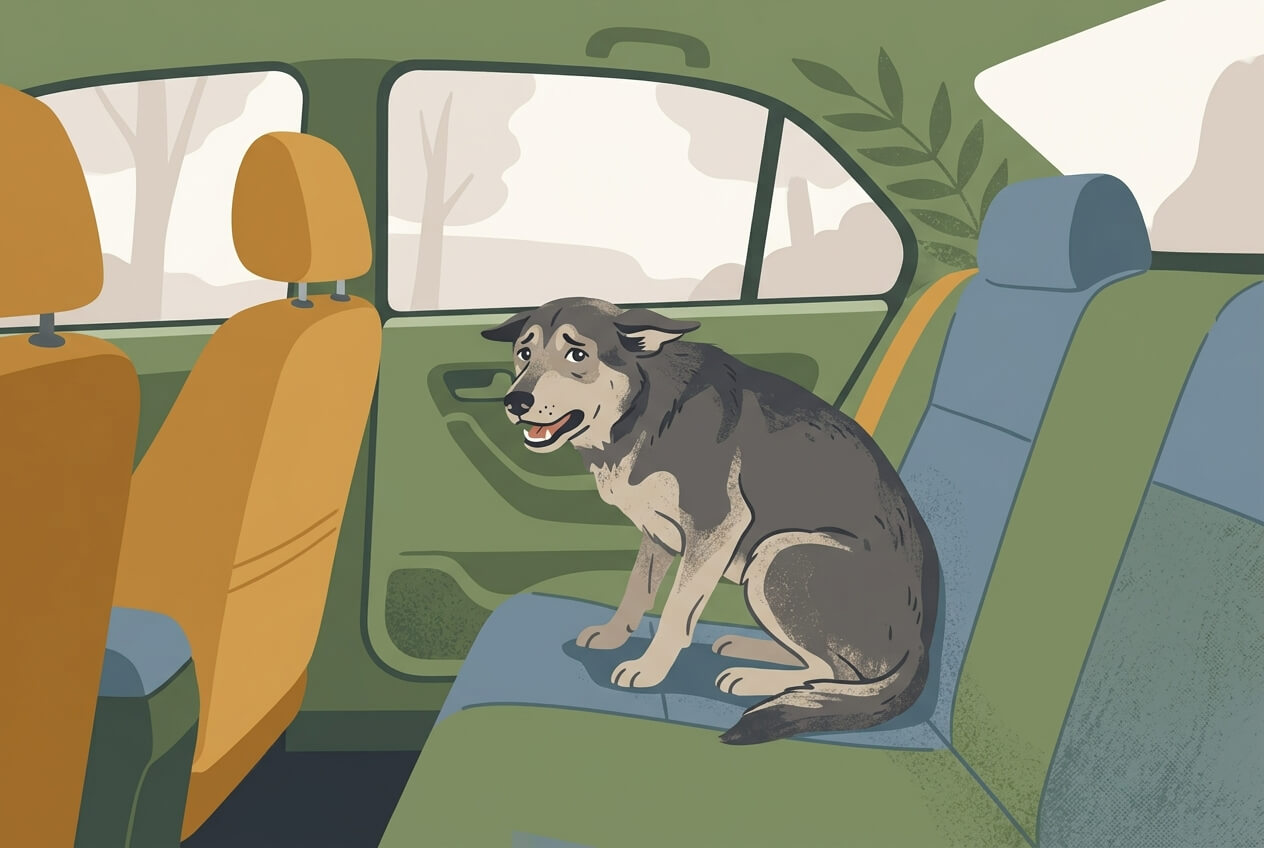
What a six-month trial found when dogs took CBD before car travel
Many dogs find car travel stressful. They may pant, whine, lick their lips, or remain visibly unsettled after the trip ends.
A research team at the Waltham Petcare Science Institute in England studied that response by taking the same dogs on the same ten-minute drive at intervals over six months.
What the study did
Nineteen dogs took part in the main trial. Each received either a CBD capsule or a matching placebo capsule with breakfast every day, tucked into a treat pocket so neither the dog nor the handler could tell them apart.
The dose was 4 mg of CBD per kilogram of body weight, given about two hours before testing, because earlier work found blood levels peak between 90 minutes and two hours after a dose. The CBD itself was a THC-free distillate, tested for purity and found to contain no detectable THC.
The dogs then took a standardized ten-minute drive around a private car park. The route included a sharp U-turn and a three-point turn, and the vehicle stayed below ten miles per hour. Testing took place at weeks 0, 8, 16, and 24.
How the dogs responded to car travel
Compared with baseline measurements, the drive produced significant increases in:
- Cortisol, a hormone involved in the stress response that was measured in blood
- Heart rate, measured during the journey
- Whining, lip licking and yawning, all recognized stress behaviors in dogs
- Activity levels, measured by a smart collar
- Observer ratings of how stressed the dogs appeared
The stress response remained measurable across the repeated trips, although the placebo group’s cortisol response declined over time.
What the CBD changed
- Cortisol rose less in the CBD group than in the placebo group after the drive, at week 0 (p = 0.007), week 8 (p = 0.014) and week 16 (p = 0.030)
- By week 24, the groups no longer differed significantly (p = 0.219). The placebo group’s cortisol response had declined over time, but the study could not determine whether this reflected habituation or a change in the effect of daily dosing
- Cortisol still rose in the CBD group from baseline to post-drive at every time point. The treatment reduced the stress response without removing it
- Heart rate did not differ between the groups
- The behavior results were inconsistent. Whining and lip licking differed only at some time points. Lip licking was worse with CBD at week 0 and better at week 16, so the behavior results did not show a uniform benefit.
The authors concluded that daily dosing at 4 mg/kg “may have a mild anxiolytic effect on dogs when traveling in a car.”
Why cortisol, and why it is not the whole picture
Cortisol was one of the main measures in both reports, but it cannot describe the dog’s full experience.
Cortisol is a hormone released during the body’s stress response. It can be measured in a blood sample, so the result does not depend on an observer’s judgment of the dog’s behavior.
A smaller rise in cortisol suggests a smaller physiological stress response, but it does not tell us how the dog felt. The behavior results also varied by behavior and time point, so the measures describe different parts of the response.
What the earlier report adds
First dose and first stress tests (2023, Frontiers in Veterinary Science): An earlier report from the same project examined the first dose and first stress tests. It included the 19 car-travel dogs and 21 dogs tested during separation.
- The car was the more stressful of the two, producing larger changes than being left alone
- Dogs given CBD had lower cortisol after the tests overall (30.0 vs 39.3 ng/ml, p = 0.028), and for the car test specifically (40.7 vs 56.7 ng/ml, p = 0.034)
- For the separation test alone, the difference was not significant (23.4 vs 28.3 ng/ml, p = 0.142)
- Observers rated CBD dogs as significantly less “sad” during car travel, and their “relaxed” ratings dropped less from baseline
- Heart rate again showed no difference
Across the two reports from the same project, CBD was associated with lower cortisol during car travel. The six-month behavior results were inconsistent: whining and lip licking differed only at some timepoints, and lip licking was worse with CBD at week 0 but better at week 16. Heart rate did not differ between groups, and the separation test produced less consistent results.
What these studies do not answer
The reports do not tell us whether CBD helps a dog who is frightened of fireworks, thunder, or strangers at the door. Those are different stressors. A lower-dose study cited by the authors found no effect when dogs were exposed to a recording of fireworks.
The reports do not tell us what a lower dose does. Both used 4 mg/kg and neither compared doses, so there is no evidence here about the amounts in most consumer products.
The six-month result also has more than one possible explanation. By week 24, the difference between groups had closed as the placebo group’s cortisol response declined. The study could not determine whether the dogs were becoming accustomed to the drive or whether the effect of daily dosing changed over time.
What this means for your dog
The safety picture
In this trial, dogs received 4 mg/kg of CBD daily for six months, and the researchers reported no adverse health effects. That finding applies to the product, dose, dogs, and monitoring used in this study. A veterinarian can help assess CBD use for an individual dog, especially one taking other medication.
The dose gap
At 4 mg/kg, a 20 kg dog would receive 80 mg of CBD per day. Neither trial tested lower doses, so the results cannot tell us what to expect from a chew or other product containing much less CBD. A veterinarian can help assess an appropriate amount for an individual dog.
What each measure showed
Cortisol differed between the CBD and placebo groups at three of four car tests, while heart rate did not. The behavior results varied by behavior and time point. These measures describe parts of the stress response, but they cannot tell us how the dogs felt.
Worth keeping in mind
- These are laboratory colony dogs at a research institute, not pet dogs in a family car on the way to the vet.
- Every author works for Mars Petcare, a pet food and veterinary company, which the papers disclose.
- The six-month report followed 19 car-travel dogs; the earlier report also included 21 dogs tested during separation.
- The stressors were car travel and being left alone. Nothing here tested fireworks, thunder, doorbells, or visitors.
- The difference between groups was no longer significant at six months. The placebo group’s declining cortisol response makes the reason difficult to determine.
- The studies used 4 mg/kg of a THC-free distillate. They did not test lower-dose products.
At 4 mg/kg, CBD was associated with a smaller cortisol response during car travel at three of four tests. The reports do not establish whether lower doses or other stressful situations would produce the same result.
About the original studies
Title: Daily dosing of cannabidiol (CBD) demonstrates a positive effect on measures of stress in dogs during repeated exposure to car travel
Published: January 2024, Journal of Animal Science
Authors:
- Hannah E. Flint, Waltham Petcare Science Institute, Leicestershire, United Kingdom
- Alysia B. G. Hunt, Waltham Petcare Science Institute
- Darren W. Logan, Waltham Petcare Science Institute
- Tammie King, Waltham Petcare Science Institute
Link: https://doi.org/10.1093/jas/skad414
Title: A single dose of cannabidiol (CBD) positively influences measures of stress in dogs during separation and car travel
Published: February 2023, Frontiers in Veterinary Science
Authors:
- Alysia B. G. Hunt, Hannah E. Flint, Darren W. Logan and Tammie King, Waltham Petcare Science Institute
Link: https://doi.org/10.3389/fvets.2023.1112604

Contributing Expert
Alan first discovered CBD while recovering from a sports injury, and he has been an advocate ever since. Over the years, he’s used CBD for sleep, skincare, easing anxiety, and even helping his family pet stay calm. With more than 20 years of experience running a marketing business, Alan now enjoys sharing scientific studies and personal experience with customers at Flourish + Live Well.