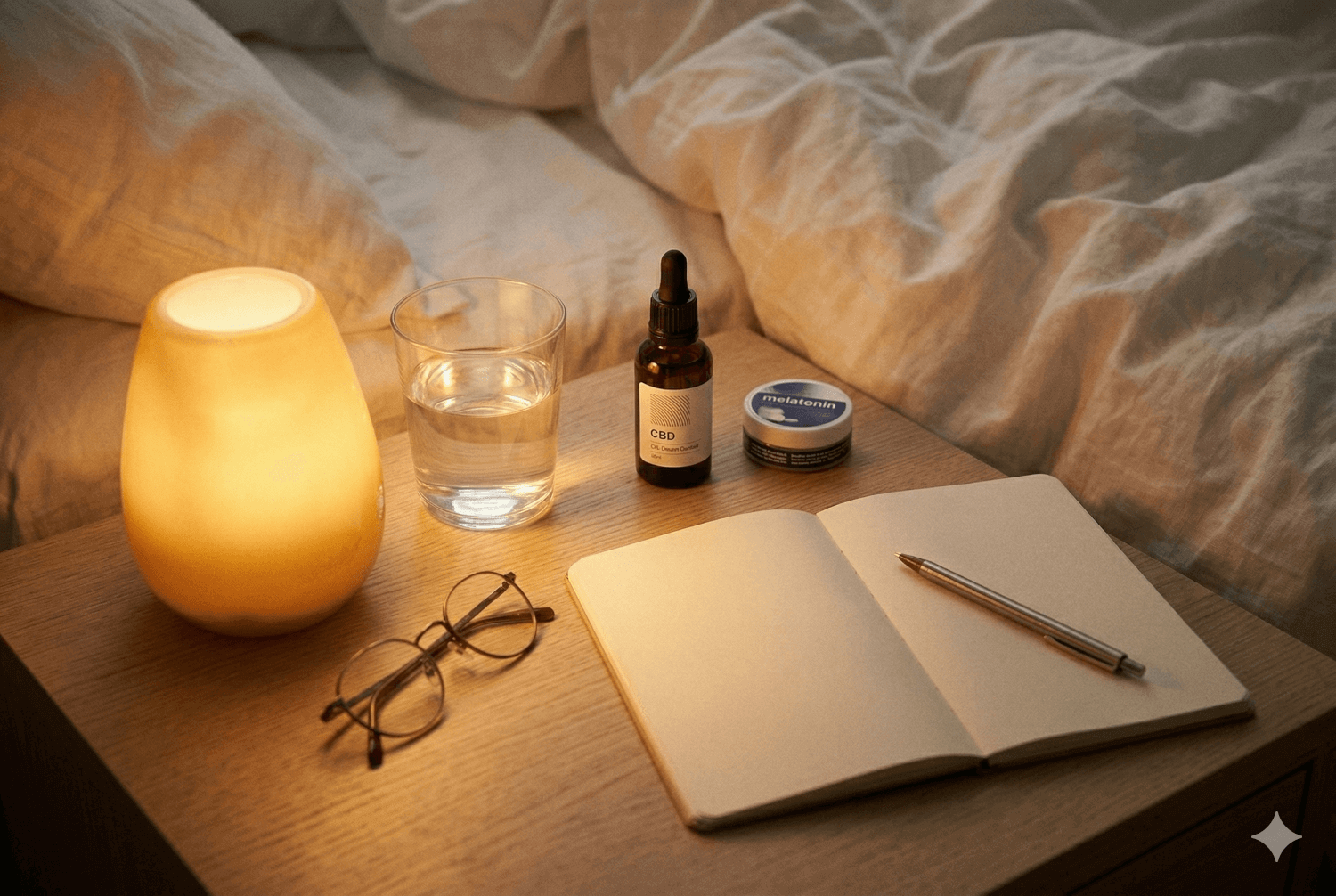
Two of the world’s most popular sleep supplements. Millions of people already combine them. But until now, nobody had rigorously mapped what happens inside your body when you do. New science finally has answers – and they matter.
The Sleep Supplement Aisle Has a Blind Spot
Americans spent over $825 million on melatonin in 2023 alone, making it one of the most purchased supplements in the country. CBD sales have surged past $5 billion annually. And a significant – and growing – number of consumers use both, often stacking them in the same nightly routine with the intuitive logic that two natural sleep aids must be better than one.
That intuition may be correct. But the science of how they interact has lagged dangerously behind consumer behavior. People have been combining these two compounds for years based on anecdotal experience and marketing copy, with almost no rigorous pharmacokinetic data to guide them on dose, timing, or the direction of their interaction.
A new study published in Pharmaceuticals (2026) fills that gap – and the findings are more nuanced, more actionable, and more important than most people in the wellness space have appreciated.
What Is Pharmacokinetics, and Why Does It Matter?
Before diving into the findings, it helps to understand what pharmacokinetics actually means – because it’s the lens through which this entire study operates.
Pharmacokinetics is the study of how the body processes a drug or supplement: how it’s absorbed, how it’s distributed through tissues, how it’s metabolized (broken down), and how it’s eliminated. When two compounds are taken together, they can influence each other’s pharmacokinetics – changing how much of each compound reaches the bloodstream, how long it stays active, and how quickly it clears the body.
These interactions happen whether you know about them or not. Taking two compounds that influence each other’s metabolism without understanding the interaction is a bit like mixing two ingredients in a recipe without knowing how they react to heat – you might get something wonderful, or you might get something unexpected. The new research from Zheng, Wang, Zhang, and colleagues gives us, for the first time, a detailed recipe.
The Two Mechanisms at the Center of This Study
The research team focused specifically on two biological mechanisms through which CBD influences melatonin pharmacokinetics:
PEPT1 – The Transporter Protein
PEPT1 is a peptide transporter expressed in the intestinal wall that plays a role in absorbing certain compounds from the gut into the bloodstream. CBD has been identified as a modulator of PEPT1 activity, which means it can influence how efficiently melatonin is absorbed after oral ingestion. In practical terms, CBD’s effect on PEPT1 can change how much melatonin actually makes it into your bloodstream – and therefore how effective your melatonin dose actually is.
CYP1A2 – The Metabolizing Enzyme
CYP1A2 is a liver enzyme responsible for metabolizing melatonin – breaking it down and clearing it from the body. CBD inhibits CYP1A2 activity, which means that when CBD is present in the system, the liver clears melatonin more slowly. The result: melatonin stays in the bloodstream longer and at higher concentrations than it would without CBD.
This is an important interaction. If you take your usual melatonin dose alongside CBD without accounting for this interaction, you may be effectively getting a higher melatonin dose than you intended – which can influence the quality of your sleep, how you feel in the morning, and how your body’s natural melatonin rhythm adjusts over time.
The Bidirectional Nature of the Interaction
The word “bidirectional” in the study’s title is key. The interaction doesn’t run in just one direction.
CBD influences melatonin metabolism – but melatonin also influences the pathways through which CBD is processed. The researchers used quantitative modeling to project how this mutual influence plays out at different dose combinations, finding that the relationship is not linear. Small changes in dose can produce disproportionate changes in the pharmacokinetic outcome.
This bidirectionality helps explain something many CBD users have noticed anecdotally: the combination of CBD and melatonin can feel noticeably different from either supplement taken alone, and the subjective experience can vary significantly depending on the doses used and how close together they are taken. The new research provides the mechanistic explanation for that variability.
The Synergistic Potential – And Why Calibration Matters
The researchers specifically note that the combination of melatonin and CBD may exert synergistic effects on improving sleep – meaning the two compounds together may produce greater benefits than either does alone, not just additive ones.
The biological rationale for this synergy is compelling. Melatonin’s primary role is signaling the brain’s circadian timing system that it is time to sleep – it works on the sleep-wake cycle at the chronobiological level. CBD, by contrast, appears to work primarily on the anxiety, stress, and physiological arousal that prevent many people from falling asleep even when they are tired and even when their melatonin levels are adequate.
These are complementary mechanisms. Melatonin tells the body when to sleep. CBD may help remove the physiological and psychological obstacles that prevent sleep from happening. Together – when properly calibrated – they may address both the timing and the quality dimensions of sleep simultaneously.
The operative phrase, however, is “properly calibrated.” Because CBD slows melatonin’s clearance, using both compounds together without adjusting doses accordingly may lead to higher-than-intended melatonin exposure – potentially causing excessive drowsiness, next-morning grogginess, or disruption of the natural melatonin rhythm over time.
The Insomnia-Cardiovascular Connection
One finding from this study that deserves particular attention is the researchers’ explicit framing of chronic insomnia as a cardiovascular health issue.
The paper notes that chronic insomnia is associated with elevated cardiovascular disease risk – a finding that connects directly to the growing body of research on CBD and heart health. Poor sleep drives elevated cortisol, increased inflammatory markers, disrupted glucose metabolism, and elevated blood pressure – all established cardiovascular risk factors.
This means that optimizing sleep isn’t just about feeling rested. It is a genuine long-term cardiovascular health strategy. CBD’s dual potential to improve sleep quality and support cardiovascular function – as highlighted in the Mayo Clinic review also covered this week – makes the CBD-melatonin combination research part of a larger, interconnected picture of whole-body wellness.
What This Means for the CBD + Melatonin Market
From a product development perspective, this research has immediate implications. The traditional approach to CBD-melatonin combination products has been to simply combine standard doses of both ingredients in a single gummy or capsule without pharmacokinetic modeling to guide the formulation.
The new research suggests that thoughtful formulation – one that accounts for CBD’s slowing of melatonin clearance – could produce better outcomes than naive combination, meaningfully. A product that delivers, say, 2mg of melatonin alongside a calibrated CBD dose that effectively extends its duration may outperform a product that delivers 5mg of melatonin without CBD – while also reducing the risk of next-morning grogginess from melatonin overshoot.
This is the kind of precision that separates scientifically grounded product development from marketing-driven supplement stacking.
Practical Takeaways
Understanding the pharmacokinetics of CBD and melatonin together translates into several concrete, actionable insights for your sleep routine:
- If you currently take melatonin and are adding CBD, consider reducing your melatonin dose initially – CBD’s inhibition of CYP1A2 means your existing melatonin dose will be effectively amplified
- Start with lower doses of both when first combining them and observe your response over 1–2 weeks before adjusting
- Timing matters – taking CBD 30–45 minutes before melatonin may allow CBD’s anxiolytic effects to begin working before melatonin’s sleep signal arrives, potentially improving the quality of sleep onset
- Morning grogginess is often a sign of too much melatonin – if you experience this after starting CBD, reducing your melatonin dose is a logical first step
- Look for combination products from reputable manufacturers who formulate with this pharmacokinetic interaction in mind, rather than simply combining arbitrary doses of both
- Consistency matters – the most reliable sleep benefits from CBD appear to build over time with daily use rather than occasional supplementation
About the Original Study
Title: Unraveling Cannabidiol’s Bidirectional Regulation of Melatonin Pharmacokinetics via PEPT1/CYP1A2: Mechanistic Insights and Quantitative Projections
Year: 2025 (published online December 30, 2025)
Journal: Pharmaceuticals (Basel), Vol. 19, No. 1, Article 80
DOI: 10.3390/ph19010080
PubMed: https://pubmed.ncbi.nlm.nih.gov/41599679/
PMC Full Text: https://pmc.ncbi.nlm.nih.gov/articles/PMC12845078/
Authors and Affiliations:
- Bohong Zheng — Academy of Military Medical Sciences, Beijing / State Key Laboratory of National Security Specially Needed Medicines, Beijing
- Mengran Wang — Academy of Military Medical Sciences, Beijing / State Key Laboratory of National Security Specially Needed Medicines / School of Pharmacy, North China University of Science and Technology, Tangshan[1]
- Qiannan Zhang — Academy of Military Medical Sciences, Beijing / State Key Laboratory of National Security Specially Needed Medicines
- Cong Li — Academy of Military Medical Sciences, Beijing / State Key Laboratory of National Security Specially Needed Medicines
- Lingchao Wang — Academy of Military Medical Sciences, Beijing / State Key Laboratory of National Security Specially Needed Medicines
- Wenpeng Zhang — Academy of Military Medical Sciences, Beijing / State Key Laboratory of National Security Specially Needed Medicines
- Chunyan Liu — School of Pharmacy, North China University of Science and Technology, Tangshan[1]
- Xiaomei Zhuang — Academy of Military Medical Sciences, Beijing / State Key Laboratory of National Security Specially Needed Medicines

Contributing Expert
Alan first discovered CBD while recovering from a sports injury, and he has been an advocate ever since. Over the years, he’s used CBD for sleep, skincare, easing anxiety, and even helping his family pet stay calm. With more than 20 years of experience running a marketing business, Alan now enjoys sharing scientific studies and personal experience with customers at Flourish + Live Well.