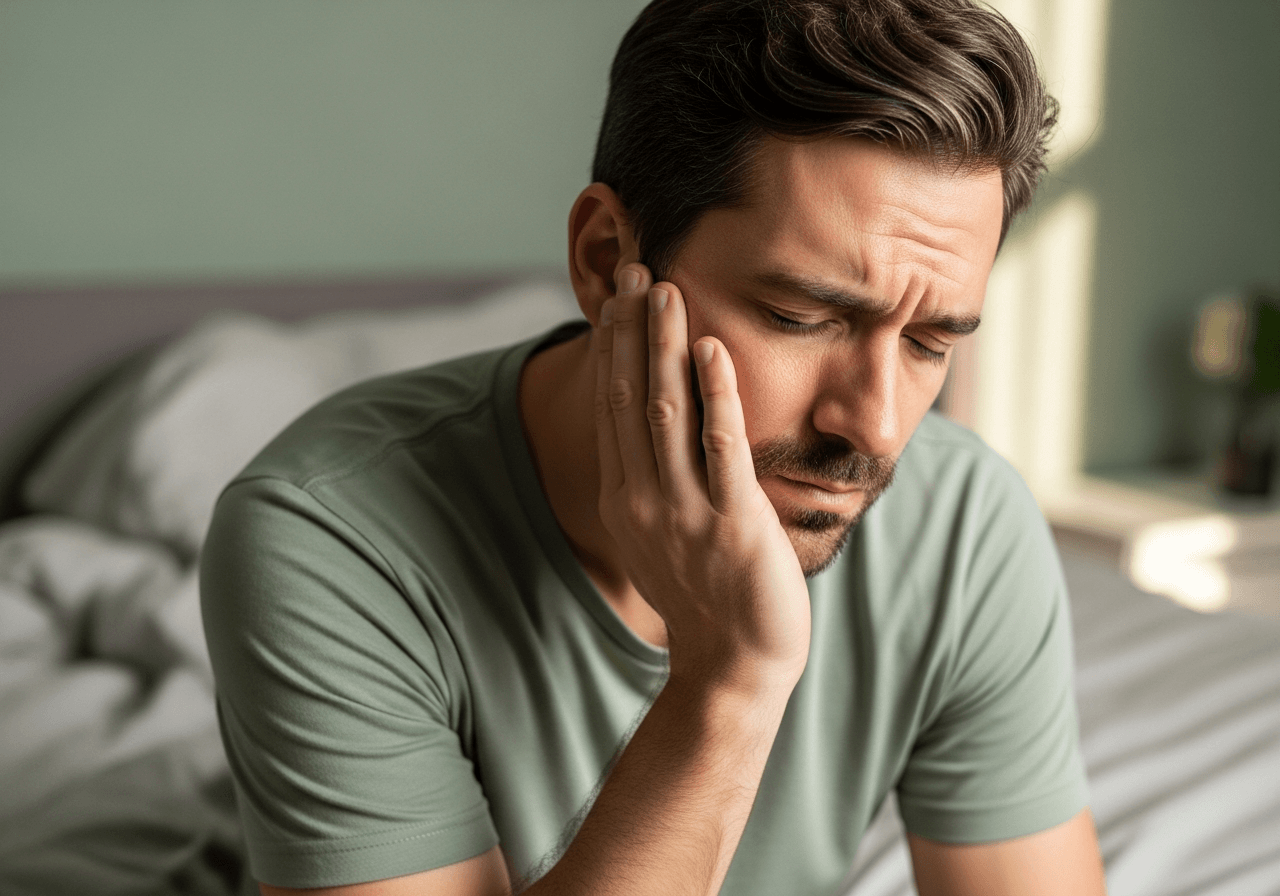
What happened to people’s sleep when CBD gel was applied to their jaw muscles before bed
Some tension you can feel. A tight shoulder announces itself. A sore back makes you change how you sit.
Then there is the tension that never reports in. The jaw is the clearest example. Many people spend the night clenching, wake with a headache they blame on stress or screens, and never connect the two.
A 2025 trial looked at that connection from an unusual direction. Rather than treating the headache or the sleep, the researchers treated the muscle, and then measured what happened to everything else.
Treating the Cause Instead of the Symptom
Jaw clenching and grinding, known clinically as bruxism, is not simply a dental problem. A muscle held under tension for hours produces pain, and pain fragments sleep. Fragmented sleep raises stress, and stress increases clenching.
That is a vicious cycle, and it is what makes the problem stubborn. Treat the headache, and the muscle keeps clenching. Treat the sleep, and the pain keeps interrupting it.
The researchers asked whether treating the muscle directly would ease the rest of the cycle.
What the Study Did
A team led by Karolina Walczyńska-Dragon at the Medical University of Silesia in Poland ran a randomized, double-blind trial in 60 people with temporomandibular disorders and bruxism. The average participant was in their early twenties, and 60% were women.
Participants were divided into three equal groups of twenty:
- A placebo gel with no CBD
- A 5% CBD gel, delivering about 25 mg per dose
- A 10% CBD gel, delivering about 50 mg per dose
Everyone applied 0.5 mL to the masseter muscles, the thick muscles at the angle of the jaw, every night for 30 days. Measurements were taken at the start, at day 14, and at day 30.
Double-blind means neither the participants nor the clinicians assessing them knew who had received which gel. That matters a great deal here because most of what was being measured, including sleep and headache, depends on what people report.
The researchers did not rely on reports alone. Alongside the questionnaires, they recorded electrical activity in the muscle itself using surface electromyography, which is an objective measurement that does not care what anyone believes about their treatment.
What the Study Found
Sleep quality improved substantially
Sleep was scored with the Pittsburgh Sleep Quality Index, where a higher number means worse sleep.
- The 10% CBD group went from a median of 12.0 at baseline to 7.0 at day 30 (p < 0.001 against control)
- The 5% CBD group went from 12.0 to 8.0 (p = 0.002)
- The placebo group started at 9.0 and finished at 9.0
The placebo group is the part worth pausing on. Over thirty days of applying a gel nightly and being assessed by a clinic, their sleep score did not move at all.
The muscle itself quietened down
This is the objective half of the result, and it is what separates this trial from a survey.
- The 10% group showed a 42.1% reduction in masseter muscle activity on electromyography
- Pain scores fell from 6.0 to 2.0 on a ten-point scale in the 10% group, and from 6.0 to 3.5 in the 5% group
- The placebo group moved from 6.0 to 5.5
Muscle activity is not a matter of opinion. Electrodes measured less electrical signal in the muscle, and the people attached to those muscles reported both less pain and better sleep.
Headache disability fell too
Migraine-related disability was scored with MIDAS, again on a scale where higher is worse.
- The 10% group fell from a median of 17.0 to 8.0 (p < 0.001)
- The 5% group fell from 15.0 to 10.0 (p = 0.01)
- The placebo group did not change
The authors noted that improvements in sleep and headache tracked alongside the reductions in muscle activity and pain, which is the pattern you would expect if the muscle really was the upstream problem.
More CBD was not better
The 10% gel used twice the CBD of the 5% gel, and on the two headline outcomes, the difference between them was not statistically significant: p = 0.602 for sleep, p = 0.185 for headache disability.
Doubling the dose did not double the benefit. That is worth remembering the next time a stronger product is presented as an obviously better one.
What Supporting Studies Add
This result did not appear out of nowhere. The same line of research has been building for several years.
A 2019 randomized double-blind trial in the Journal of Clinical Medicine tested transdermal CBD applied over the masseter muscle in patients with myofascial pain and found reduced muscle activity and improved muscle condition. That study established the myorelaxant effect this newer work builds on.
A 2024 randomized double-blind trial, also in the Journal of Clinical Medicine, examined CBD for muscular tension, pain, and sleep bruxism intensity, and reported reductions in bruxism activity alongside the reductions in pain.
Different research teams, different years, different outcome measures. The direction of the finding has stayed consistent: CBD applied over a chronically tense muscle reduces measured activity in that muscle.
What the Study Didn’t Prove
The authors are unusually clear about the limits of their own work, and those limits are worth passing along.
Thirty days is not a long time. Whether the benefit holds at three months or a year is genuinely unknown.
Sleep was measured by questionnaire, not in a sleep lab. The PSQI is validated and widely used, but it is a self-report. The authors say plainly that future work should use polysomnography or actigraphy. The muscle data is objective; the sleep data is not.
No corrections were applied for multiple comparisons. The study tested a number of outcomes at once without adjusting the statistics for that, which raises the chance that at least one result is a false positive.
Sixty people across three groups is twenty per group. The authors acknowledge that their initial sample size calculation was too small, though they report the study was adequately powered on later analysis.
Absorption was never measured. No pharmacokinetic testing was done, so how much CBD entered the body, if any meaningful amount did, remains unquantified.
The participants were young. With a mean age of roughly 24, this tells us little about how a fifty-year-old with decades of clenching would respond.
One Important Detail About How It Was Used
This deserves its own section because it is the easiest thing to get wrong.
The gel in this trial was applied intraorally, inside the mouth, directly against the masseter muscle. That is a clinical application under supervision, using a product formulated for it.
It is not what a topical CBD cream is for. Body creams, balms, and roll-ons are made for external use on skin, and nothing in this study suggests putting any of them in your mouth. Do not do that.
What the study demonstrates is a principle rather than a protocol: CBD applied topically over a muscle that stays tense overnight reduced measurable activity in that muscle, and the people it was applied to slept better. Whether the same holds for a shoulder, a neck, or a lower back treated with an external cream is a reasonable question that this trial did not answer.
What This Means for You
Tension you cannot feel still costs you sleep. The participants here were not lying awake, aware of their jaws. The clenching was happening below the level of noticing, and it was still showing up in their sleep scores and their headaches.
Where you apply a topical matters more than how much you use. The strongest signal in this study was location, applied directly over the muscle that was the problem, rather than concentration. The 5% gel performed about as well as the 10%.
Timing is part of it. This was a nightly routine for thirty days, not an occasional application. The measurements at day 14 sat roughly halfway between the start and day 30, which suggests the benefit accumulated rather than arriving at once.
A headache in the morning is worth tracing backwards. If you wake with head or jaw pain and poor sleep, the loop this study describes is at least worth considering, and it is worth raising with a dentist, who can look for the wear patterns that confirm clenching.
About the Original Study
Title: Expanding the Therapeutic Profile of Topical Cannabidiol in Temporomandibular Disorders: Effects on Sleep Quality and Migraine Disability in Patients with Bruxism-Associated Muscle Pain
Published: Pharmaceuticals (Basel), 2025; 18(7):1064
Authors:
- Karolina Walczyńska-Dragon, Department of Temporomandibular Disorders, Medical University of Silesia, Zabrze, Poland
- Jakub Fiegler-Rudol, Medical University of Silesia, Zabrze, Poland
- Stefan Baron, Department of Temporomandibular Disorders, Medical University of Silesia, Zabrze, Poland
- Aleksandra Nitecka-Buchta, Department of Temporomandibular Disorders, Medical University of Silesia, Zabrze, Poland
Link: https://pmc.ncbi.nlm.nih.gov/articles/PMC12300357/ (DOI: 10.3390/ph18071064)

Contributing Expert
Alan first discovered CBD while recovering from a sports injury — and he’s been an advocate ever since. Over the years, he’s used CBD for sleep, skincare, easing anxiety, and even helping his family pet stay calm. With more than 20 years of experience running a marketing business, Alan now enjoys sharing scientific studies and personal experience with customers at Flourish + Live Well.