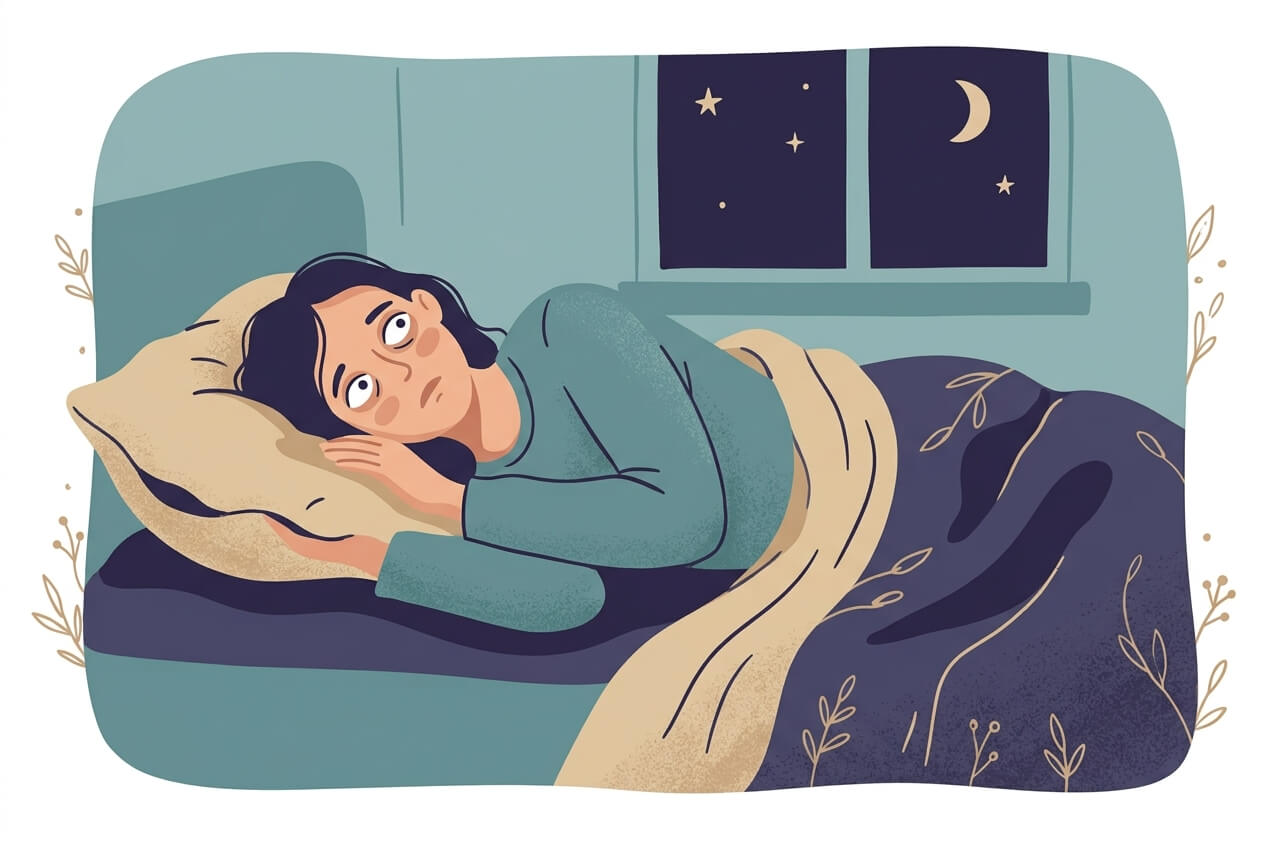
What 55 hospital staff reported during a four-week CBD-coated pillow-cover study
Study summary: Most CBD sleep studies test capsules, oils, or other products taken by mouth. Researchers in Taiwan tried something different: a pillow cover made with CBD-coated fabric.
Participants reported better sleep and lower anxiety by the end of the study, but wrist trackers found no statistically significant change in sleep duration or structure.
What the study did
Researchers at China Medical University in Taichung recruited 55 members of hospital staff, all of whom were sleeping badly before the study started. Forty-five were women, ten were men, and most were between 21 and 40 years old. Ten were already taking sleeping medication.
The study lasted four weeks: one baseline week, two intervention weeks, and one follow-up week in which participants continued using the covers.
The researchers measured sleep in two ways:
- What people reported, using the Pittsburgh Sleep Quality Index, a standard questionnaire where a score of 5 or higher means poor sleep
- What a device recorded, using a Fitbit Charge 3 worn on the wrist to track sleep stages
- Mood and daytime sleepiness, using the Hospital Anxiety and Depression Scale and the Epworth Sleepiness Scale
Who was in the study
The group was mostly young and female. About 58% worked fixed day shifts, and roughly 22% rotated between shifts. In the later subgroup analysis, participants on fixed night shifts had a larger improvement in questionnaire scores than those on fixed day shifts. Ten participants were taking sleep medication, and fifteen exercised regularly.
At the start, the group averaged about six hours of sleep a night, with 48% of that time in light sleep and about 16% in deep sleep. Everyone scored 5 or higher on the sleep questionnaire, which is the threshold for poor sleep.
Key finding: better questionnaire scores, but little change on the tracker
The group’s median sleep questionnaire score fell from 9.0 to 7.0 (p < 0.001), which indicates an improvement in reported sleep quality. Anxiety scores also decreased (p < 0.005), while drowsiness and depression scores improved as well.
The Fitbit data told a different story:
- Light sleep rose from about 196 minutes to 207 minutes a night, which was not statistically significant (p = 0.337)
- Deep sleep rose from about 62 minutes to 64 minutes, also not significant (p = 0.288)
- Total sleep time barely moved, from about 362 minutes to 365 minutes
- Four participants (7.3%) crossed from poor sleep into the good sleep range, a change the researchers themselves report as not statistically significant (p = 0.091)
Participants reported better sleep and less anxiety, but the tracker did not record statistically significant changes in sleep duration or structure. Because the study had no control group, neither result shows that the pillow cover caused the changes.
Why the researchers tested a CBD-coated pillow cover
The researchers proposed skin contact as a possible way CBD might have an effect without being swallowed or inhaled. They noted that skin contains endocannabinoid receptors and tested whether overnight contact with the coated fabric was associated with measurable changes. The study did not measure CBD absorption, so it cannot show whether any CBD entered the body.
A pillow cover would also be easy to use because it does not require anyone to remember a nightly capsule. The study did not compare adherence with another product, however, and it did not establish that the cover itself worked. Those questions need a controlled trial.
Who improved most
The researchers also looked for characteristics associated with greater changes. Three associations reached statistical significance:
- Men improved more than women on the sleep questionnaire, by about 2.2 points
- People on fixed night shifts improved more than those on fixed day shifts
- Participants already taking sleep medication showed a decrease in the percentage of light sleep
Exercise habits were not a significant predictor in the regression models.
These results came from small subgroups within a small study. They may help researchers decide what to examine in a larger trial, but they should not be treated as evidence that the cover works better for any one group.
What the study did not prove
The study did not show that CBD crossed the skin. The researchers took no blood samples, and the paper does not report how much CBD was on the fabric.
The study did not show that the pillow cover caused the changes. There was no control group, so expectation, repeated questionnaires, or other changes over the four weeks could have affected the reported scores.
The tracker did not record statistically significant changes in sleep duration or structure. Total sleep time increased by about three minutes, deep sleep by about two minutes, and light sleep by about eleven minutes.
The study ended after a one-week follow-up during which participants continued using the covers. It cannot tell us whether the reported changes lasted after participants stopped using them.
What a placebo-controlled oral CBD study found
Oral CBD, 50 mg a day (2023, Nutrients): A separate trial at the University of Northern Colorado randomly assigned 28 healthy young adults to take either a 50 mg CBD capsule or a matched placebo daily for eight weeks.
- Sleep quality measured by questionnaire improved significantly in the CBD group (p = 0.0023)
- Natural killer cell function, an immune measure, also improved (p = 0.0125)
- Sleep quantity did not change, and neither did the mental health measures
In the oral CBD trial, participants who took CBD reported a larger improvement in sleep quality than the placebo group, but their sleep quantity did not change significantly. The pillow-cover study also found better questionnaire scores without a significant change in tracker measurements. The studies used different products, measures, and designs, so the similar pattern does not establish that the pillow cover delivered CBD or caused the reported improvement.
The oral trial included a placebo group; the pillow-cover study did not. That makes the oral trial better suited to testing whether CBD caused the reported change, but it cannot validate a different product or method of use.
What the studies tell us
The safety picture
The pillow-cover study reported no adverse events. In the oral trial, 50 mg of CBD daily did not produce significant changes in body weight, body mass index, or body fat over eight weeks. Neither small study can establish broad safety, and CBD can interact with some medications. Anyone taking medication should check with a pharmacist or doctor before using CBD.
What the study says about the endocannabinoid system
The authors proposed that CBD might interact with endocannabinoid receptors in the skin. The study did not measure absorption and did not report the amount of CBD on the fabric, so this remains a proposed explanation rather than a demonstrated mechanism.
Anxiety and sleep
Anxiety scores decreased during the pillow-cover study (p < 0.005), but the sleep questionnaire showed stronger statistical evidence (p < 0.001). Without a control group, the study cannot show that the pillow cover caused either change or that one change led to the other.
Participants reported better sleep, but the tracker did not show significantly longer or differently structured sleep. The study cannot determine whether the questionnaire captured a change the tracker missed, an expectation effect, or something else.
Study limitations
- There was no control group. Nobody slept on an ordinary pillow cover for comparison, so some of the improvement could come from expectation or from simply paying attention to sleep for a month.
- The pillow covers were supplied by their manufacturer, and one of the paper’s authors works for that company. The researchers disclose this.
- The dose is unknown. The paper does not state how much CBD was on the fabric or how much reached the skin.
- The participants were hospital staff in Taiwan, most of them women in their twenties and thirties. Sleep problems in that group may not look like yours.
- The two measurement methods disagreed, and that disagreement is the finding, not a flaw to explain away.
Most CBD sleep research has studied products taken by mouth. This pilot tested a coated fabric, but its design cannot tell us whether CBD was absorbed or caused the reported changes. A controlled trial that measures dose and absorption would be needed to answer those questions.
About the original study
Title: Pilot Study on the Effect of Cannabidiol-Coated Fabric for Pillow Covers Improves the Sleep Quality of Shift Nurses
Published: March 2025, Healthcare (Basel)
Authors:
- Mashita Afzal, Graduate Institute of Biomedical Sciences, School of Medicine, China Medical University, Taichung, Taiwan
- Chieh-Liang Huang, TsaoTun Psychiatric Center, Nantou, Taiwan
- Shih-Hao Huang, SONG BEAM International Co., Ltd., Taichung, Taiwan
- Chia-Ing Li, Graduate Institute of Biomedical Sciences, School of Medicine, China Medical University, Taichung, Taiwan
- Wen-Chun Liao, School of Nursing, China Medical University, Taichung, Taiwan
- Juan-Cheng Yang, Department of Medical Research, China Medical University Hospital, Taichung, Taiwan
- Wen-Lung Ma, Graduate Institute of Biomedical Sciences, School of Medicine, China Medical University, Taichung, Taiwan
Link: https://doi.org/10.3390/healthcare13060585
Supporting study: Kisiolek JN, Flores VA, Ramani A, Butler B, Haughian JM, Stewart LK. Eight Weeks of Daily Cannabidiol Supplementation Improves Sleep Quality and Immune Cell Cytotoxicity. Nutrients 2023;15(19):4173. https://doi.org/10.3390/nu15194173

Contributing Expert
Alan first discovered CBD while recovering from a sports injury, and he has been an advocate ever since. Over the years, he’s used CBD for sleep, skincare, easing anxiety, and even helping his family pet stay calm. With more than 20 years of experience running a marketing business, Alan now enjoys sharing scientific studies and personal experience with customers at Flourish + Live Well.