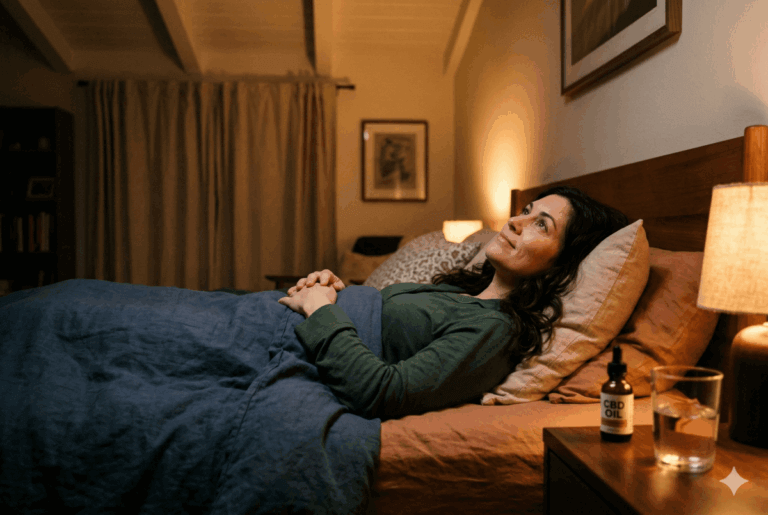
For the chronic worrier, bedtime can feel like an unwanted invitation to your own personal replay reel. A new clinical study — the most rigorous of its kind — explores whether CBD can change that.
When Your Brain Refuses to Clock Out
You’re exhausted. You’ve been going all day. You climb into bed, close your eyes — and then it starts. The mental replays. The anticipatory anxiety about tomorrow. The vague, low-grade sense that something has been forgotten or said wrong. For people who are chronic worriers, the transition from wakefulness to sleep isn’t a gentle glide. It’s a negotiation.
Sleep scientists have a name for this tendency: high trait worry. It’s not just stress about a specific situation — it’s a personality characteristic, a persistent mode of thinking that stays elevated even when there’s nothing urgent to worry about. And among people who have it, sleep disturbances are one of the most common and disruptive outcomes.
That’s why a new clinical study published in 2026 stands out. For the first time, researchers specifically targeted this population — high trait worriers — to test whether cannabidiol (CBD) could help them sleep better.[1]
What Is CBD, and Why Does It Matter for Sleep?
CBD, short for cannabidiol, is a non-intoxicating compound derived from the hemp plant. Unlike THC — the component of cannabis associated with the “high” — CBD does not alter your state of consciousness or impair cognitive function. It interacts with the body’s endocannabinoid system (ECS), a network of receptors involved in regulating mood, stress response, pain, immune function, and yes — sleep.[2]
The endocannabinoid system plays a direct role in the sleep-wake cycle. Cannabinoid receptors in the brain influence the transition between sleep stages, and research suggests that CBD may help support more restorative sleep by reducing the anxiety and physiological arousal that keep so many people awake.[2]
Despite a wave of consumer interest in CBD for sleep, the actual clinical research has lagged behind. Most early studies were small, observational, or not designed specifically for people whose primary sleep obstacle is anxious, worry-driven thinking. That’s exactly the gap the University of Arkansas research team set out to fill.[1]
The Study: Gold-Standard Science Meets Everyday Struggle
The research was conducted by a team of psychologists at the Department of Psychological Sciences, University of Arkansas, and published in Experimental and Clinical Psychopharmacology in 2026.[1]
This was a double-blind, randomized, placebo-controlled trial — the same rigorous design standard used in pharmaceutical drug research. Neither the participants nor the researchers knew who was receiving CBD and who was receiving a placebo during the study period. This controls for the powerful “expectation effect” that can skew results when people know what they’re taking.
The study focused specifically on participants identified as high trait worriers — individuals who score highly on validated psychological measures of chronic, difficult-to-control worry. These are people for whom worry isn’t a temporary response to a stressful week. It’s a baseline.[1]
CBD, described in the study as “a nonintoxicating molecule derived from the cannabis plant,” was evaluated for its potential to improve sleep-related outcomes in this specific, underserved group.[10]
This kind of targeted, population-specific research design is considered a significant step forward in cannabinoid science, because it stops treating sleep problems as monolithic and starts asking: who struggles with sleep, why do they struggle, and what kind of help might actually work for them?
What the Growing Evidence Tells Us
While the full peer-reviewed data from the Gournay et al. study continues to be reviewed in the scientific community, it fits into a growing body of clinical evidence pointing toward CBD’s potential for sleep support — particularly in people whose sleep is disturbed by anxiety and worry.
A 2025 randomized crossover trial published in the Journal of Clinical Sleep Medicine found that a CBD-terpene combination significantly increased the proportion of time participants spent in slow-wave and REM sleep compared to placebo — the deepest and most restorative sleep stages.[5]
Another controlled trial showed that nightly supplementation of 150mg of CBD was associated with greater well-being and superior objective sleep efficiency after two weeks compared to a placebo group.[11]
A comprehensive scoping review published in 2025 found that at least 60% of individuals with anxiety disorders report sleep disturbances, suggesting the connection between worry and wakefulness is not coincidental — it’s physiological. That makes the Gournay team’s decision to focus on high trait worriers not just logical, but strategically important for future research and product development.[2]
Why This Research Matters for You
If you’re someone who lies awake running mental loops, you already know that standard sleep advice — cut the caffeine, dim the lights, avoid screens — only goes so far. The noise isn’t in the room. It’s in your head.
The research emerging from clinical trials like this one suggests that CBD may work on the underlying physiological drivers of worry-related sleeplessness, rather than simply sedating the body the way conventional sleep aids do. That’s a meaningful distinction.
Here are a few things the research consistently supports:
- Consistency matters. CBD appears to work best as part of a nightly routine, not occasional use. The endocannabinoid system responds to sustained interaction.
- Timing is key. Most clinical protocols involve taking CBD 30 to 60 minutes before bed, giving the compound time to be absorbed and reach relevant receptors.
- Dose matters. Research studies have used doses ranging from 150mg to 300mg for sleep-related applications. Many consumer products start lower — it’s worth discussing your specific needs with a healthcare provider.
- Worry is the signal. If anxiety or overthinking is your primary sleep disruptor, the science suggests that CBD’s anxiolytic (anxiety-reducing) properties may be the mechanism through which it supports better sleep.[2]
Daylight Saving Time: The Annual Sleep Disruption Nobody Asks For
There’s never a bad time to be intentional about your sleep. But this week has a particular urgency: Daylight Saving Time begins Sunday, March 8 — meaning most Americans will lose a full hour of sleep this weekend. Research consistently shows that even a one-hour shift in sleep timing can disturb circadian rhythms for days. Heart attacks and traffic accidents both spike in the days following the spring clock change.
If there was ever a moment to take your sleep routine seriously, this is it. CBD’s ability to support relaxation and ease the transition into sleep makes it worth considering as part of your DST adjustment plan.
Practical Takeaways
Whether you’re a chronic worrier, a light sleeper, or simply someone who wants to make the most of every night’s rest, here’s what to keep in mind:
- Start with a quality full-spectrum CBD oil — products that contain a range of cannabinoids and terpenes alongside CBD may offer broader benefits than isolated CBD alone
- Track your experience — keep a simple sleep journal for 2 to 4 weeks when starting CBD to identify patterns
- Give it time — unlike pharmaceutical sleep aids, CBD isn’t a one-dose knockout. Its benefits build with consistency
- Talk to your doctor — CBD can interact with certain medications, particularly blood thinners and some antidepressants
About the Original Study
Title: The effects of cannabidiol on sleep disturbances within a sample of high trait worriers: A double-blind, randomized placebo-controlled trial
Year: 2026
Journal: Experimental and Clinical Psychopharmacology
DOI: 10.1037/pha0000832
PubMed: https://pubmed.ncbi.nlm.nih.gov/41678223/
Authors — All affiliated with the Department of Psychological Sciences, University of Arkansas:
- L. Riley Gournay — PhD, Experimental Psychology (University of Arkansas). Lead researcher with 4+ years of clinical science experience investigating the psychiatric effects of cannabinoids. Has served as trial lead on 6 double-blind, randomized, placebo-controlled trials.[8]
- Morgan L. Ferretti — PhD Student, University of Arkansas. Research focus: cannabinoid science, substance use, health behavior change.[4]
- Harrison B. Dickens — Doctoral Student in Clinical Psychology, University of Arkansas.[9]
- Veronica Floyd — Graduate researcher, University of Arkansas Department of Psychological Sciences.[12]
- Daniella A. Fernandez — Graduate researcher, University of Arkansas Department of Psychological Sciences.[1]
- Ezri Rathbun — Graduate researcher, University of Arkansas Department of Psychological Sciences.[1]
- Anna-Marie Nguyen — Graduate researcher, University of Arkansas. Research includes the intersection of sleep and emotional health.[12]
- Ellen W. Leen-Feldner, Ph.D. — Senior author. Professor and Vice Chair, Department of Psychological Science, University of Arkansas. Director of the Arkansas Interdisciplinary Sciences (ArKIDS) Laboratory. Expert in experimental psychopathology, anxiety, and adolescent development.[6][7]
Contributing Expert
Alan first discovered CBD while recovering from a sports injury — and he’s been a believer ever since. Over the years, he’s used CBD for sleep, skincare, easing anxiety, and even helping his family pet stay calm. With more than 20 years of experience running a marketing business, Alan now enjoys sharing scientific studies and personal experience with customers at Flourish + Live Well.