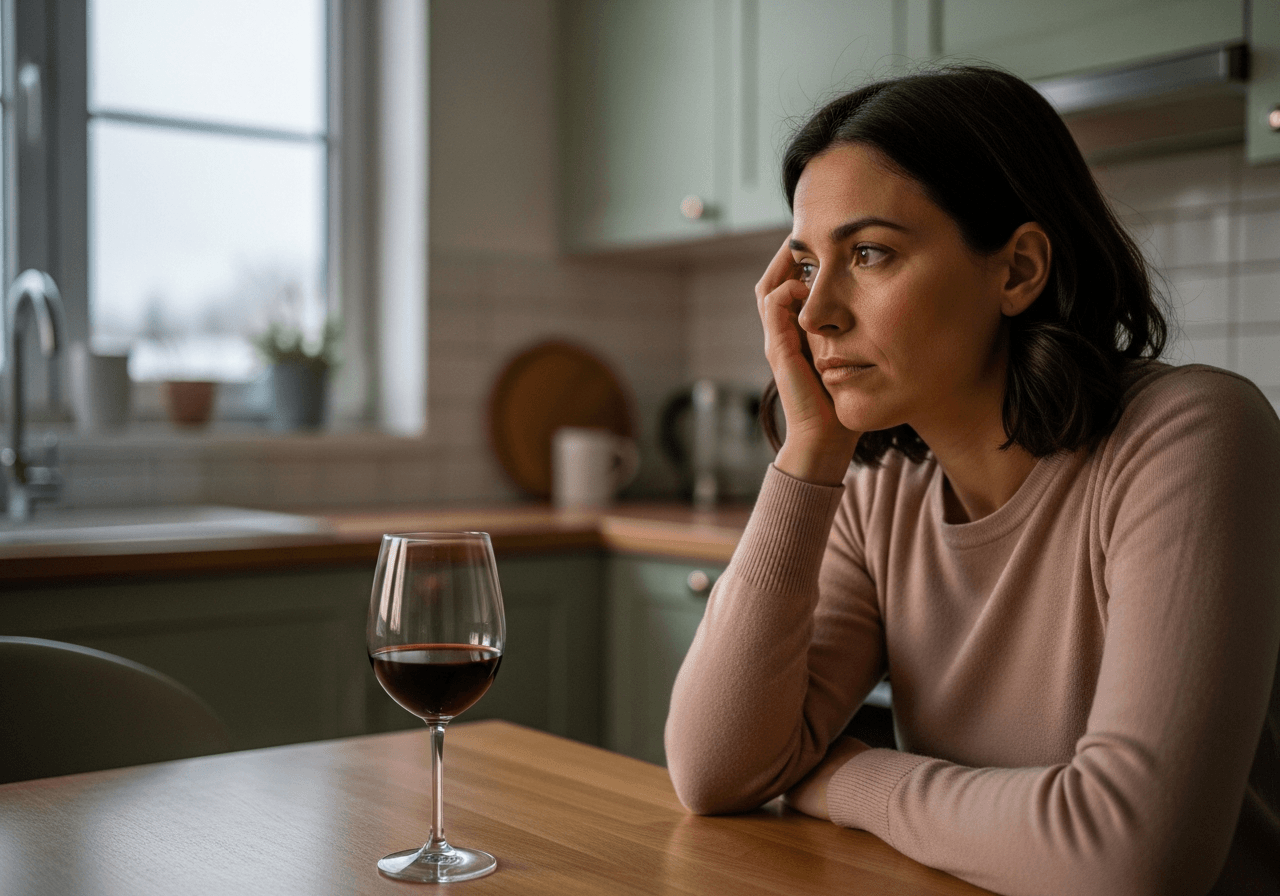
A lot of people carry a quiet thought they rarely say out loud: that they would probably be better off drinking a little less. Not a crisis, not rock bottom, just the sense that the two or three glasses most nights have become a habit that runs itself. Cutting back sounds simple until the end of a long day arrives and the pull toward a drink is stronger than the plan to skip it. That gap, between wanting to drink less and actually doing it, is where a 2025 clinical trial from the University of Colorado decided to look, and it asked a specific question: could a daily dose of CBD make that gap a little easier to cross?
The study was published in April 2025 in Frontiers in Psychiatry. It is small and the researchers are careful to call it preliminary, so nobody should read it as a finished answer. It is still worth understanding closely, because it measured something more interesting than whether CBD makes people feel calm. It measured whether CBD changed how much people craved alcohol and how well they held to their own limits.
Why Drinking Less Is Harder Than It Sounds
Alcohol is woven into daily life in a way that makes moderation genuinely difficult. The habit is social, it is tied to unwinding and reward, and the craving that shows up at the end of the day is a genuine signal in the brain, not a failure of willpower. Craving is the engine of the whole problem. It is the thing that turns “I’ll skip tonight” into “well, just one,” and it tends to get louder exactly when a person is tired or stressed and least equipped to argue with it.
This is why a compound that could soften craving, rather than just relax someone in the moment, would matter. Feeling calm is pleasant, but it does not necessarily change behavior. Wanting the drink less is a different kind of effect, and it is the one that actually helps a person hold to a plan.
What the Researchers Did
The trial enrolled 44 adults who met the criteria for alcohol use disorder and split them into three groups. Thirteen received full-spectrum CBD, fifteen received broad-spectrum CBD, and sixteen received a placebo. Full-spectrum means the extract keeps the natural range of hemp compounds, including a trace of THC; broad-spectrum has the THC removed. Each person took 150 mg of CBD a day for eight weeks, followed by a further eight weeks of monitoring, for sixteen weeks in total.
Everyone involved was blinded, so neither the participants nor the researchers scoring the results knew who was on which treatment until the study was over. That design is what separates a true signal from wishful thinking. The team tracked alcohol craving, how often people failed at their own attempts to control their drinking, standard AUD symptom scores, and safety markers including liver enzymes.
What They Found
The results split along a clear line, and the split is the most interesting part of the study.
The full-spectrum group improved on the measures that mattered. The people taking broad-spectrum or placebo mostly did not.
- Craving dropped. The full-spectrum group reported lower alcohol craving at week 8 and again at week 16 compared with placebo. The effect held after the active treatment period, not just during it.
- Control improved. From week 4 through week 16, the full-spectrum group had a greater reduction in failed attempts to control their drinking. In plain terms, when they set a limit, they were better able to keep it.
- Symptom scores fell. Scores on the AUDIT, a standard screening measure for alcohol problems, dropped significantly in the full-spectrum group relative to placebo by week 16.
- It was well tolerated. Both CBD formulations were safe across the study, with no serious adverse events and no changes in liver enzymes, which is a reasonable concern any time a supplement is taken daily alongside alcohol.
Broad-spectrum CBD, the version with the THC removed, produced little benefit on these measures. That contrast is the finding the researchers keep returning to, and it points somewhere specific.
The Full-Spectrum Wrinkle
Why would the full-spectrum extract work when the THC-free version mostly did not? The answer is that the study cannot say for certain, and the researchers do not claim to know the mechanism. The leading idea is what is sometimes called the entourage effect, the notion that hemp’s compounds work better together than any one of them does alone, and that the trace of THC and the other minor cannabinoids in full-spectrum extract contribute something the isolated CBD does not.
That trace of THC is also the catch worth stating plainly. Full-spectrum products contain a small amount of THC, under the legal limit but not zero, and that matters for anyone who is drug tested, pregnant, sensitive to THC, or simply prefers to avoid it. The study’s more encouraging results came from the formulation that carries that trace, so the benefit and the caveat are attached to the same bottle.
The Bigger Pattern Across Substances
The alcohol trial does not stand entirely on its own. CBD has been tested against another habit driven by craving, and that second result is worth putting beside it.
Cigarettes (2013, Addictive Behaviors): a pilot trial of 24 smokers given an inhaler to use whenever they felt the urge.
- The people using CBD cut the number of cigarettes they smoked by about 40% over one week, while the placebo group showed no change.
Two different habits, two different research teams, and a pattern that is genuine but less tidy than it first looks. The smoking trial used CBD on its own. The alcohol trial found a benefit only from the full-spectrum extract, with its trace of THC, while broad-spectrum CBD matched placebo. So this is not a simple case of CBD by itself easing every craving. What the results share is narrower and still worth noting: hemp-derived cannabinoids have shown a measurable signal against more than one hard-to-break habit, and the alcohol study is a reminder that in some cases the whole extract, not isolated CBD, appears to be what matters. None of these studies is large, and none of them proves CBD “cures” anything. Together they make the alcohol result look less like a fluke and more like part of a pattern worth studying properly.
The System Underneath
The reason one compound keeps showing up across alcohol and cigarettes comes down to the endocannabinoid system, a signaling network in the body that helps regulate stress, mood, reward, and the way the brain returns to balance. Craving and reward run partly through this system, which gives a plausible reason why a compound that works with it might dampen the urge for very different substances.
That system is not unique to people with a diagnosis. Everyone has one, and it is part of why the same research keeps drawing interest from people who would never consider themselves to have a drinking problem but who recognize the ordinary pull of a habit they would like to loosen.
What This Means for You
If you have ever wanted to drink a bit less and found the wanting harder than expected, the useful read here is measured rather than dramatic.
This was 44 people, and CBD was not a switch that turned off the desire for a drink. What it appeared to do, in the full-spectrum group, was soften the craving and make it a little easier to hold a limit. That is a meaningful kind of help, and it is also a modest one. It is best understood as possible support for a person’s own effort, not a substitute for it.
The safety data was reassuring, including no effect on liver enzymes over the study, which matters for anyone thinking about a daily supplement. Even so, alcohol and any daily supplement is a combination worth raising with a doctor, especially for anyone on other medication or drinking heavily, where cutting back has its own medical considerations. CBD is not a treatment for alcohol use disorder, and anyone whose drinking feels genuinely out of control deserves proper clinical support, not a supplement alone.
For the far larger group of people who simply want a quieter relationship with alcohol, the research is an early, encouraging signal that CBD may have a role, most likely as one small part of a broader effort that includes the ordinary work of habit change.
What the Study Didn’t Prove
The researchers are the first to list the limits, and those limits matter.
- The sample was small, only 44 people, and the full-spectrum group was just 13 of them.
- The dose was 150 mg a day, lower than several other CBD trials, so this is not the last word on how much is needed.
- Much of the drinking data was self-reported, which is never as clean as a lab measure.
- The clearer benefits came only from full-spectrum CBD, which carries a trace of THC, so the result does not transfer to THC-free products.
- This is a preliminary trial. The next step is a larger study that can confirm the effect, not a firm conclusion.
None of that cancels the encouraging part. In a properly blinded trial, a daily full-spectrum CBD dose was linked to less craving, better control over drinking, and lower symptom scores, with a clean safety record. For an early study of a hard problem, that is a result worth taking seriously and watching closely.
About the Original Study
Title: A preliminary randomized trial of the safety, tolerability, and clinical effects of hemp-derived cannabidiol in alcohol use disorder
Published: April 2025, Frontiers in Psychiatry
Authors:
- Raeghan L. Mueller: Researcher, Department of Psychiatry, University of Colorado Anschutz Medical Campus; cannabinoids and substance use
- L. Cinnamon Bidwell, PhD: Associate Professor, Psychology and Neuroscience, University of Colorado Boulder; cannabinoid clinical research
- Angela D. Bryan, PhD: Professor, Psychology and Neuroscience, University of Colorado Boulder; health behavior change
- Kent E. Hutchison, PhD: Professor of Psychiatry, University of Colorado Anschutz Medical Campus; addiction science, directs the CHAOS Lab
Link: Frontiers in Psychiatry (2025)
Contributing Expert
Alan first discovered CBD while recovering from a sports injury — and he’s been an advocate ever since. Over the years, he’s used CBD for sleep, skincare, easing anxiety, and even helping his family pet stay calm. With more than 20 years of experience running a marketing business, Alan now enjoys sharing scientific studies and personal experience with customers at Flourish + Live Well.