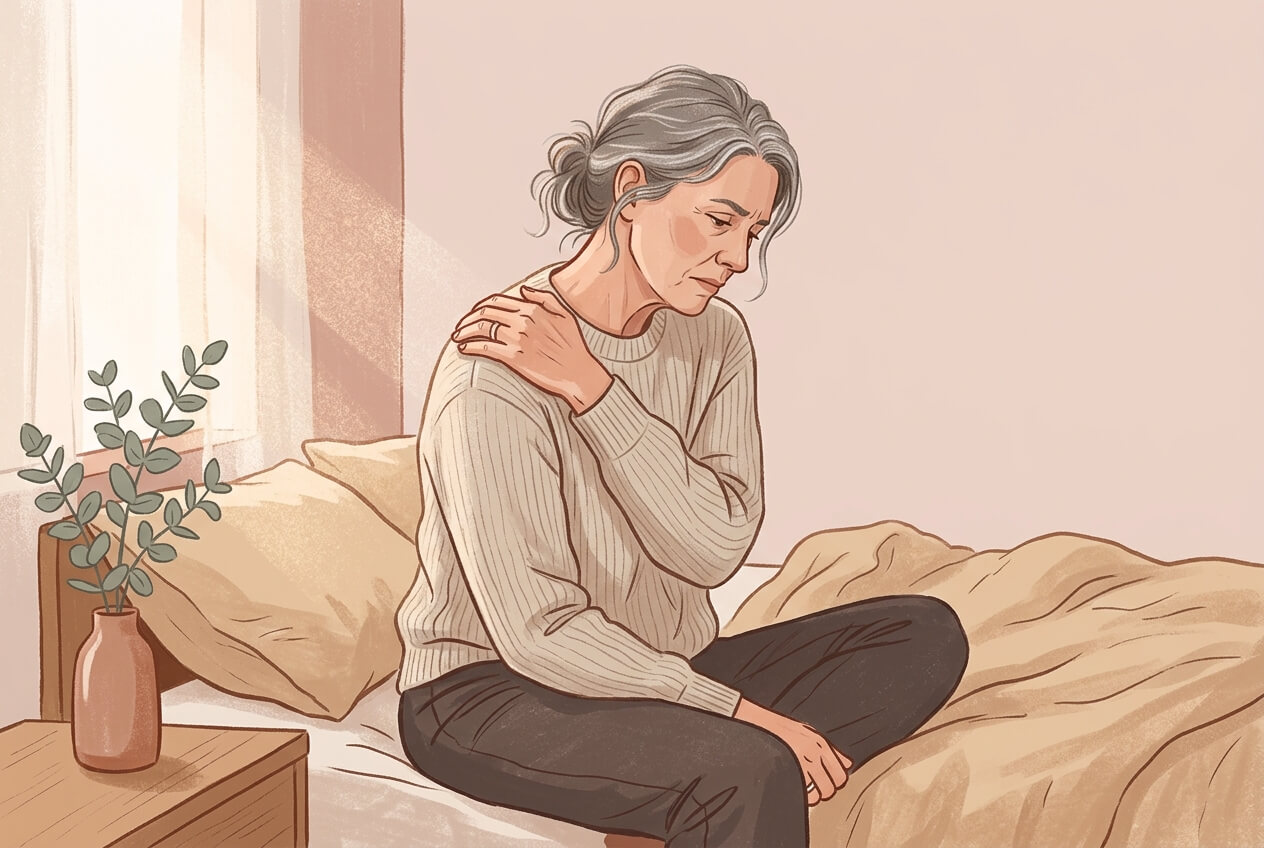
What Happened When Thirty Women Applied It Every Eight Hours for Twelve Weeks
Key finding: in a 12-week pilot study, thirty women with fibromyalgia applied a CBD-containing cream to one painful area every eight hours, and their pain in that area came down enough to matter clinically, with 60% clearing the threshold researchers use to separate a meaningful improvement from statistical noise. The part that makes this worth reading carefully is what did not change, and we will come to that.
September is Pain Awareness Month, which is as good a reason as any to look closely at a study on a condition that has frustrated researchers for decades. Fibromyalgia involves widespread pain, fatigue, and difficulty functioning, and the medications available for it work modestly at best and are often poorly tolerated. That gap is why topical approaches keep getting tested. A cream applied to one sore area is a smaller proposition than a drug taken daily for a whole-body condition, and it carries a correspondingly smaller set of risks, so it is a reasonable place for researchers to look.
What the researchers did
The study ran at Hospital Clínic de Barcelona and was published in July 2026 in Cannabis and Cannabinoid Research. Thirty women with fibromyalgia took part, all of whom also had clinically relevant localized pain from a musculoskeletal, neuropathic, or skin-related condition alongside the fibromyalgia itself.
Each participant applied a commercially available CBD-containing topical to a painful area, every eight hours, for twelve weeks. Measurements were taken at the start, at four weeks, and again at twelve.
Two design choices are worth flagging before the results, because they shape what the study can and cannot claim.
- There was no control group. This was a single-arm pilot, meaning everyone received the cream and there was nobody taking a placebo for comparison. The authors are direct about this and call their own findings exploratory and hypothesis-generating.
- The product was not pure CBD. It was a commercial formulation with multiple ingredients, so any effect cannot be attributed to CBD alone. The authors list this among the reasons to interpret the results cautiously.
How they measured it
Rather than relying on whether a number moved, the researchers used minimal clinically important difference thresholds, usually shortened to MCID. An MCID is the smallest change a patient would notice and describe as meaningful. It is a stricter and more useful test than statistical significance on its own, because a change can be statistically significant and still be too small for anyone to feel.
They also tracked the Widespread Pain Index and the Symptom Severity Scale, the two instruments used to assess fibromyalgia against the 2010 American College of Rheumatology criteria. Together those scores describe how much of the body is involved and how severe the accompanying symptoms are, which is why a change in them carries more weight than a change in a single pain rating.
The analysis itself was built for a small sample. The researchers used nonparametric repeated-measures methods and Monte Carlo resampling, which are the appropriate tools when you have thirty people rather than three hundred and cannot assume the data are neatly distributed. That choice is a point in the study’s favour, whatever its other limits.
What they found
- Localized pain dropped significantly by week four and stayed down through week twelve, with 60% of participants reaching the MCID threshold.
- Functional capacity improved significantly, and 50% of participants exceeded the MCID for function by four weeks.
- Widespread Pain Index and Symptom Severity Scale scores fell progressively, and by twelve weeks a smaller proportion of participants met the 2010 ACR diagnostic criteria for fibromyalgia.
- Every participant reported full adherence to the eight-hour schedule at both follow-up visits, which is unusual and says something about how manageable the routine was.
- No adverse events or side effects were reported by anyone, across twelve weeks of three-times-daily application.
The result that did not arrive
Generalized pain, fatigue, anxiety, and depression showed no significant change. The benefit stayed where the cream was applied.
We find that more interesting than the headline number. A treatment that improved everything at once, in a study with no control group, would raise the obvious question of whether participants were simply feeling better because they were being looked after and expected to improve. A benefit that appears in the treated area and nowhere else fits less comfortably with that explanation. We want to be careful not to overstate it, because an uncontrolled study cannot separate a drug effect from expectation, and the authors do not claim otherwise. But the shape of the result is worth noticing.
What supporting studies add
Topical CBD in former professional athletes (2023, Journal of Cannabis Research): Researchers at LSU Health Shreveport followed 20 people who had competed professionally in American football, track and field, or basketball, all carrying chronic lower-extremity pain from old injuries. Participants used topical CBD at 10 mg twice daily for six weeks.
- Self-reported pain fell from 3.5 to 1.7 (P < 0.001).
- Pain-related disability improved across every domain measured, including home responsibilities, work, recreation, self-care, and social activity, all at P < 0.001.
- Tolerability was the study’s primary focus, and the adverse effects were minor and skin-related: skin dryness in 43% of completers and rash in 21%, all resolving quickly.
- Only 70% of participants completed the study, and the design was open-label with self-reported data from a convenience sample.
That study is a useful companion for two reasons. It reaches a similar place from a very different population, which is what supporting evidence should do. And it reports a side-effect pattern the Barcelona study did not see at all, which is a reminder that skin reactions are the realistic downside of any topical, CBD or otherwise.
What this means for you
The safety picture
Across both studies, the safety findings are unremarkable in the way you want them to be. Thirty women applied a CBD cream three times a day for three months with no adverse events reported. Twenty athletes used one for six weeks and the worst of it was dry skin and, for a smaller group, a rash that cleared. Topicals do not enter the bloodstream the way a tincture or capsule does, which is part of why their safety profile tends to look this way.
Why “localized” is the operative word
The Barcelona result is specifically about the area the cream was applied to. Nothing in it suggests that a topical addresses whole-body symptoms, and the study itself found that it did not. If you are thinking about a topical, think about a specific spot that hurts, not a general sense of feeling unwell.
Routine is doing some of the work
Every participant kept to an eight-hour schedule for twelve weeks. That is a lot of consistency, and it is a reasonable guess that consistency is part of why they saw the results they did. A cream used occasionally, when the pain is already bad, is a different intervention from one applied on a schedule, whether it hurts that day or not. Both studies here used a schedule, and the athletes’ study ran twice daily rather than three times, which suggests there is room between those two intervals rather than one correct answer.
The adherence figure is worth dwelling on for a different reason. Applying anything three times a day for three months is demanding, and studies of chronic pain treatments frequently lose people along the way. Nobody dropped the routine here, which tells you the burden was tolerable even if it tells you nothing about whether the cream worked.
Limitations worth knowing
- No control group. This is the big one. Without a placebo arm, nothing here establishes cause, and the authors say so plainly.
- Fibromyalgia symptoms fluctuate on their own. In a condition that naturally waxes and wanes, an uncontrolled study will sometimes capture improvement that would have happened anyway.
- The product had several active ingredients. CBD cannot be credited with the result on its own.
- Thirty participants, all women, at a single hospital. The findings need testing in a larger and more varied group.
- The supporting study was open-label with self-reported outcomes, and roughly a third of the people who started did not finish.
Where that leaves things
Both research teams reached the same conclusion about their own work, which is that it justifies a proper randomized controlled trial rather than a recommendation. That is where the evidence sits, and we would rather report it than dress it up.
What has changed is that there are now effect size estimates for topical CBD in fibromyalgia where previously there were none, along with a practical finding that a three-times-daily schedule is something patients will stick to for three months. Both of those make the next study easier to design, and that is how this kind of research is supposed to work.
About the Original Study
Title: CBD-Containing Topical Formulation for Localized Pain in Fibromyalgia: A 12-Week Pilot Feasibility Study
Published: July 9, 2026, Cannabis and Cannabinoid Research
Authors:
- Tamara L. Rodríguez-Araya (Rheumatology Service, Institut Clínic d’Especialitats Mèdiques i Quirúrgiques, Hospital Clínic de Barcelona, Spain)
- Anna Arias (Rheumatology Service, Institut Clínic d’Especialitats Mèdiques i Quirúrgiques, Hospital Clínic de Barcelona, Spain)
- Luciano Polino (Rheumatology Service, Institut Clínic d’Especialitats Mèdiques i Quirúrgiques, Hospital Clínic de Barcelona, Spain)
- Gemma Ochoa (Clinical Health Psychology Section, Institut Clínic de Neurociències, Hospital Clínic de Barcelona, Spain)
- Esther Hernández (Clinical Health Psychology Section, Institut Clínic de Neurociències, Hospital Clínic de Barcelona, Spain)
- Xavier Torres (Clinical Health Psychology Section, Institut Clínic de Neurociències, Hospital Clínic de Barcelona, Spain)
Link: https://doi.org/10.1177/25785125261468882

Contributing Expert
Alan first discovered CBD while recovering from a sports injury — and he’s been an advocate ever since. Over the years, he’s used CBD for sleep, skincare, easing anxiety, and even helping his family pet stay calm. With more than 20 years of experience running a marketing business, Alan now enjoys sharing scientific studies and personal experience with customers at Flourish + Live Well.