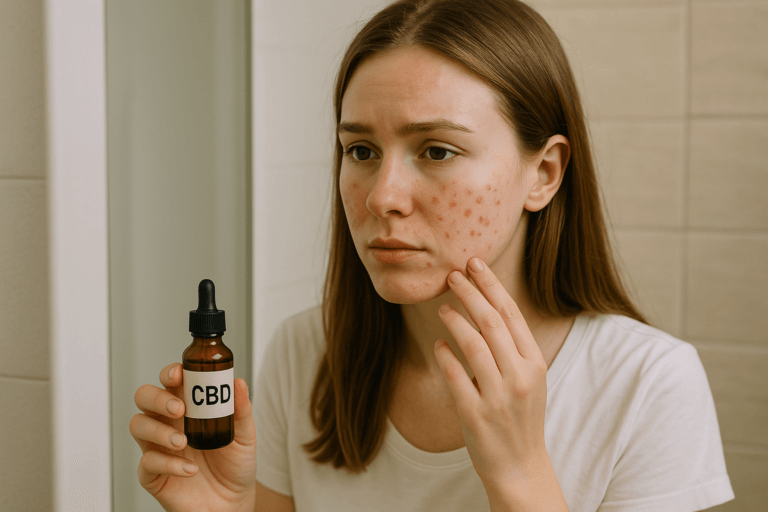
A new study reveals how CBD talks to oily, inflamed skin and the findings could reshape how we treat breakouts forever.
If you’ve dealt with acne, you already know it’s not “just a skin thing.” It affects how you feel when you wake up.
How you look at yourself in the mirror.
How confident you feel when someone notices a breakout.
How much makeup you pile on to hide redness.
How uncomfortable you feel when nothing seems to work.
Acne has a way of invading your mood, your social life, your pictures, your confidence, everything.
So when new research shows CBD might help calm acne-prone skin at multiple levels, it becomes more than a study. It becomes a small breath of relief for anyone who’s felt defeated by their skin.
This study didn’t look at surface-level beauty results. It dug deep into how CBD interacts with the actual cells responsible for breakouts, and the findings are surprisingly hopeful.
Science Snapshot
What the study tested
CBD’s effect on acne-related skin cells: oil production, inflammation, texture, and repair.
Key findings
- Reduced inflammatory cytokines
- Lowered oil production
- Decreased keratin 16 (less pore clogging)
- Boosted collagen + elastin
- Activated a new acne-related pathway (AMPK–SREBP-1)
Why it matters
Acne isn’t caused by one thing — CBD appears to support multiple factors at once.
CBD Did Something Remarkable to the Very Cells Behind Breakouts
Acne doesn’t appear out of nowhere. It’s fueled by four major forces:
- Too much oil
- Too much inflammation
- Too many dead skin cells building up
- Too little collagen to repair damage
This study explored all four, using human sebocytes and keratinocytes, the exact cells that control oil production, inflammation, and skin renewal.
Here’s what researchers found:
CBD appeared to calm inflammation, reduce excess oil, support cleaner pores, and help boost proteins that improve skin texture.
That’s a powerful combination for acne-prone skin.
Even more interesting?
CBD worked in a dose-dependent way; the more the cell needed support, the more CBD responded.
The Breakout-Driving Inflammation CBD Helped Reduce
Inflammation is the spark that turns small bumps into red, painful, angry breakouts.
In this study, CBD significantly reduced several of the strongest acne-related inflammatory signals:
- CXCL8 (IL-8)
- IL-1α
- IL-1β
These are major contributors to swelling, redness, and tenderness.
When they calm down, the skin has space to recover instead of staying in an angry, reactive cycle.
This could be one reason people often report calmer-looking skin after using CBD topically.
CBD Also Helped Slow Down Overactive Oil Production
Oily skin is one of the biggest drivers of acne, especially when sebum becomes thick and sticky.
CBD did something important here:
It helped decrease lipid (oil) production by influencing the AMPK–SREBP-1 pathway.
You don’t need to remember the pathway name — what matters is what it does:
- SREBP-1 is like the “oil-making switch”
- CBD turned that switch down
That means less shine, less pore-clogging buildup, and fewer opportunities for breakouts to form.
This one discovery alone is a huge win for acne science.
CBD Reduced the Thickening That Leads to Clogged Pores
Acne doesn’t only come from oil; it also comes from hyperkeratinization, the process by which skin produces too many dead cells that stick together and clog pores.
The study found that CBD helped reduce keratin 16, a protein linked to this pore-clogging buildup.
With fewer sticky cells collecting inside pores, the skin can stay clearer. This combination, less oil + fewer dead cells, is one reason this research feels so promising.
CBD Even Supports Skin Repair, Including Collagen and Elastin
Breakouts often leave behind:
- Scars
- Texture
- Pits
- Discoloration
- Rough patches
CBD showed something unexpected here:
It stimulated the production of collagen I, collagen III, and elastin.
These are the proteins your skin uses to repair itself.
That means CBD didn’t just help prevent new breakouts, it supported the skin’s ability to recover from old ones.
For anyone who’s stared at acne scars in the mirror wishing they’d fade faster, this part of the study hits home.
The Most Exciting Part: A Completely New Pathway Was Identified
Scientists discovered that CBD influences a pathway involved in acne that hasn’t been talked about much:
AKT/AMPK–SREBP-1
This pathway controls inflammation, oil production, and cellular energy, three huge pieces of the acne puzzle.
CBD’s ability to modulate this pathway means researchers may have found a new angle to target acne-prone skin.
And that opens doors to future treatments that feel calmer, gentler, and more supportive than traditional acne products.
What This Could Mean for Your Skin Journey
The problem this research explores is one you may know all too well:
Acne steals confidence, comfort, and control, and sometimes nothing seems to help.
Here’s what this study means for you:
- CBD may help calm the redness and inflammation that make breakouts look and feel worse
- It may help reduce excess oil, making pores less likely to get congested
- It may help limit sticky, dead skin buildup, which helps prevent new breakouts
- It may support collagen and elastin, helping skin recover from old blemishes
- It may offer a gentler, soothing option for sensitive or acne-reactive skin
This doesn’t mean CBD cures acne.
It doesn’t mean CBD replaces your dermatologist.
It doesn’t mean CBD is a miracle solution.
But it does show that CBD is doing something meaningful at the cellular level, something that aligns with what acne-prone skin desperately needs:
Calm.
Balance.
Less oil.
Fewer clogged pores.
More healing.
More confidence.
For anyone who has felt stuck in an endless breakout cycle, that’s the kind of hope that feels worth paying attention to.
Original Study Section
Title: Potential of cannabidiol as acne and acne scar treatment: novel insights into molecular pathways of pathophysiological factors
Date: June 2024
Authors: Jun Hyo Lee, Ji Young Yoon, Dong Hyo Kim, Yoon Gyung Kwon, Geun-Hyeong Kim, Byoung Jun Park, Dae Hun Suh
Link to Study: https://link.springer.com/article/10.1007/s00403-024-03131-9

Contributing Expert
Alan first discovered CBD while recovering from a sports injury — and he’s been a believer ever since. Over the years, he’s used CBD for sleep, skincare, easing anxiety, and even helping his family pet stay calm. With more than 20 years of experience running a marketing business, Alan now enjoys sharing scientific studies and personal experience with customers at Flourish + Live Well.