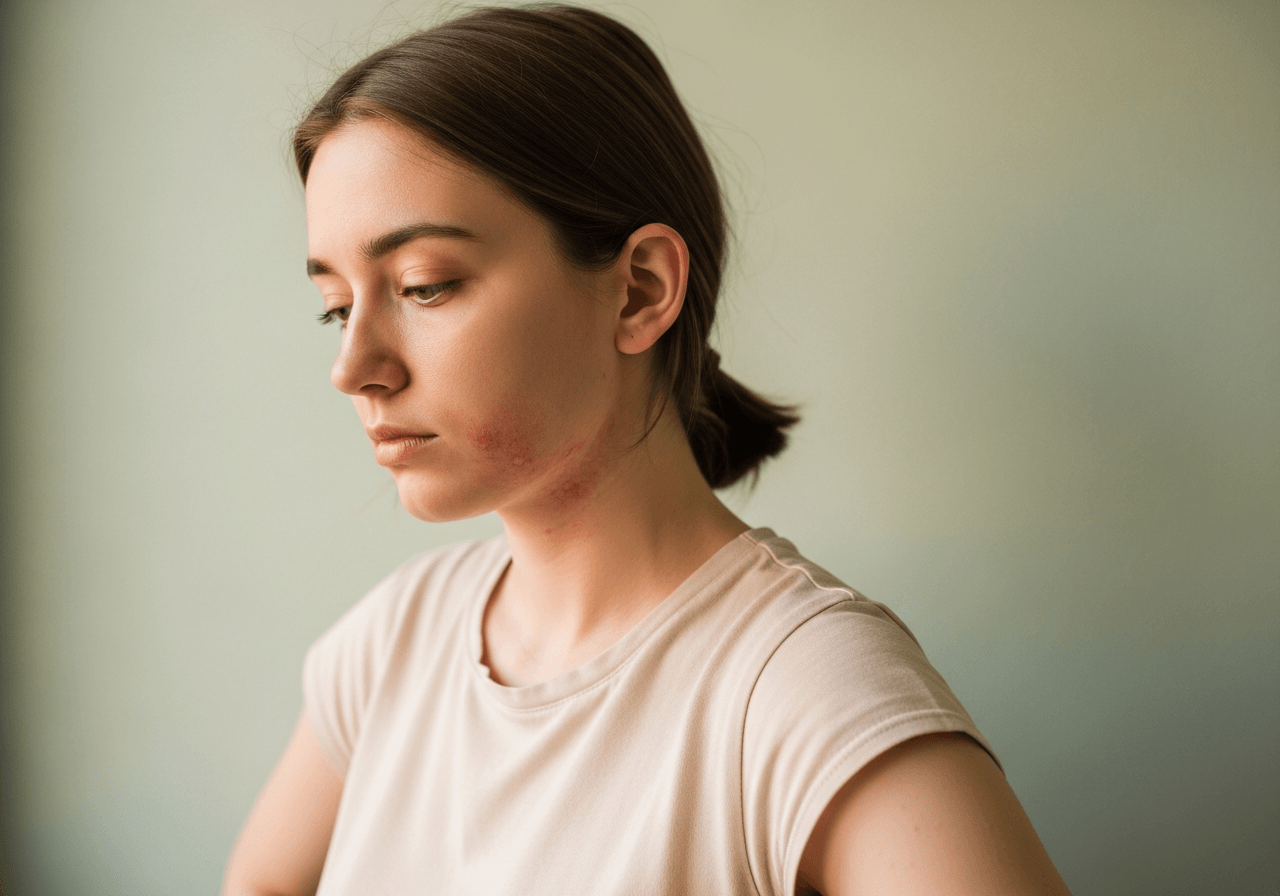
A small Thai study tested a CBD gel on inflammatory acne for seven days
Most acne treatments work by being harsh. That is not a criticism of them so much as a description of how they operate: strip the oil, speed up cell turnover, kill the bacteria.
They work. They also, very often, leave skin red, tight, and peeling, which is why so many people abandon a treatment that was helping. And the antibiotic route carries a second cost that reaches beyond any one face, because bacteria that survive repeated exposure become harder to treat for everybody.
A research group in Bangkok went looking at the problem from the other end. Instead of asking what kills acne bacteria fastest, they asked whether the inflammation itself could be calmed without irritating the skin in the process.
Why CBD Is Difficult to Put on Skin
CBD has been of interest to dermatology researchers for over a decade, for two reasons that happen to line up with what acne actually is: it has shown anti-inflammatory activity, and it has shown an effect on how much oil the skin produces.
The obstacle has never really been the compound. It has been getting it to stay put and stay stable.
CBD dissolves in fat and not in water, and it degrades with exposure to light and air. A skincare formula is mostly water. Put a fat-loving, unstable molecule into a water-based gel, and you get poor solubility, poor stability, and inconsistent delivery into skin.
So the Thai team’s work is only partly about CBD. The other half is about the vehicle.
What the Study Did
A group led by Peerawas Kopongpanich at the Faculty of Pharmaceutical Sciences, Chulalongkorn University in Bangkok, built what is called a nanogel: CBD loaded into a carrier made from hyaluronic acid grafted with poly(N-isopropylacrylamide). Hyaluronic acid will already be familiar to anyone who reads skincare labels. The grafted polymer is what makes the carrier hold onto CBD and release it in a controlled way.
The work came in two halves.
In the laboratory, they characterized the formulation’s physical and chemical behavior and tested its anti-inflammatory and antioxidant activity in cells.
In people, they ran what they describe as an exploratory clinical study: 22 Asian participants with inflammatory acne applied the gel twice daily for seven days. Skin tolerance, lesion size, redness, and pigmentation were assessed at the start, at day 2, and at day 7, using both clinical examination and imaging analysis.
That word “exploratory” is doing real work, and the next section explains why.
What the Study Found
By day 7:
- Inflammatory lesion size was reduced by 46%
- Redness improved significantly, as did post-inflammatory pigmentation, the darker marks that linger after a spot has gone
- The gel was clinically tolerated, with no evidence of comedogenic or acnegenic potential, meaning it did not clog pores or trigger new breakouts
- Every participant reported a subjective reduction in acne severity and said they were satisfied with the outcome
The tolerability result deserves as much attention as the lesion result, and possibly more. A great many acne treatments produce a version of the efficacy finding. Far fewer produce it while leaving skin comfortable, and the treatments people actually stay on are the ones they can tolerate.
The pigmentation finding is worth a moment too. Post-inflammatory marks often outlast the spot that caused them by months, and for a lot of people, they are the more upsetting half of the problem.
What Supporting Studies Add
The mechanism here is not a new idea, which is part of why the result is plausible.
A 2014 study in the Journal of Clinical Investigation by Attila Oláh and colleagues remains the foundational work: it found that CBD exerts sebostatic and anti-inflammatory effects on human sebocytes, the cells that produce skin oil. That paper showed, in human cells, that CBD acts on both the oil and the inflammation behind acne, more than a decade ago.
A 2022 study in the Journal of Inflammation Research by Ziqi Jiang and colleagues went after the specific pathway. It found that CBD inhibited inflammation triggered by extracellular vesicles from Cutibacterium acnes, the bacterium implicated in acne, and that it did so by activating the CB2 receptor in keratinocytes, the main cell type in the outer layer of skin.
So there is a coherent chain: a known receptor in skin cells, a demonstrated effect on the inflammatory response to the relevant bacterium, and a demonstrated effect on oil production. The Thai study sits at the end of that chain and asks whether a usable formulation can deliver on it.
What the Study Didn’t Prove
This is where care is required, because the design has real limits and the authors are the first to say so.
There was no control group. Nobody applied a gel without CBD. That single fact constrains everything else, because inflammatory acne fluctuates on its own, and simply applying a soothing hyaluronic acid gel twice a day is itself an intervention.
It was open-label and non-randomized. Everyone knew what they were using. Expectation shapes how people rate their own skin, and it can shape how an unblinded assessor scores a photograph.
Twenty-two people is a very small group, and all were of one broad ethnic background, which limits how far the result generalizes.
Seven days is a very short window. Acne is managed over months. What happens at week six or month three is unknown.
Three of the eight authors are employed by Nabsolute Co., Ltd., a company with a commercial interest in the formulation. This is common in formulation research and does not by itself invalidate anything, but it should be stated upfront.
The authors’ own conclusion is appropriately restrained: the gel is “a safe and promising delivery system,” and “larger randomized controlled studies are required to validate these preliminary findings.” That is the correct reading, and it is the one to carry away.
What This Means for You
Treat this as a research direction, not a recommendation. A 46% figure from an uncontrolled seven-day study in 22 people is a reason for researchers to run a proper trial. It is not evidence that a CBD product will clear anyone’s skin, and nothing here should displace advice from a dermatologist.
The delivery system may matter as much as the ingredient. The reason this study exists at all is that CBD on its own does not sit well in a skincare formula. When a product’s CBD content is the only thing advertised, that leaves the more important question unanswered.
Gentleness is a real finding. The tolerability data is the least dramatic part of this paper and possibly the most useful, because irritation is why people quit.
Inflammation is the common thread. The through-line across all three studies is the inflammatory response rather than the bacteria, and inflammation in skin is not exclusive to acne.
About the Original Study
Title: Cannabidiol-Loaded Hyaluronic Acid-Based Nanogel for Inflammatory Acne: In Vitro and Open-Label, Non-Randomized Clinical Evaluation of Efficacy and Tolerability
Published: Cosmetics, 2026; 13(4):165, 28 June 2026
Authors:
- Peerawas Kopongpanich, MSc. Program in Research for Enterprise, Faculty of Pharmaceutical Sciences, Chulalongkorn University, Bangkok, Thailand
- Kittima Lekmanee, Nabsolute Co., Ltd., Bangkok, Thailand
- Kittipong Sanookpan, Nabsolute Co., Ltd., Bangkok, Thailand
- Vipaporn Panapisal, Department of Pharmaceutics and Industrial Pharmacy, Chulalongkorn University, Bangkok, Thailand
- Chavee Laomeephol, Department of Biochemistry and Microbiology, Chulalongkorn University, Bangkok, Thailand
- Sornkanok Vimolmangkang, Department of Pharmacognosy and Pharmaceutical Botany, Chulalongkorn University, Bangkok, Thailand
- Visarut Buranasudja, Department of Pharmacology and Physiology, Chulalongkorn University, Bangkok, Thailand
- Jittima Amie Luckanagul, Department of Pharmaceutics and Industrial Pharmacy, Chulalongkorn University, Bangkok, Thailand
Link: https://doi.org/10.3390/cosmetics13040165

Contributing Expert
Alan first discovered CBD while recovering from a sports injury — and he’s been an advocate ever since. Over the years, he’s used CBD for sleep, skincare, easing anxiety, and even helping his family pet stay calm. With more than 20 years of experience running a marketing business, Alan now enjoys sharing scientific studies and personal experience with customers at Flourish + Live Well.