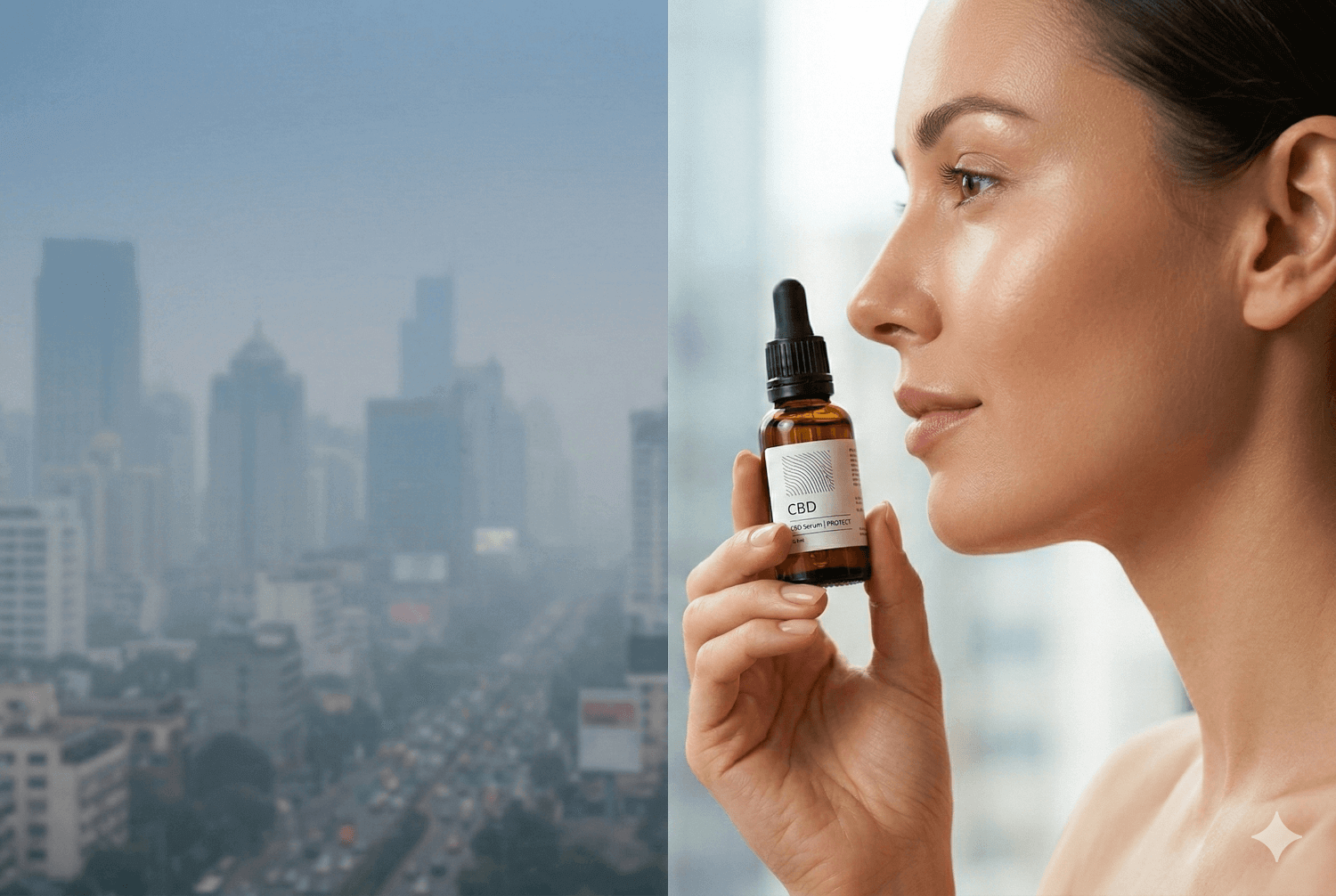
You protect your skin from the sun. You moisturize. You wear SPF. But what about the invisible threat drifting through the air every single day? A groundbreaking new study reveals that CBD may be one of the most powerful tools yet discovered for defending your skin against pollution damage.
The Invisible Enemy Aging Your Skin
Most people have a skincare routine built around two threats: UV radiation and dryness. Both are real. Both matter. But there is a third threat that affects nearly every person on earth – one that most skincare routines are completely unequipped to handle.
Airborne particulate matter (PM) – the microscopic particles suspended in polluted air from vehicle exhaust, industrial emissions, construction dust, and wildfire smoke – is now recognized by dermatologists as one of the leading environmental drivers of premature skin aging, chronic inflammation, and barrier dysfunction.
PM2.5 particles (2.5 micrometers or smaller) are particularly dangerous because they are small enough to penetrate deeply into the skin’s layers, far below the surface. Once there, they trigger a cascade of biological damage: they generate free radicals that destroy collagen and elastin, activate inflammatory immune pathways, deplete the skin’s natural antioxidant defenses, and physically disrupt the tight junctions that keep the skin’s protective barrier intact.
The visible results accumulate over time: uneven skin tone, increased sensitivity, accelerated wrinkling, loss of firmness, and chronic redness. And unlike sunburn – which is noticeable and immediate – pollution damage is slow, silent, and cumulative. Most people don’t realize it’s happening until years of damage have already been done.
According to the World Health Organization, 99% of the global population currently lives in areas where air quality exceeds WHO safety guidelines. This is not a niche problem for people in heavily industrialized cities. It is a universal skin health crisis.
Why CBD Is a Logical Candidate for Pollution Defense
CBD – cannabidiol – is a non-intoxicating phytocannabinoid derived from hemp. It has been extensively studied for its anti-inflammatory, antioxidant, and immunomodulatory properties. Dermatology researchers have increasingly recognized that these same properties make CBD a uniquely well-suited candidate for addressing the specific biological damage that pollution causes in skin.
The skin’s endocannabinoid system (ECS) plays a direct role in regulating skin homeostasis – the balance of cell growth, inflammation, barrier function, and immune response. Cannabinoid receptors CB1 and CB2 are expressed throughout the skin in keratinocytes, sebaceous glands, hair follicles, and immune cells. When those receptors are activated or modulated by CBD, the downstream effects include reduced production of pro-inflammatory cytokines, enhanced antioxidant activity, and support for barrier integrity.
These are precisely the mechanisms that pollution attacks. That biological alignment is what made researchers at Chulalongkorn University ask the central question of their new study: Can CBD directly counteract pollution-induced skin damage?
About the Study
The research team – led by Dr. Warangkana Klinngam, Assistant Professor of Pharmacology and Physiology at Chulalongkorn University’s Faculty of Pharmaceutical Sciences in Bangkok – used an ex vivo human skin model to test CBD’s protective effects against pollution-induced damage.
An ex vivo model uses real human skin tissue removed from the body and maintained in controlled laboratory conditions. This is a significant methodological choice. It overcomes two major limitations of cheaper research models:
- Cell culture studies test individual skin cells in isolation, which doesn’t capture the full complexity of how the skin’s layers interact
- Animal studies have well-documented translational limitations – mouse and rat skin is structurally quite different from human skin
Ex vivo human skin models provide results that far more closely reflect what actually happens in the human body, making this study’s findings substantially more relevant to real-world application than most preclinical skincare research.
The companion study by the same research group – published in Colloids and Interfaces (2026) – extended this work by testing CBD-loaded nanoemulsions specifically formulated for enhanced skin penetration, applying the pollution protection findings to next-generation topical delivery technology.
What the Research Found
The results demonstrated that CBD exerted significant protective effects against particulate matter-induced damage across three key biological dimensions:
1. Anti-Inflammatory Protection Exposure to particulate matter triggers the release of pro-inflammatory cytokines – signaling proteins that activate the skin’s immune response and drive chronic inflammation. Left unchecked, this inflammatory response accelerates cellular aging and contributes to conditions like eczema, rosacea, and contact dermatitis.
CBD significantly modulated cytokine production in the PM-exposed skin tissue, reducing the inflammatory cascade at a molecular level. This wasn’t a surface-level effect – it reflected genuine modulation of the skin’s immune signaling pathways.
2. Antioxidant Defense Particulate matter generates reactive oxygen species (ROS) – unstable free radical molecules that attack collagen, elastin, lipid membranes, and DNA in skin cells. This oxidative stress is one of the primary mechanisms through which pollution causes visible aging.
CBD demonstrated meaningful antioxidant activity in the study, helping to neutralize ROS and reduce the oxidative burden on skin cells. This finding aligns with CBD’s well-documented antioxidant properties, which some researchers have compared favorably to established antioxidants like vitamins C and E.
3. Skin Barrier Preservation The skin barrier – composed of tightly linked keratinocyte cells and a lipid matrix – is the body’s first line of defense against environmental threats. Pollution particles physically disrupt this barrier, increasing transepidermal water loss (TEWL), reducing hydration, and making the skin more vulnerable to allergens and irritants.
CBD helped maintain barrier integrity in the pollution-exposed tissue, preserving the structural and functional organization of the skin’s outermost protective layer.
The Nanoemulsion Breakthrough
The companion study adds another layer of practical significance. CBD’s primary limitation as a topical ingredient has historically been its poor water solubility – as a lipophilic (fat-loving) molecule, CBD doesn’t naturally blend into water-based formulations and can struggle to penetrate deeply enough into skin to reach relevant targets.
The Chulalongkorn team developed a CBD-loaded oil-in-water nanoemulsion – a formulation in which CBD is encapsulated in microscopic droplets that dramatically enhance its ability to penetrate the skin’s surface layers and deliver the active compound to where it is needed most.
The nanoemulsion formulation significantly outperformed conventional CBD topical preparations in terms of skin penetration and protective efficacy. This represents an important bridge between the fundamental science of CBD’s skin benefits and the practical formulation technology needed to deliver those benefits effectively in a consumer product.
Connecting the Science to Your Skincare Routine
A 2025 comprehensive review of CBD in skin health published in PMC confirmed that CBD has emerged as a “promising multifunctional agent in dermatology and cosmetic science,” documenting its efficacy across inflammation, oxidative stress, barrier function, sebum regulation, and wound healing. The Klinngam et al. study adds direct, human tissue-based evidence specifically for the pollution protection application – one of the most commercially and clinically relevant use cases in modern skincare.
What makes CBD particularly compelling in this context is the breadth of its protective action. Most antioxidant skincare ingredients address only the oxidative stress component of pollution damage. Niacinamide addresses inflammation. Ceramides support the barrier. CBD appears to act across all three mechanisms simultaneously – making it an unusually comprehensive pollution defense ingredient.
Practical Takeaways
If pollution-related skin aging is a concern – and given that 99% of the world’s population lives in areas with suboptimal air quality, it should be for almost everyone – here is what this research suggests for your routine:
- Apply CBD topically in the morning, before going outside, to create a proactive barrier against daily pollution exposure rather than just reacting to damage after the fact
- Look for nanoemulsion or liposomal CBD formulations – the delivery system matters enormously for how much CBD actually reaches the deeper skin layers where it does its best work
- Pair CBD with complementary antioxidants like vitamin C or niacinamide for layered protection across multiple oxidative and inflammatory pathways
- Consistency is key – pollution damage is cumulative and daily, so CBD skin protection works best as a non-negotiable part of your daily morning routine rather than occasional use
- Evening application matters too – nighttime is when skin does its most active repair work; applying a CBD serum or oil before bed supports the recovery from daily environmental exposure
About the Original Study
Title: Cannabidiol Mitigates Pollution-Induced Inflammatory, Oxidative, and Barrier Damage in Ex Vivo Human Skin
Year: 2026
Journal: Biomolecules, Vol. 16, No. 1
DOI: 10.3390/biom16010053
Full Text: https://pmc.ncbi.nlm.nih.gov/articles/PMC12467061/
Authors – Faculty of Pharmaceutical Sciences, Chulalongkorn University, Bangkok, Thailand:
- Warangkana Klinngam, PhD – Assistant Professor, Department of Pharmacology and Physiology, Faculty of Pharmaceutical Sciences, Chulalongkorn University. Research specializations include skin pharmacology, topical drug delivery, anti-inflammatory agents, and cosmetic science. Lead author on multiple CBD dermatology studies.
- Ornrumpa Loruthai – Graduate researcher, Faculty of Pharmaceutical Sciences, Chulalongkorn University. Co-investigator on the companion CBD nanoemulsion skin protection study published in Colloids and Interfaces (2026).
- Sontaya Vimolmangkang, PhD – Associate Professor, Department of Pharmacognosy and Pharmaceutical Botany, Faculty of Pharmaceutical Sciences, Chulalongkorn University. Research focus: natural product pharmacology, botanical medicine, and cannabinoid science in dermatological applications.

Contributing Expert
Alan first discovered CBD while recovering from a sports injury — and he’s been an advocate ever since. Over the years, he’s used CBD for sleep, skincare, easing anxiety, and even helping his family pet stay calm. With more than 20 years of experience running a marketing business, Alan now enjoys sharing scientific studies and personal experience with customers at Flourish + Live Well.