Researchers tested topical cannabinoids on irritated skin in two small studies
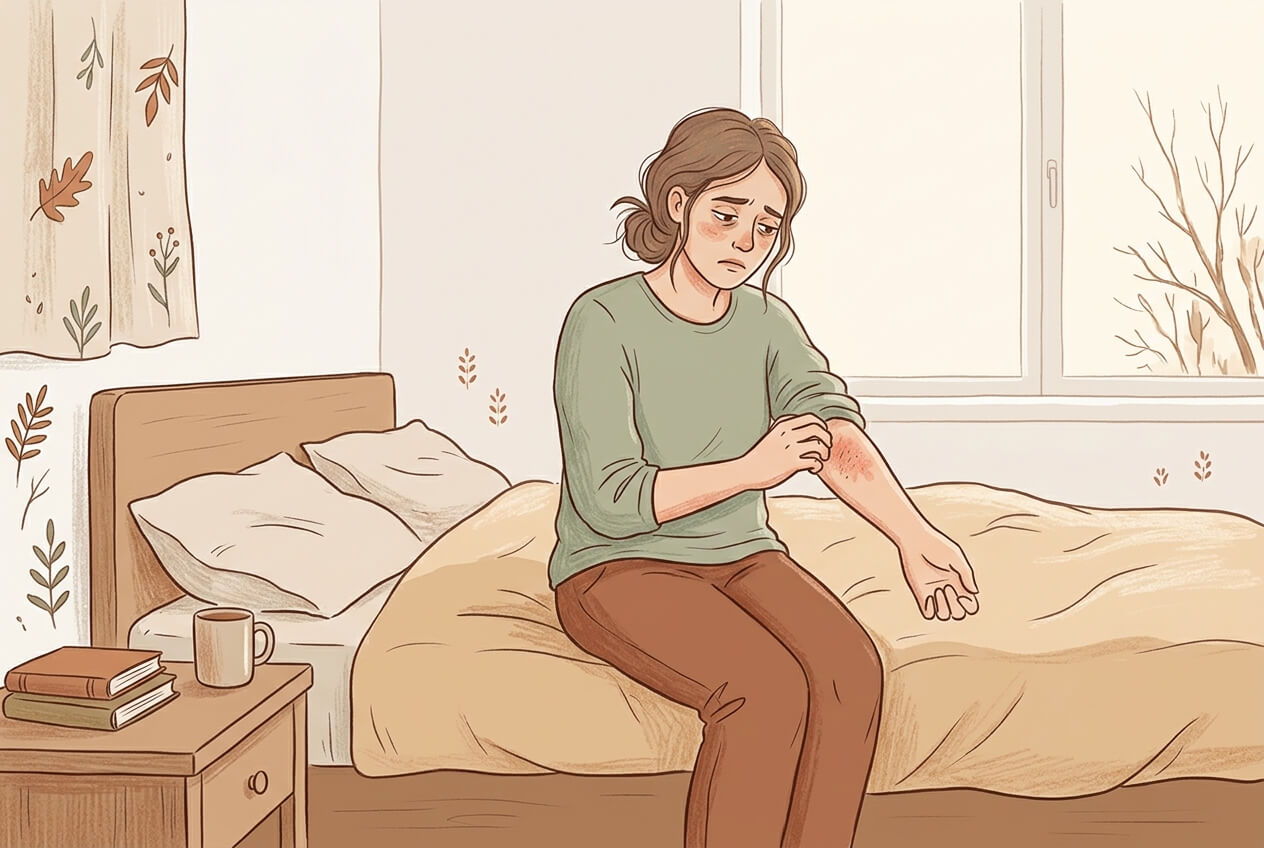
Persistent itch can disturb sleep and make eczema difficult to ignore. Two small studies examined whether topical cannabinoid preparations changed either the skin itself or the symptoms participants reported.
One study used instruments to measure changes in the skin barrier. The other asked participants about eczema severity, itch, and emotional burden. Neither study had a control group, and the two sets of results answer different questions.
The questions the studies asked
Most research on cannabinoids and skin has been conducted in cells, tissue models, or laboratory studies. These two studies tested topical preparations in people, but they did so with different products, methods, and outcomes.
The Polish team measured hydration, water loss, sebum, redness, pigment, and pH. The US team measured participants’ reports of eczema severity and its emotional effects.
The Polish study: measuring the skin
Researchers at the Medical University of Silesia recruited nine adults with atopic dermatitis, five men and four women, aged 20 to 67. They used an ointment compounded with 30% CBD and 5% CBG, hemp seed oil, and a cholesterol ointment base.
Participants applied a generous layer to the same area of the forearms once a day before sleep and covered it with a wet wrap. The researchers measured their skin at the start, at four weeks, and at eight weeks under standardized conditions.
What the instruments recorded at eight weeks
- Hydration rose from 19.22 to 30.99 on the device’s scale (p < 0.001), moving the group into the normal range
- Water loss through the skin fell from 35.40 to 20.62 g/m²/h (p < 0.001), which is the measure of how well the skin barrier holds moisture in
- Redness fell from 394 to 324 (p < 0.01), and this was the one measure already improving at the four-week mark
- Sebum levels rose from 2.56 to 23.33 mg/cm² (p < 0.05), which the authors read as skin that had been abnormally dry moving back toward normal
- Skin pigment and pH did not change (p = 0.624 and p = 0.389)
Redness had already decreased significantly at four weeks. Hydration, water loss, and sebum did not change significantly until eight weeks.
What the instruments measure
The Polish team used probes to measure four aspects of the skin. Two of them are especially relevant to dryness: hydration in the outer layer and the rate at which water escapes through the skin.
The hydration probe measures how the outer layer of skin conducts a small electrical signal. The reading rises as that layer holds more water.
The water-loss probe measures transepidermal water loss, or the rate at which water escapes through the skin into the air. Higher readings indicate a less effective barrier. In this group, the average fell from 35.40 to 20.62 g/m²/h over eight weeks.
The other probes measured sebum, redness, pigment, and pH. Redness was the only measure that had improved significantly by week four.
The American study: measuring the experience
A US dermatology group took a different approach. Twenty people with self-reported eczema were given a topical CBD gel, and sixteen completed a questionnaire at the start and again two weeks later.
Instead of instruments, they used two standard scored questionnaires: one that measures eczema severity as the patient experiences it, and one that measures the emotional burden of the condition.
- Eczema severity scores fell from 16 to 8.25 (p < 0.0007)
- The emotional burden score fell from 20.9 to 8.375 (p < 0.004)
- 67% of participants reported less itch
- 50% said their eczema had improved by more than 60%
The authors describe this as an observational study. It had no control group and relied on what participants reported about their own symptoms.
How the studies differ
The Polish study found changes in measured skin properties after eight weeks, with redness improving earlier. The US study found lower symptom and emotional-burden scores after two weeks. Because the studies used different products and measured different outcomes, their results should not be treated as confirmation of the same effect.
Both studies lacked a control group. Neither can separate the cannabinoid preparation from the effects of its base ingredients, the wet wrap used in the Polish study, participants’ expectations, or the attention given to the skin during the study. The Polish formulation contained 30% CBD and 5% CBG, while the US paper did not report the concentration of its gel.
Itch is usually measured by asking the person who feels it. In the US study, 67% of participants reported less itch, but the open-label design means we cannot tell how much of that change came from the product itself.
What neither study proved
Neither study showed that CBD was the active ingredient. The Polish ointment also contained CBG, hemp seed oil, and a cholesterol base, and participants used a wet wrap. Each of those factors could have affected the results.
Neither study followed anyone after the treatment stopped, so how long the changes last is unknown.
Neither study tested a typical retail cream. The results apply only to the specific preparations and conditions used, and they support further controlled research rather than a conclusion about topical CBD products in general.
A blinded trial comparing a cannabinoid preparation with the same base formula without cannabinoids would help separate those effects. Neither study made that comparison.
What this means for you
The safety picture
Neither report identified a serious safety concern during its short study period, but the samples were too small to establish the safety of topical cannabinoids more broadly. Anyone with eczema or another diagnosed skin condition should discuss treatment with a dermatologist.
The endocannabinoid connection
Skin contains cannabinoid receptors and produces its own endocannabinoid signaling molecules. That helps explain why researchers are studying cannabinoids in skin conditions, but it does not show that a topical CBD product will improve symptoms.
Seasonal dry skin is a different question
Indoor heating and lower humidity can contribute to dry, tight skin in autumn and winter. These studies enrolled people with diagnosed atopic dermatitis or self-reported eczema, so their results cannot be transferred directly to seasonal dry skin.
The Polish study also does not establish how long an ordinary skincare routine needs to work. It tested one high-concentration CBD and CBG ointment, used with wet wraps, for eight weeks. Redness improved by week four, while hydration and water loss changed later.
Worth keeping in mind
- The studies included nine and sixteen participants. In samples this small, a few people can have a large effect on the averages.
- No control group in either one. Some of the improvement could come from the base ointment, the wet wraps, or the attention itself.
- The Polish preparation contained 30% CBD and 5% CBG. Results from that formulation cannot be assumed to apply to products with different concentrations or ingredients.
- The American study measured participant reports. Without blinding or a control group, those reports may reflect expectations as well as changes in symptoms.
- Both studies were in people with a diagnosed or self-reported skin condition, so the results do not transfer straight to ordinary dry skin.
- The timing differed by measure. Redness improved significantly at four weeks; hydration, water loss, and sebum changed significantly at eight weeks.
These studies offer preliminary human data on two specific topical cannabinoid preparations. Controlled trials are still needed to determine whether cannabinoids themselves improve eczema symptoms or skin-barrier measures.
About the original studies
Title: Evaluation of Biophysical Parameters of the Skin of Patients With Atopic Dermatitis After Application of an Ointment Containing 30% Cannabidiol and 5% Cannabigerol
Published: March 2025, Clinical, Cosmetic and Investigational Dermatology
Authors:
- Dawid Burczyk, Doctoral School of the Medical University of Silesia, Katowice, Poland
- Dominika Wcisło-Dziadecka, Department of Practical Cosmetology and Skin Diagnostics, Medical University of Silesia
- Paweł Olczyk, Department of Community Pharmacy, Medical University of Silesia
- Elżbieta Chełmecka, Department of Medical Statistics, Medical University of Silesia
- Wiktoria Burczyk, Faculty of Health and Life Sciences, De Montfort University, Leicester, UK
Link: https://doi.org/10.2147/CCID.S472746
Title: An Observational Study of the Application of a Topical Cannabinoid Gel on Sensitive Dry Skin
Published: December 2020, Journal of Drugs in Dermatology
Authors:
- Jalal Maghfour, Hope Rietcheck, Chandler Rundle, Taylor Runion, Zainab Jafri, Sam Dercon, Peter Lio, Jon Fernandez, Mayumi Fujita, Robert Dellavalle and Helena Yardley
Link: https://doi.org/10.36849/JDD.2020.5464

Contributing Expert
Alan first discovered CBD while recovering from a sports injury, and he has been an advocate ever since. Over the years, he’s used CBD for sleep, skincare, easing anxiety, and even helping his family pet stay calm. With more than 20 years of experience running a marketing business, Alan now enjoys sharing scientific studies and personal experience with customers at Flourish + Live Well.