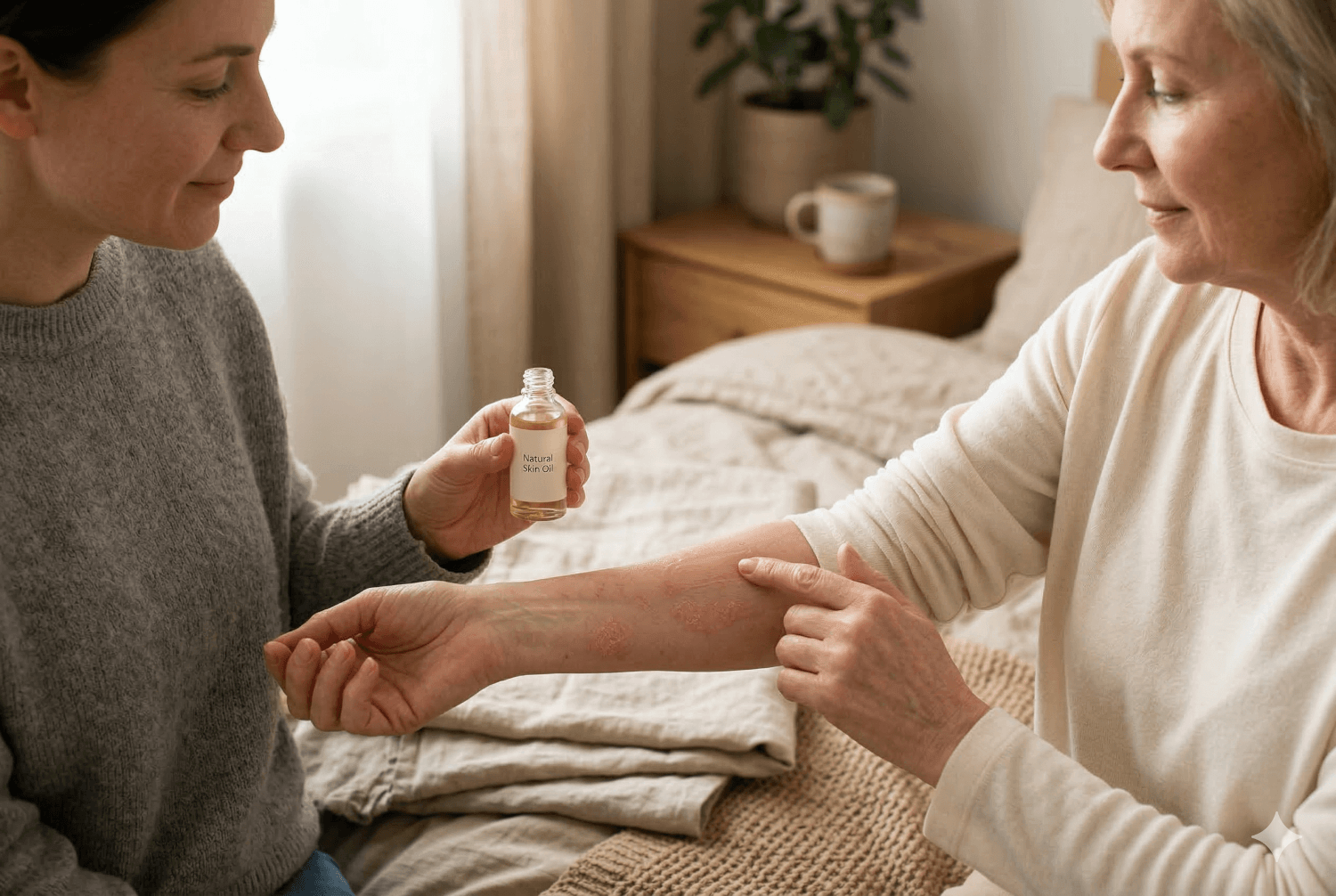
How a randomized trial tested CBD oil for people living with stubborn psoriasis flare‑ups.
If you live with psoriasis, you already know the routine: new cream, new routine, new hope… and then the same red, itchy, flaking patches staring back in the mirror. It’s frustrating when your skin seems to ignore everything you throw at it.
So when you hear people talking about CBD oil for psoriasis, it’s fair to wonder: is this just another internet trend, or is anyone actually putting it to the test in real patients? A recent randomized, double‑blind, placebo‑controlled trial finally did exactly that.
What did this study actually do?
Researchers in a 2026 dermatology trial set out with a clear goal: to find out whether a specific CBD oil formulation could safely improve psoriasis symptoms compared with a placebo. Psoriasis is a chronic inflammatory skin condition that causes red, scaly, often painful plaques and can seriously affect quality of life.
Here’s the basic setup, in plain language:
- Adults with psoriasis were randomly assigned to receive CBD oil or a placebo oil.
- Neither the patients nor the investigators knew who got what (double‑blind).
- They followed participants over time, measuring changes in psoriasis severity and symptoms using standard dermatology scores and patient‑reported outcomes.
CBD was chosen because earlier lab and animal work suggested it may help calm inflammation, oxidative stress, and overactive immune responses in the skin. This trial was one of the first to move that idea into a more rigorous human setting.
What did they find?
The CBD group showed signs of clinical improvement compared with placebo on key measures of psoriasis severity and symptom burden. In other words, for many people in the CBD arm, plaques looked and felt better than would be expected by chance alone.
Some simple ways to think about the results:
- Skin changes:
Participants using CBD oil tended to have better reductions in psoriasis severity scores (how red, thick, and scaly lesions looked) than those on placebo. - Symptoms:
Itch, discomfort, and other day‑to‑day symptoms improved in many people using CBD compared with the control group, which matters because “how it feels” often matters more than “how it looks.” - Safety:
The CBD formulation used in this trial was generally well-tolerated over the study period, with no major safety red flags reported by the authors.
At the same time, the researchers were careful not to oversell their findings. This was a single study, with a specific CBD oil, in a defined group of patients, over a limited time window. It did not prove that CBD cures psoriasis or replaces standard dermatology care.
Why might CBD help in psoriasis?
Psoriasis is driven by an overactive immune response in the skin, leading to inflammation, rapid skin‑cell turnover, and the characteristic plaques. CBD is a non‑intoxicating cannabinoid that interacts with several signaling systems, including the endocannabinoid system, and may help modulate inflammation and oxidative stress.
In preclinical and ex vivo models, CBD has been shown to:
- Influence inflammatory signaling pathways in skin cells
- Act as an antioxidant under certain conditions
- Interact with receptors and ion channels involved in skin barrier function and immune responses
The trial doesn’t prove these exact mechanisms in living humans, but it builds on that earlier work by showing that a real‑world CBD oil, used by actual patients, can move the needle on clinical scores.
What this means for you
The problem: psoriasis often sticks around despite doing “all the right things,” leaving people searching for something that can make their routine feel more manageable and their skin more comfortable.
Here’s how to think about this trial in everyday terms:
- CBD oil is starting to move from “internet rumor” to “clinically tested option” for psoriasis, at least as an add‑on in carefully selected patients. That doesn’t make it a magic wand, but it does mean there’s more to the story than anecdotes alone.
- In this study, many participants using CBD oil experienced better improvements in severity and symptoms than those using a placebo, with an acceptable safety profile over the trial period. That’s encouraging, especially if you’re already curious about CBD and looking for evidence‑informed choices.
- At the same time, CBD in this context should be viewed as a possible supportive tool, not a stand‑alone psoriasis treatment. Standard prescriptions, phototherapy, lifestyle, and follow‑up with your dermatologist remain the foundation of care.
A quick reality check (and safety notes)
Before anyone rushes out to buy the first CBD cream they see, it’s worth keeping a few grounded points in mind:
- The study used a specific CBD oil formulation under controlled conditions. Over‑the‑counter products vary widely in potency, purity, and added ingredients.
- CBD can interact with medications via liver enzymes, especially at higher doses or when used orally. If you take prescriptions—particularly for the immune system, blood pressure, or mood—it’s wise to loop in your clinician.
- Regulatory agencies have not approved retail CBD products as psoriasis treatments, and labels should not claim to diagnose, treat, cure, or prevent disease.
Using CBD in a way that respects these limits keeps you aligned with current regulations while still exploring its potential benefits.
How to talk about this study with your dermatologist
If you’re curious about trying CBD as part of your psoriasis routine, you’ll get the most value by turning this into a real conversation with your dermatologist instead of a solo experiment.
You might bring up questions like:
- “A randomized trial found CBD oil improved psoriasis severity scores—does a trial like that change how you feel about me trying a reputable CBD product alongside my current plan?”
- “Given my current medications, do you see any concerns about interactions or liver‑enzyme issues if I add CBD?”
- “If we decide to try it, what would you want me to track—itch, sleep, flare frequency, photos?”
That kind of structured, collaborative approach lets you test CBD in a measured way instead of guessing based on social media.
What this could look like in real life
To make this a bit more concrete, imagine two different approaches:
- Unstructured:
You grab an untested CBD cream because a friend swears by it, use it off and on, and then decide “CBD doesn’t work for me” without really knowing what you used or how. - Structured (more like this study):
You pick a reputable CBD product, talk with your dermatologist about timing and frequency, and track your skin over 4–8 weeks with photos and a simple symptom scale.
The second path doesn’t guarantee success, but it gives you real information—and a better chance of spotting whether CBD is actually contributing anything helpful.
About the Original Study
Title: Efficacy and safety of cannabidiol oil in psoriasis: a randomized, double‑blind, placebo‑controlled trial
Year: 2025
Journal: Journal of Dermatological Treatment
PubMed: https://pubmed.ncbi.nlm.nih.gov/41459647/
Publisher full text: https://www.tandfonline.com/doi/full/10.1080/09546634.2025.2604448
Authors:
- Wanjarus Roongpisuthipong, MD – Associate Professor of Dermatology, Faculty of Medicine Vajira Hospital, Navamindradhiraj University, Bangkok, Thailand. 30 years of clinical experience specializing in psoriasis, phototherapy, and Mohs micrographic surgery.[6][1]
- Theerawut Klangjareonchai, MD – Endocrinologist and Internal Medicine specialist, MedPark Hospital, Bangkok. Fellowship‑trained at Mahidol University; visiting research scholar, University of California, Irvine.[2]
- Sathit Kurathong, MD – Assistant Professor of Internal Medicine and Nephrology; Vice Dean for Research and Academic Affairs, Faculty of Medicine Vajira Hospital, Navamindradhiraj University, Bangkok, Thailand.[3][5]
- Anuvat Roongpisuthipong, MD – Dean, Faculty of Public Health, Eastern Asia University, Thailand. Board certified in OB‑GYN; Mahidol University graduate.[4]

Contributing Expert
Alan first discovered CBD while recovering from a sports injury — and he’s been an advocate ever since. Over the years, he’s used CBD for sleep, skincare, easing anxiety, and even helping his family pet stay calm. With more than 20 years of experience running a marketing business, Alan now enjoys sharing scientific studies and personal experience with customers at Flourish + Live Well.